
Pam Hawley Marlin July 4, 2026
From New York to London, a journey through one of the American Revolution's
most remarkable true stories in celebration of America's 250th anniversary.

During the autumn of 1897, a fierce windstorm swept through the quiet Dutch village of Tappan, New York. When the storm had passed, residents stepped outside to survey the damage. To their surprise, little had been harmed except for one weathered stone building standing along Main Street.
For years the old structure had sat abandoned, its empty rooms slowly surrendering to time. Then, under the force of the gale, the aging front wall began to fail. First a few bricks tumbled to the ground. Then a few more. Suddenly, with a deafening crash, the entire front facade collapsed into the street.
As the dust settled, the old building surrendered more than its bricks. Buried beneath years of neglect, one of the most remarkable stories of the American Revolution seemed to emerge once again. The crumbling walls had enclosed a place forever linked to the final days of Major John André, the British officer whose fate became forever intertwined with Benedict Arnold's treason. More than a century after André's death, the old building had finally revealed itself once again.
The thing I love most about studying history is that it allows us to pause at the crossroads - to stand in a moment in time before anyone knew how the story would end. The events surrounding British Major John André and American General Benedict Arnold’s espionage plot during the Revolutionary War represent one of those defining moments in history, where nearly every decision, unexpected circumstance, and stroke of chance altered the course of events.
We know that during the Revolutionary war Benedict Arnold's name would become synonymous with treason. We know that Major British Major John André would be captured by a group of three New York militia men, and eventually hanged as a spy. We know that George Washington would emerge from the crisis with the Continental Army intact. But the people living those events knew none of that. They were simply making decisions, one after another, each believing they were acting in the best interests of their country, their God, their king, or themselves.
History is often shaped by moments that seem almost insignificant at the time: a delayed meeting, a chance encounter on a country road, a decision to search a traveler, a document hidden in a boot, an untimely dispatch. Looking back, it's fascinating to realize how easily events could have unfolded differently. Had André not been captured, had Arnold's plan succeeded, or had West Point fallen into British hands, the course of the American Revolution, and perhaps the birth of the United States itself, might have been very different.
As someone who spends countless hours researching old records and forgotten stories, I often find myself reflecting on these moments. History isn't simply a collection of dates and names. It's the story of ordinary people making extraordinary decisions, without the benefit of hindsight. Those decisions ripple through generations, shaping the world we inherit today.
The paths of John André and Benedict Arnold first began to converge in April 1779, setting into motion one of the most remarkable espionage stories in American history. That month, André was appointed Adjutant General of the British Army in North America, a position that also placed him in charge of British intelligence operations under General Henry Clinton. At nearly the same time, Benedict Arnold married Peggy Shippen, the spirited daughter of a prominent Loyalist family in Philadelphia whose social circle included British officers during the occupation of the city - including the young and charismatic Major John André.
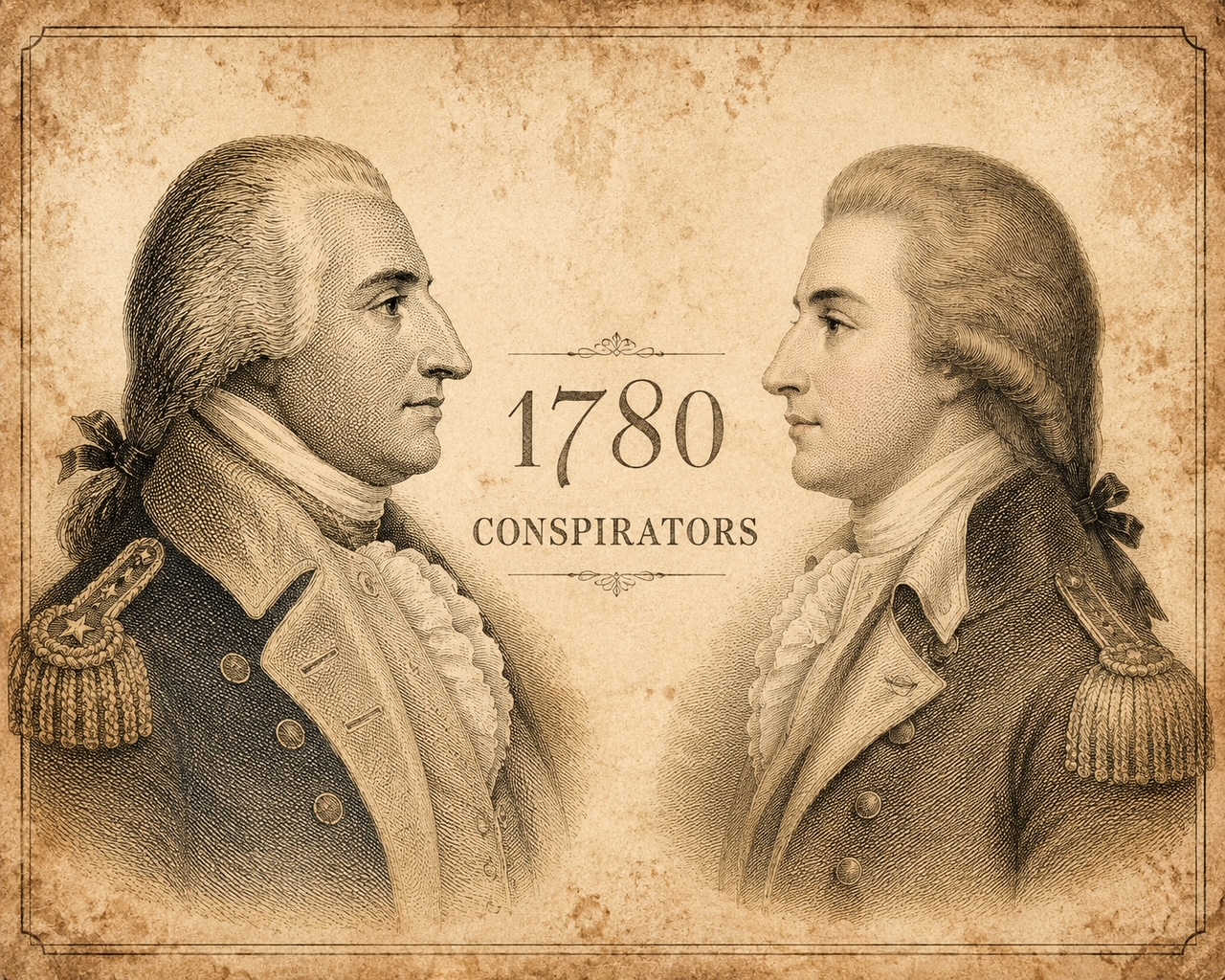 Representative sketch of Benedict Arnold and John André.
Shortly thereafter, a Philadelphia merchant named Joseph Stansbury made a secret trip to New York City for a meeting with Major John André. A committed Loyalist, Stansbury had recently been in the company of the newly married couple, Benedict and Peggy Arnold. He conveyed a startling possibility to André: Arnold, increasingly disillusioned with the American cause, was willing to consider offering his services to the British command. Whether through direct cooperation or the provision of intelligence, Arnold believed he might help bring the war to a swift conclusion.
For André, the proposal must have seemed almost unbelievable. Benedict Arnold was no minor figure in the Continental Army. He was one of its most celebrated generals, renowned for his bravery at Quebec and his decisive role at Saratoga. Yet beneath that reputation lay growing resentment. Burdened by debt, frustrated by what he perceived as a lack of recognition for his service, and embittered by political attacks, Arnold had begun to question the cause he had once defended with such conviction.
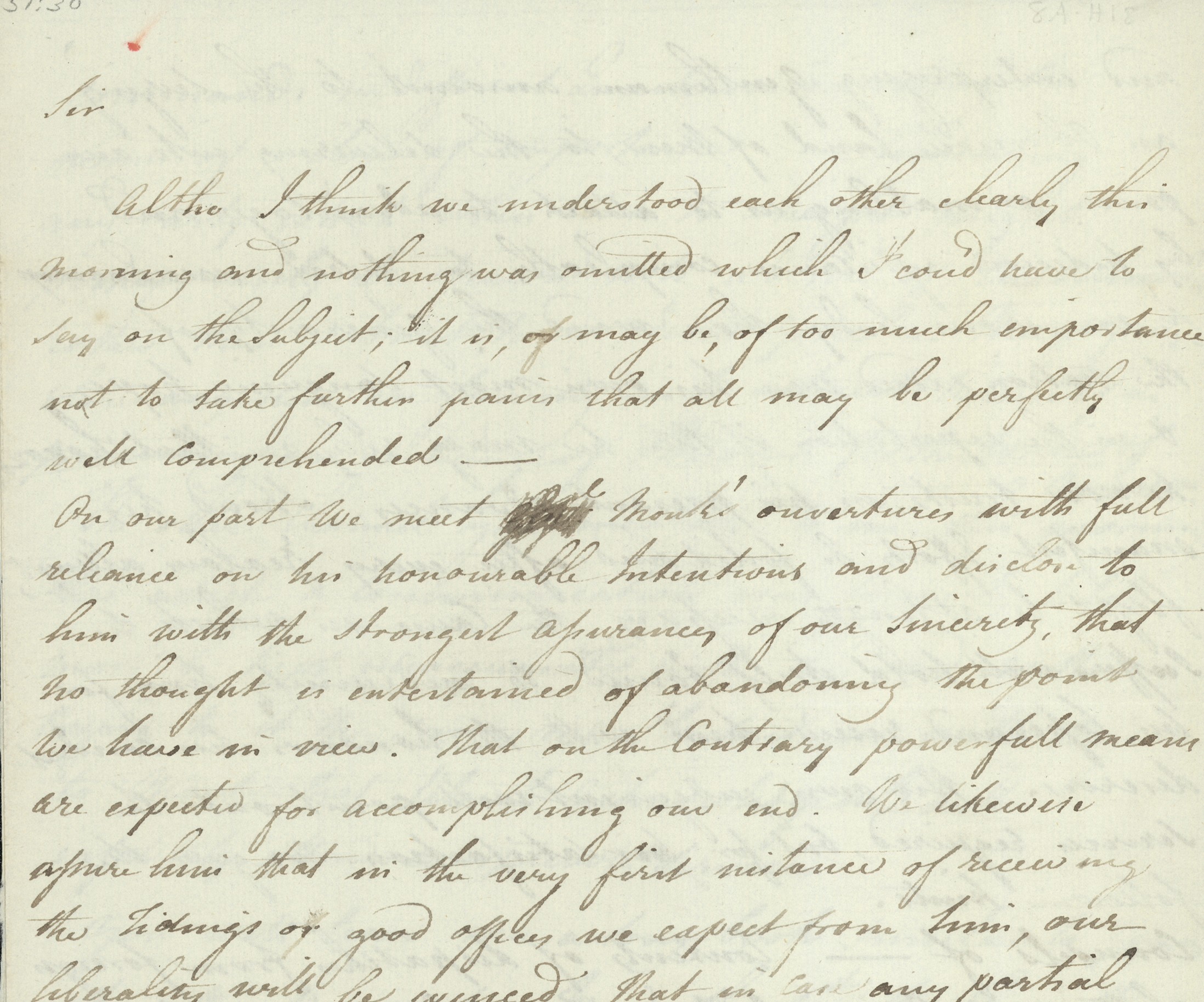 John André Letter to Joseph Stansbury, May 10, 1779, with terms of Arnold's treason.
Joseph Stansbury was born in London, but he lived in Philadelphia during the Revolution. When the British occupied Philadelphia, he was in British favor.
He served as the main intercessory between Benedict Arnold and John André. Henry Clinton Papers.
William L. Clements Library
John André Letter to Joseph Stansbury, May 10, 1779, with terms of Arnold's treason.
Joseph Stansbury was born in London, but he lived in Philadelphia during the Revolution. When the British occupied Philadelphia, he was in British favor.
He served as the main intercessory between Benedict Arnold and John André. Henry Clinton Papers.
William L. Clements Library
Over the next sixteen months, André and Arnold would enter into a clandestine correspondence conducted through coded messages, invisible ink, and assumed identities. What began as cautious communication gradually developed into a dangerous plan. Arnold’s objective was to weaken the defenses of West Point by persuading General George Washington to place him in command of the fort. Once compromised, West Point could be seized by British forces, effectively splitting the American colonies and altering the course of the war.
After months of planning, an elegant farewell dinner was held in New York City on the evening of September 19, 1780, in honor of Major John André. The gathering, attended by British General Sir Henry Clinton and several members of his senior staff, served as a final send-off before André embarked on one of the most dangerous missions of the Revolutionary War. Although admired by his fellow officers for his wit, charm, and artistic talents, André was noticeably subdued that evening. According to those present, he eventually broke into song, lending the occasion a melancholy air.
Before setting out on the mission, Sir Henry Clinton had warned André to follow three important rules: He was not to go behind American lines, not to disguise himself in civilian clothing, and not to carry any incriminating documents. As long as André remained a uniformed officer operating under a flag of truce, he would be entitled to the protections afforded a prisoner of war if captured. Violating any of these conditions, however, could cause him to be treated as a spy.
Two days later, on the night of September 21, André felt the gentle swells of the Hudson River as a small rowboat carried him away from the British sloop Vulture. Also in the boat was Joshua Hett Smith, a local resident who had assisted Benedict Arnold's intelligence network, accompanied by two boatmen. Reaching the west bank of the Hudson River near Haverstraw, New York, André quietly stepped ashore. Waiting for him was the man with whom he had spent months corresponding through coded letters and trusted intermediaries, General Benedict Arnold. Remarkably, this was the first time the two conspirators had ever met face to face.
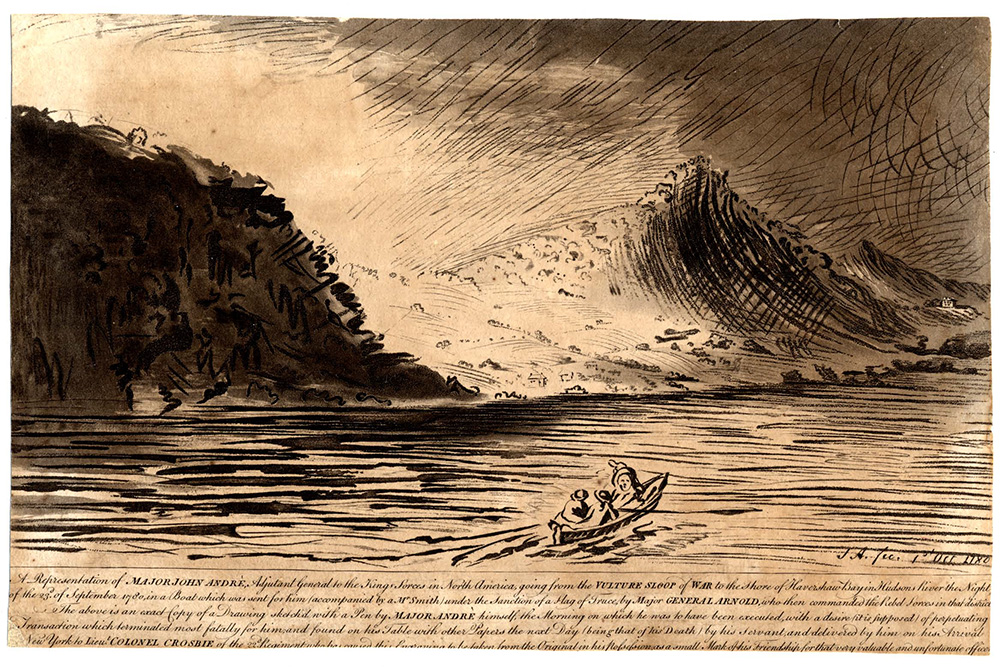 A Representation of Major John Andre, Adjutant General to the
King's Forces in North America going from the Vulture Sloop of War
to the shore of Haverstraw Bay in Hudson's River the night of September 21, 1780,
in a boat sent for him and accompanied by Joshua Hett Smith.
Consider the
Source New York
A Representation of Major John Andre, Adjutant General to the
King's Forces in North America going from the Vulture Sloop of War
to the shore of Haverstraw Bay in Hudson's River the night of September 21, 1780,
in a boat sent for him and accompanied by Joshua Hett Smith.
Consider the
Source New York
Hidden from view along the riverbank, André and Arnold talked for hours. As the night wore on, they negotiated the details of Arnold's betrayal, discussing the price of his treason and the strategic value of West Point. By the time their business was finished, the first light of dawn was beginning to creep over the Hudson. The boatmen who had brought André ashore refused to make the trip back to the British warship, feigning exhaustion and the concern that something was amiss. Any hope of a quiet return to the Vulture had vanished.
With daylight fast approaching, Arnold proposed an alternative. The two men withdrew a few miles inland to the Joshua Hett Smith House in West Haverstraw, where they could complete their negotiations in safety. But before André ever reached the Smith House, he had made the first of his crucial errors. Sir Henry Clinton had warned him not to venture behind American lines, yet the Smith House lay squarely within American-held territory.
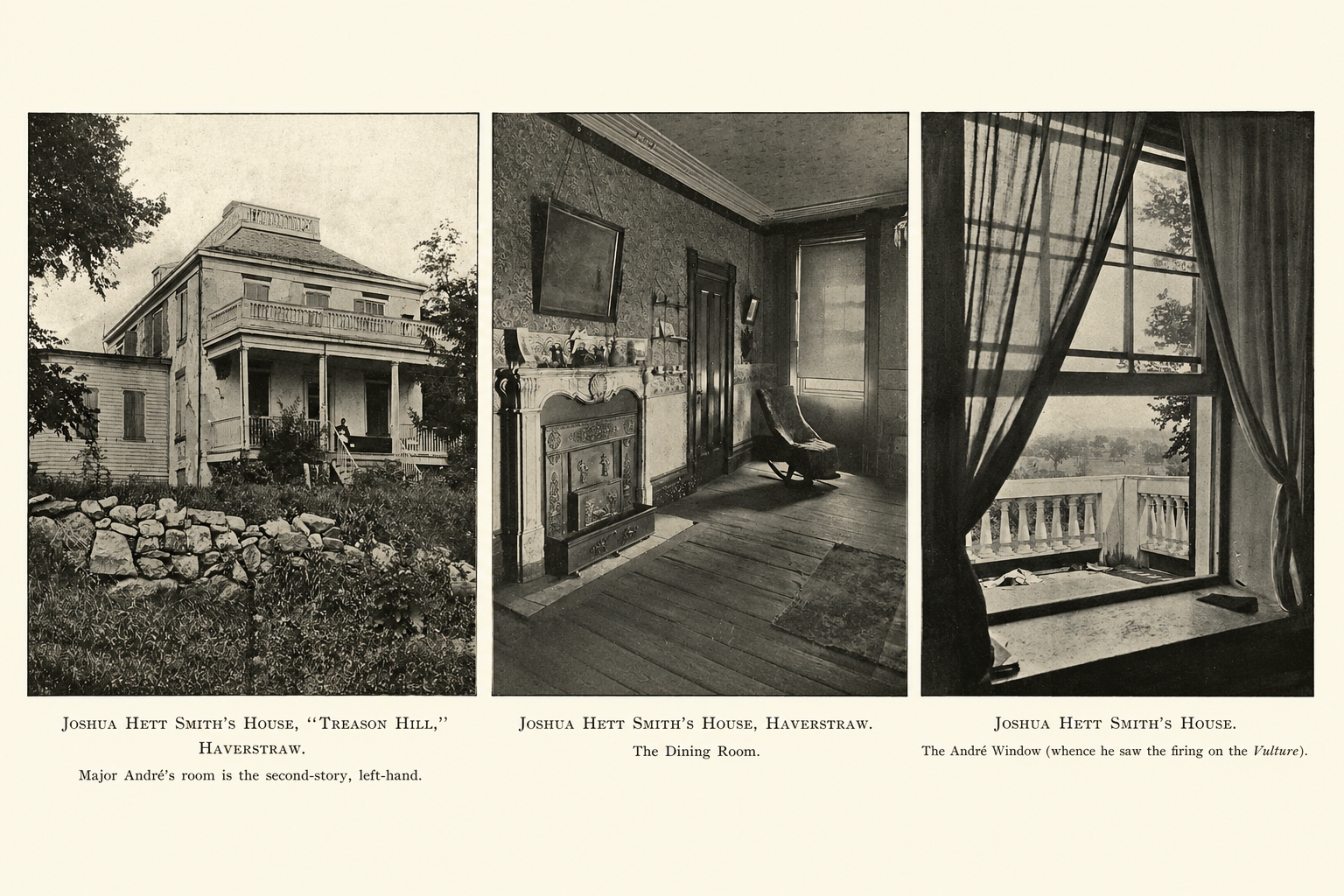 Photos of the Joshua Hett Smith House (Treason House).1 The house was
demolished in the 1920s. Today, the Helen Hayes Hospital occupies the site.
Photos of the Joshua Hett Smith House (Treason House).1 The house was
demolished in the 1920s. Today, the Helen Hayes Hospital occupies the site.
As André waited for nightfall and his escape to the Vulture, he paced the floor, growing increasingly anxious. Then, without warning, the stillness was shattered by the distant boom of cannon fire. Startled, Arnold and André rushed to an upstairs window. Along the river below, another unexpected turn of events was unfolding. Concerned that the British warship Vulture lay dangerously close to the American shore, Colonel James Livingston ordered his artillery to fire on the vessel. Unable to withstand the bombardment, the Vulture slipped downstream to a safer anchorage.
For André, the bombardment proved disastrous. The Vulture's withdrawal abruptly cut off his planned escape by river, leaving him stranded behind American lines. With the warship gone, he had only one remaining option: a hazardous overland journey back to New York City.
With the Vulture now beyond reach, Arnold began preparing André for the dangerous overland journey back to New York City, accompanied by Joshua Hett Smith. He provided André with a pass identifying him under the alias "John Anderson," allowing him to travel through American checkpoints without arousing suspicion. Arnold also persuaded André to exchange his British uniform for civilian clothing and to hide the West Point plans inside his stockings. In doing so, André violated the final two warnings of Sir Henry Clinton's most important instructions: never travel in disguise and never carry incriminating documents.
After days of tension and uncertainty, Major John André had every reason to believe his ordeal was nearly over. His hazardous journey with Joshua Hett Smith had carried him safely past several American checkpoints, his forged identity as "John Anderson" had held, and the security of British-held New York City was now only a short distance away. By the morning of September 23, however, Smith had departed, unwilling to venture any farther into the contested countryside. André continued alone toward Tarrytown, unaware that his greatest danger still lay ahead.
The previous day, a small band of local militia had taken up patrol along the road near Tarrytown, New York. Their mission was routine: intercept cattle being driven to the British in New York. This stretch of Westchester County was notorious as the "Neutral Ground," a lawless region caught between the opposing armies where Loyalist "Cowboys" and Patriot "Skinners" raided farms, stole livestock, and preyed on civilians. Anyone traveling these roads risked being stopped by friend or foe.
About mid- morning, just beyond Pine's Bridge, André encountered three of the militiamen: John Paulding, Isaac Van Wart, and David Williams. Paulding was wearing a Hessian military coat he had acquired after escaping British captivity. To André, the uniform was reassuring. Believing he had encountered fellow Loyalists, he relaxed his guard at precisely the wrong moment.
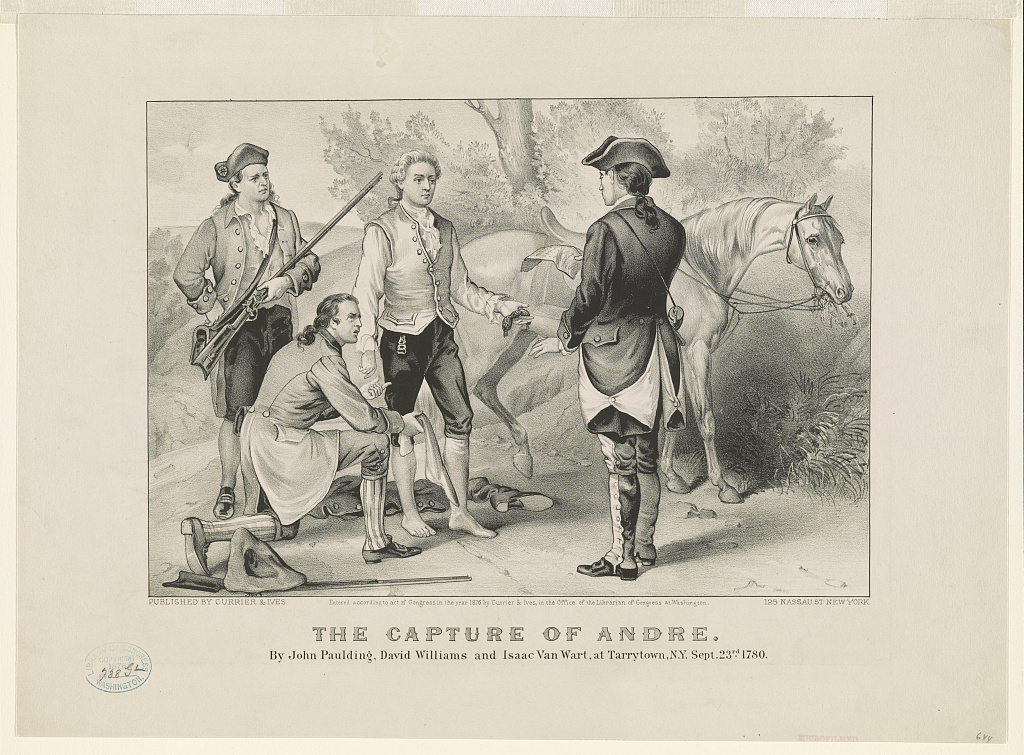 The capture of Andre: By John Paulding, David Williams and Isaac Van Wart, at Tarrytown, New York,
September 23, 1780.
Library of Congress
The capture of Andre: By John Paulding, David Williams and Isaac Van Wart, at Tarrytown, New York,
September 23, 1780.
Library of Congress
Instead of first producing the travel pass that Benedict Arnold had so carefully prepared, André confidently announced that he was a British officer "on urgent business." The words were scarcely out of his mouth before he realized his catastrophic mistake. He quickly tried to reverse himself, producing Arnold's pass and claiming to be an American officer. But it was too late. His contradictory story had already aroused suspicion, and the three militiamen decided to search him.
The following is an account of the capture told by John Paulding at the trial of Joshua Hett Smith. 1
"Myself, Isaac Van Wart, and David Williams were lying by the side of the road about half a mile above Tarrytown, and about fifteen miles above Kingsbridge, on Saturday morning, between nine and ten o'clock, the 23d of September. We had lain there about an hour and a half, as near as I can recollect, and saw several persons we were acquainted with, whom we let pass. Presently, one of the young men who were with me said, "There comes a gentleman-like looking man, who appears to be well dressed, and has boots on, and whom you had better step out and stop, if you don’t know him." On that I got up, and presented my firelock at the breast of the person, and told him to stand, and then I asked him which way he was going. "Gentlemen," said he, "I hope you belong to our party." I asked him what party. He said, "The Lower Party." Upon that I told him I did. Then he said, "I am a British officer, out in the country on particular business, and I hope you will not detain me a minute," and, to show that he was a British officer, he pulled out his watch. Upon which I told him to dismount. He then said, "My God! I must do any thing to get along," and seemed to make a kind of laugh of it, and pulled out General Arnold’s pass, which was to John Anderson, to pass all guards to White Plains and below. Upon that he dismounted. Said he, "Gentlemen, you had best let me go, or you will bring yourselves into trouble, for your stopping me will detain the general’s business;" and said he was going to Dobbs’s Ferry to meet a person there and get intelligence for General Arnold."
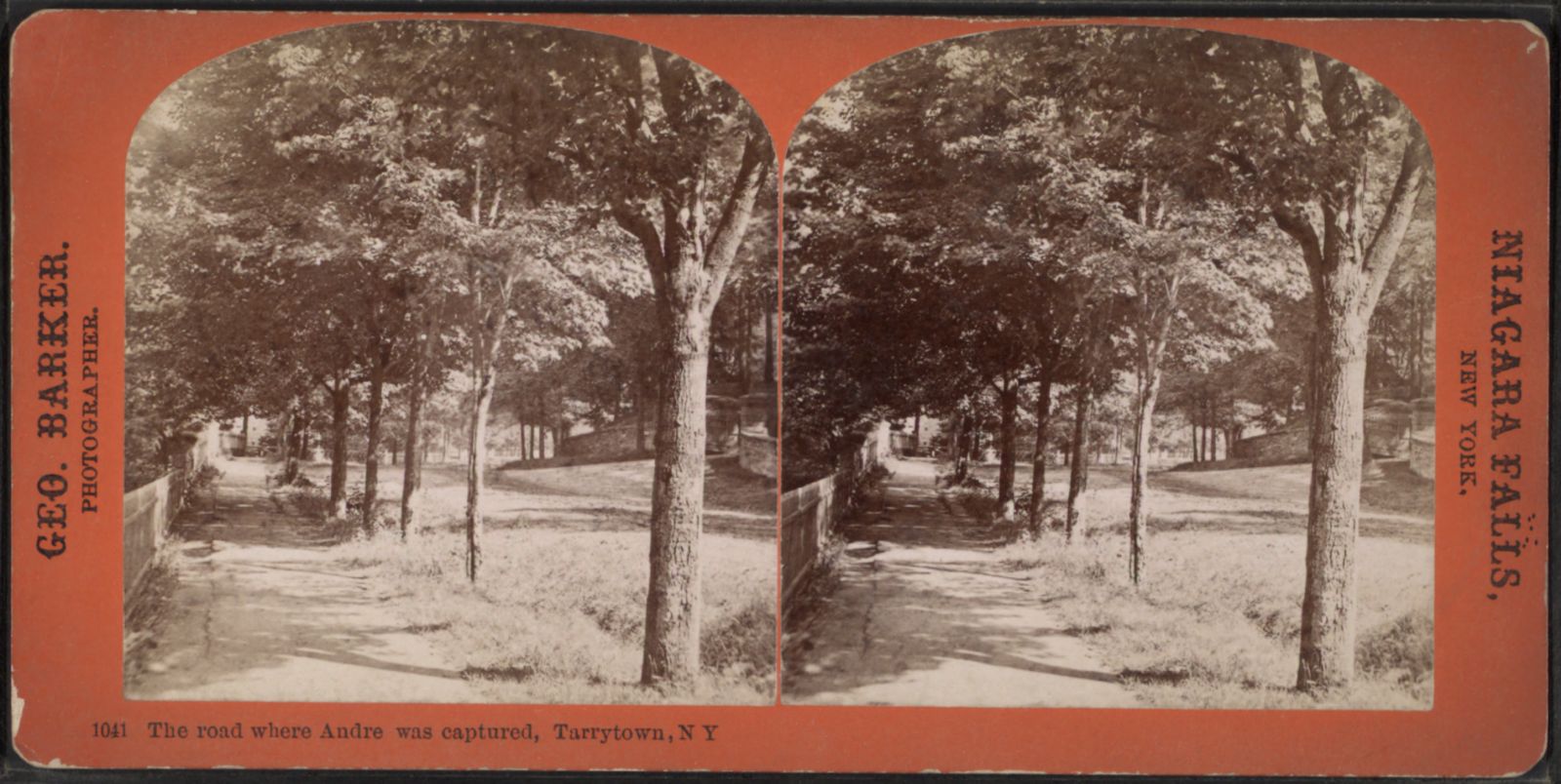 The road where André was captured at Tarrytown.
New York Digital Collections
The road where André was captured at Tarrytown.
New York Digital Collections
David Williams, another captor, also gave his account at the trial, "We took him into the bushes,” said Williams, "and ordered him to pull off his clothes, which he did; but, on searching him narrowly, we could not find any sort of writings. We told him to pull off his boots, which he seemed to be indifferent about; but we got one boot off, and searched in that boot, and could find nothing. But we found there were some papers in the bottom of his stocking next to his foot; on which we made him pull his stocking off, and found three papers wrapped up. Mr. Paulding looked at the contents, and said he was a spy. We then made him pull off his other boot, and there we found three more papers at the bottom of his foot within his stocking."
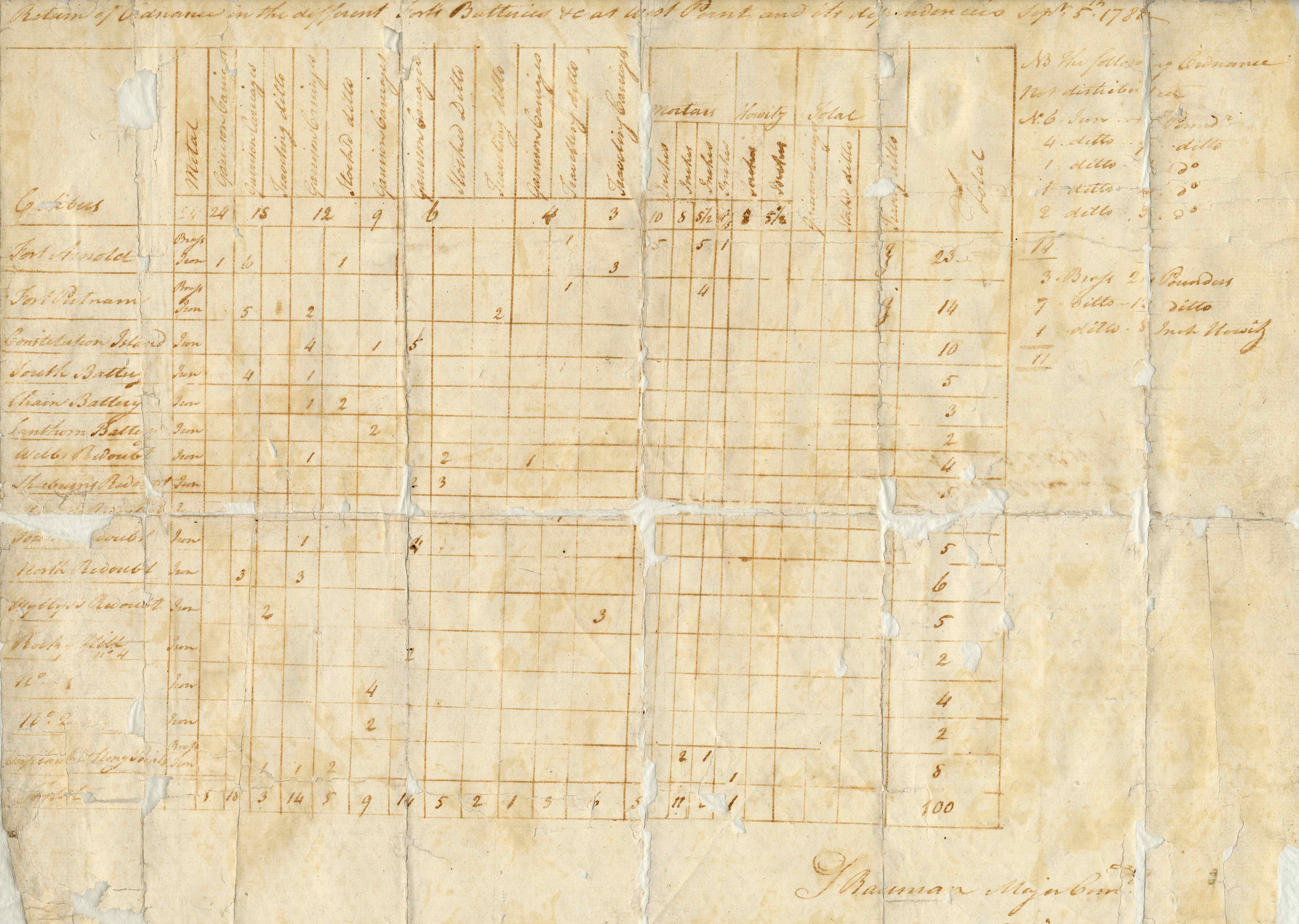 Return of Ordnance for West Point and its dependencies found on British Major John André at the
time of his capture by the Americans, during the American Revolution. The document is signed “S.
Bauman, Major Commandant of Artillery”. Sebastian Bauman was the Artillery Commander at West Point.
Papers found on Major John André (New York State Archives)
Return of Ordnance for West Point and its dependencies found on British Major John André at the
time of his capture by the Americans, during the American Revolution. The document is signed “S.
Bauman, Major Commandant of Artillery”. Sebastian Bauman was the Artillery Commander at West Point.
Papers found on Major John André (New York State Archives)
In a matter of moments, a mission that had come within sight of success began to unravel. Hidden inside André's stockings, the militiamen discovered the incriminating papers Arnold had entrusted to him. The conspiracy that might have changed the course of the Revolutionary War had been exposed by three ordinary citizens who simply refused to let a suspicious traveler continue on his way.
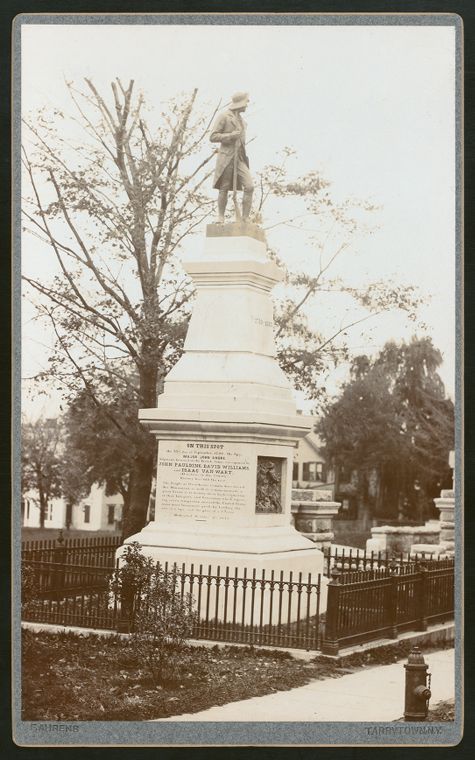 Monument in Tarrytown recognizing the efforts of the three militiamen.
New York Digital Collections
Monument in Tarrytown recognizing the efforts of the three militiamen.
New York Digital Collections
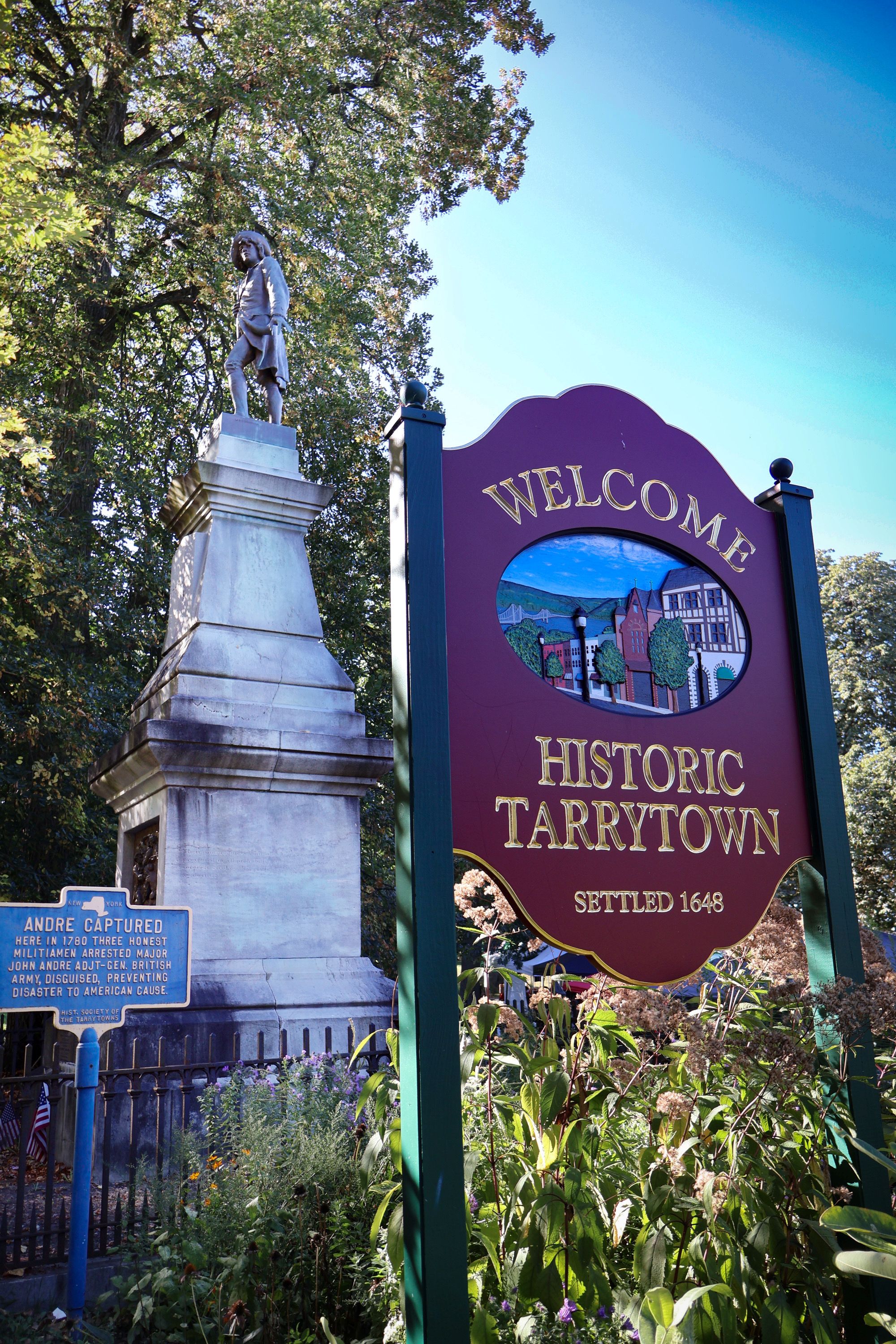 The monument located at Patriot's Park today. P Marlin 2025
In 1853, a monument honoring André's three captors was erected near the spot where André was captured. Twenty-seven years later, during the centennial commemoration of André's capture in 1880, the memorial was expanded and crowned with a bronze statue of John Paulding, the militiaman whose Hessian coat famously contributed to André's fatal mistake. Today, the Captors' Monument still stands in Patriot's Park in Tarrytown, quietly marking the place where one brief encounter changed the course of the American Revolution.
After his capture, André was escorted to the American outpost at North Castle, New York, where he and the incriminating papers hidden inside his boot were turned over to Lieutenant Colonel John Jameson, the officer in command. Yet, as remarkable as the chain of events had already been, the conspiracy still came within a hair's breadth of succeeding.
Although Jameson could plainly see that several of the documents were written in Benedict Arnold's own hand, he failed to grasp their significance. Convinced Arnold was incapable of treason, he sent him a letter reporting the capture of a British officer carrying papers in Arnold's own handwriting. Incredibly, Jameson then ordered André sent under guard to Arnold's headquarters while forwarding the incriminating documents to General George Washington. Jameson had unwittingly warned the very man whose treason those papers exposed.
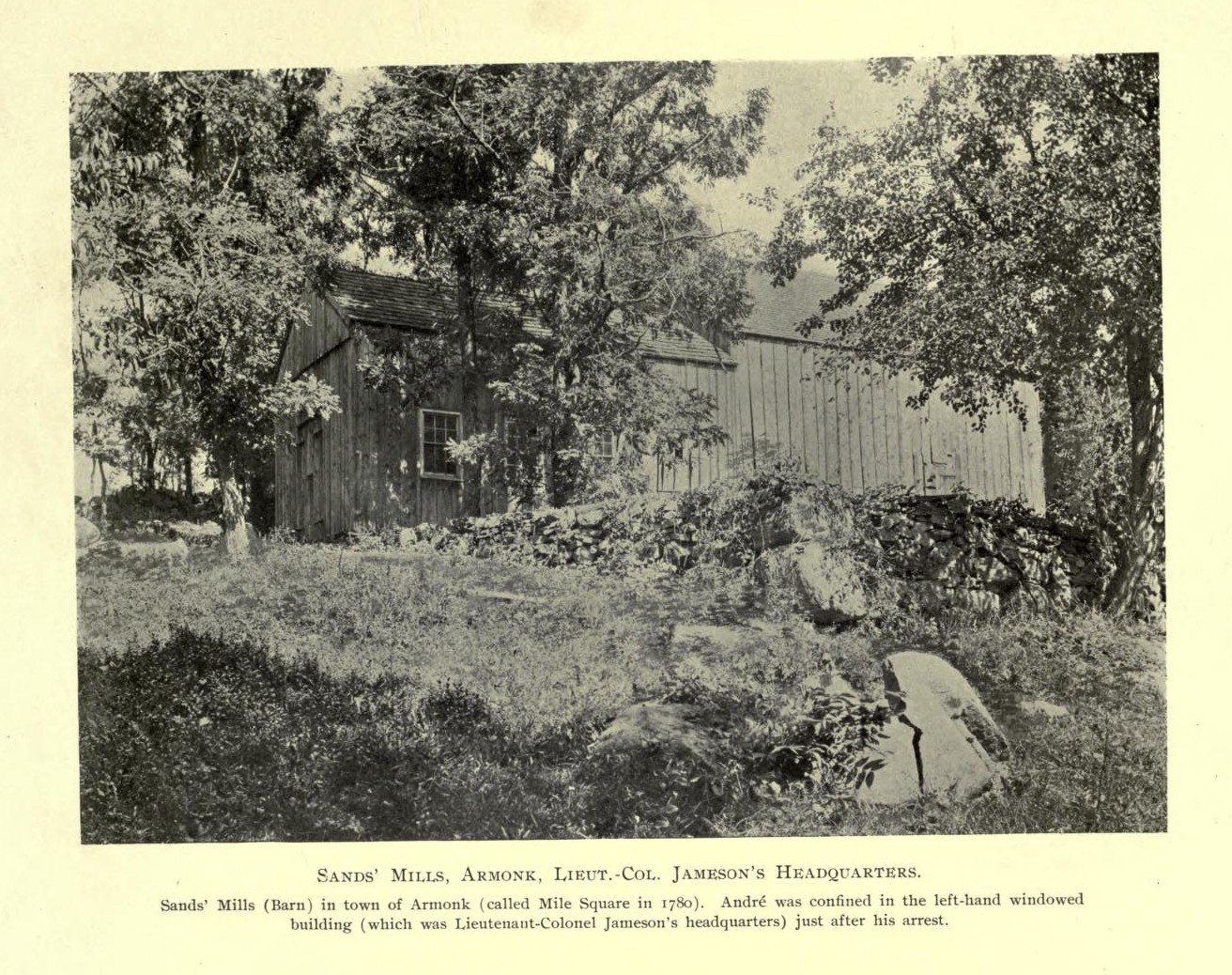 Jameson Headquarters in North Castle, New York.1
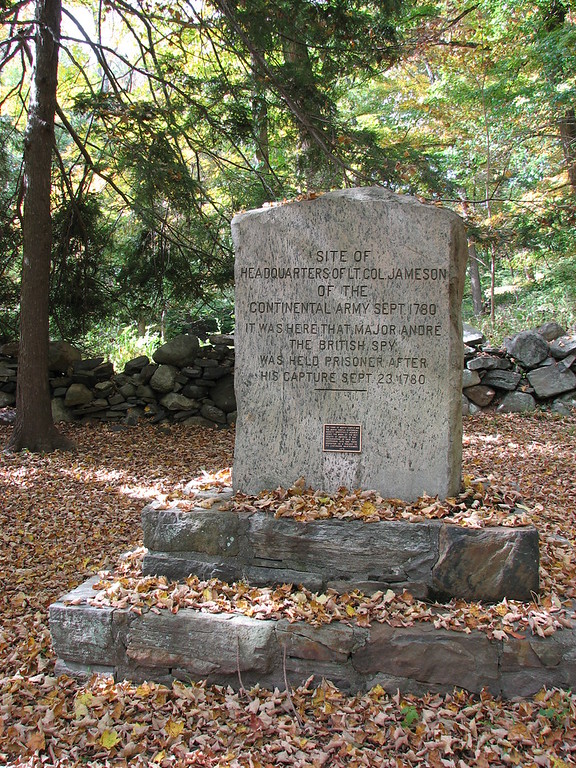 Today, a marker commemorates the site of the Jameson Headquarters in North Castle, New York.
Sand's Mill Site
Today, a marker commemorates the site of the Jameson Headquarters in North Castle, New York.
Sand's Mill Site
Fortunately, Benjamin Tallmadge, Washington’s chief intelligence officer, immediately recognized the danger. Convinced that Benedict Arnold himself was implicated, he was stunned by Lieutenant Colonel Jameson’s decision to send John André back toward Arnold’s headquarters. Acting at once, Tallmadge urged Jameson to recall André. Dragoons were dispatched and intercepted him shortly before he reached Arnold’s headquarters, bringing him back to the American outpost.
As these events unfolded in North Castle, Benedict Arnold sat down to what appeared to be an ordinary breakfast on the morning of September 25 at his headquarters in the Beverly Robinson House. General George Washington was expected to arrive at any moment to inspect the fortress, and Arnold needed to have his head clear for the deception ahead. The morning seemed routine as papers lay scattered across the table and conversation followed the familiar rhythm of military life. Washington's aides arrived at the Robinson House ahead of him and joined Arnold for breakfast, unaware that within minutes an urgent dispatch would unravel the carefully laid conspiracy.
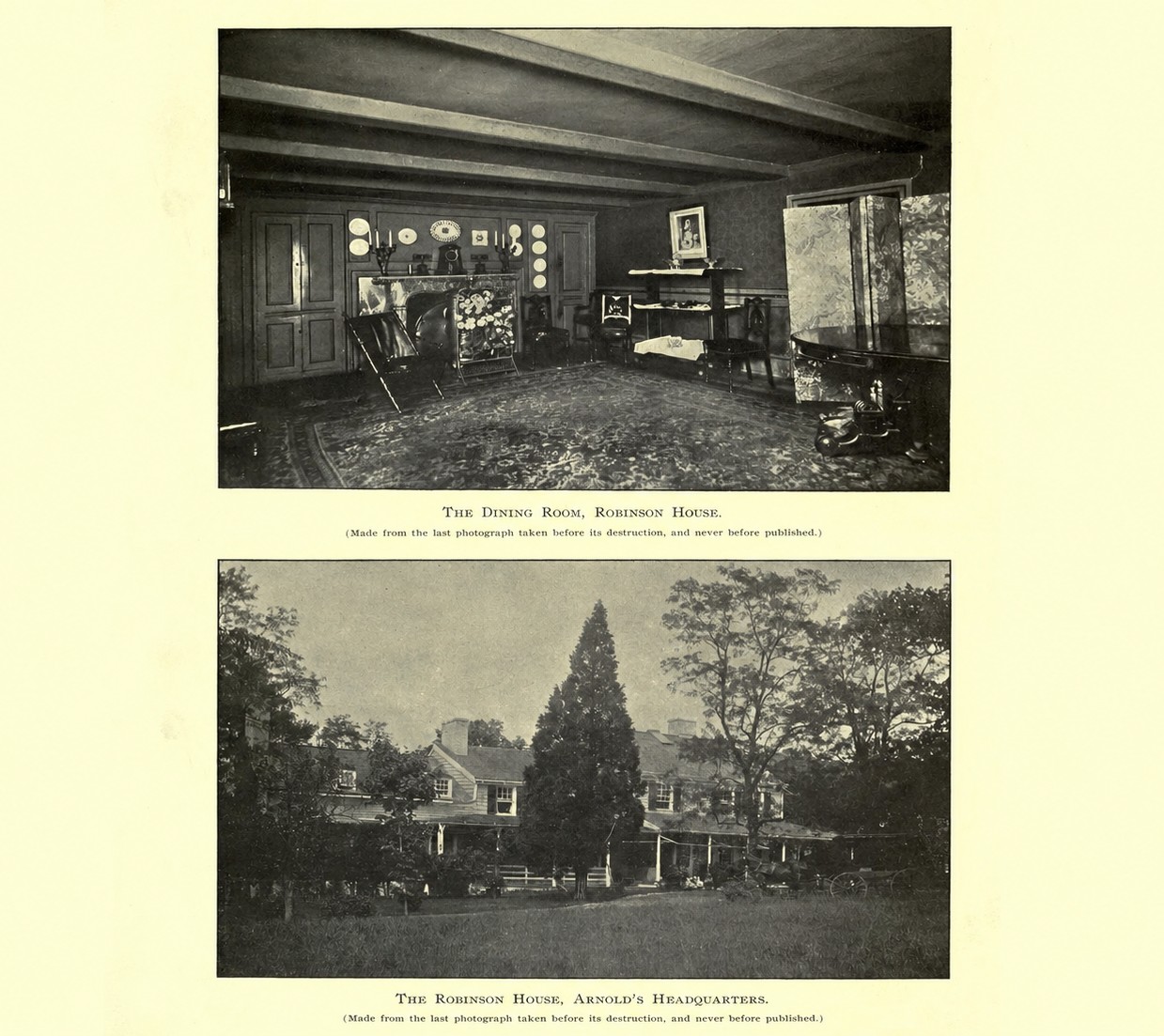 The Beverly Robinson House. 1
The Beverly Robinson House today
The Beverly Robinson House. 1
The Beverly Robinson House today
During the meal, a messenger arrived carrying a critical letter from Lieutenant Colonel Jameson reporting the capture of "John Anderson" (Major John André) and the seizure of suspicious papers found in his possession. Realizing instantly that the conspiracy had been uncovered, Arnold managed to conceal his alarm, calmly finished reading the letter, then excused himself from the table under the pretense of urgent business. Upstairs, he quickly informed his wife that he had to flee at once before slipping out of the Robinson House and making his desperate escape to the British lines.
As Arnold galloped toward the Hudson and his escape to the Vulture, General George Washington arrived at the Robinson House expecting to meet Benedict Arnold. When Washington arrived mid morning, he found only confusion in Arnold’s absence. He was told that Arnold had been unexpectedly called away to West Point, a report that seemed plausible enough to delay suspicion. After briefly taking breakfast himself, Washington crossed the river to continue his planned inspection of West Point, still unaware that the fragmentary reports already in motion had exposed a full act of treason, and that the man he intended to meet had already vanished into flight.
When Washington reached West Point, he expected Arnold to be waiting for him. Instead, he learned that Arnold had never arrived. The mystery was soon resolved when he received Lieutenant Colonel John Jameson's dispatch describing the capture of a suspicious traveler calling himself "John Anderson," along with the incriminating papers discovered hidden in the prisoner's stocking. As Washington examined the documents, many written in Arnold's own hand, he immediately grasped the terrible truth: one of his most trusted generals had betrayed the American cause. Deeply shaken, he is said to have exclaimed, "Arnold has betrayed us. Whom can we trust now?"
Realizing his deception had come to an end, André wrote directly to George Washington, openly revealing his identity: "The person in your possession is Major John André, Adjutant General to the British Army." A complete transcription of André's letter, together with a portion of Major Benjamin Tallmadge's account describing the journey to Tappan, is available through Founders Online.
Under heavy guard, André was escorted to Tappan by Lieutenant Colonel Benjamin Tallmadge, Washington's trusted chief of military intelligence. As they journeyed, they found themselves briefly removed from the surrounding drama of war. The Hudson flowed quietly around them, but the meaning of André’s capture pressed heavily on both men.
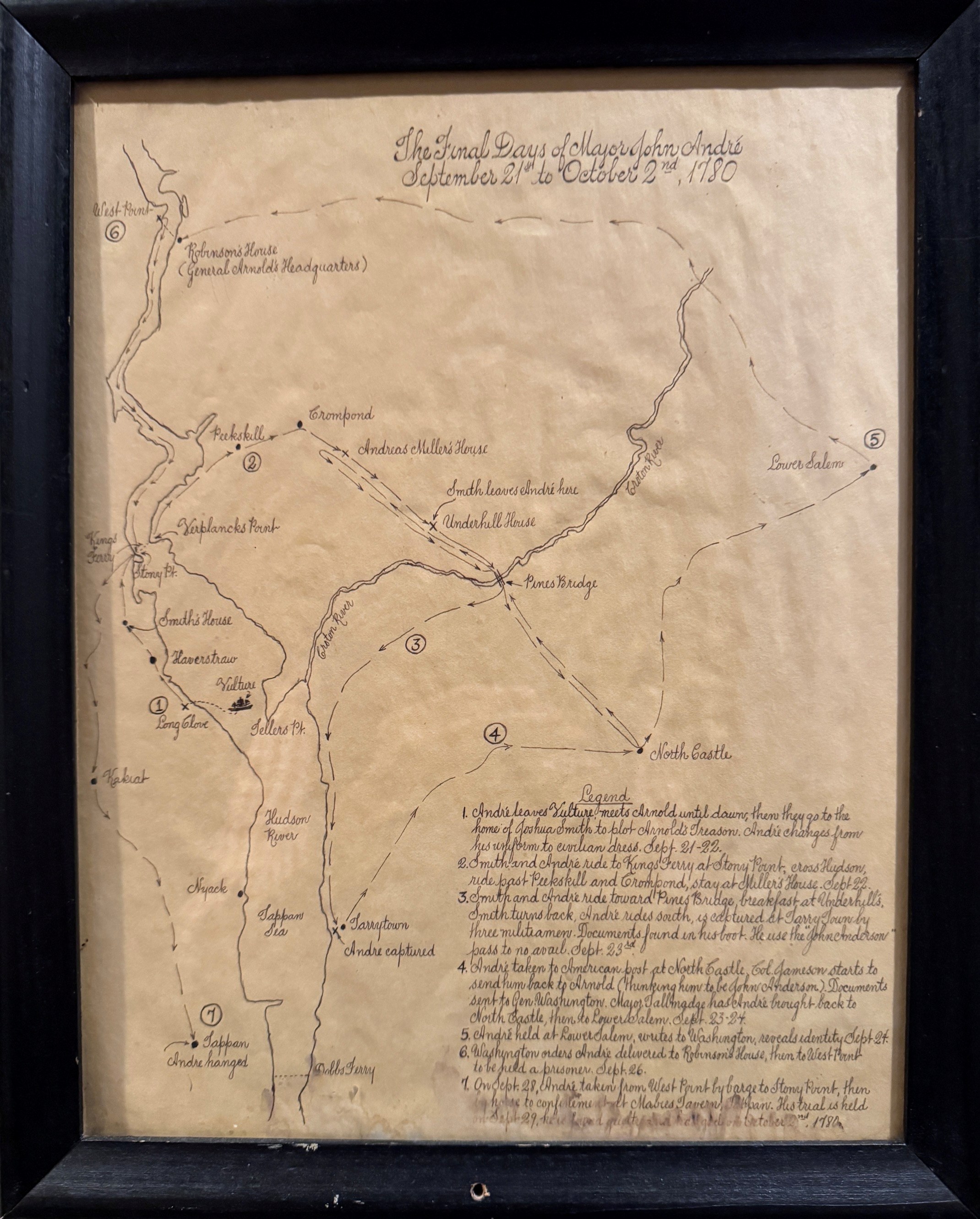 The final days of André map hangs in the Old '76 House in Tappan.
Larger Version. P Marlin 2025
The final days of André map hangs in the Old '76 House in Tappan.
Larger Version. P Marlin 2025
At one point during the journey, André directly asked Tallmadge what his fate would be. It was a question that cut through the formality of their roles and reached the heart of the situation. Tallmadge recalled that the inquiry immediately brought to mind his former Yale classmate, Nathan Hale, who had been captured by the British in 1776 and executed as a spy without trial.
Sensing Tallmadge’s hesitation, André pressed the matter further. “Surely,” he asked, “you do not consider his case and mine alike?”
Tallmadge did not soften his answer. According to his later recollection, he replied, “Yes, precisely similar, and similar will be your fate.” For André, the realization must have been deeply sobering, if not devastating, as the implication of those words became unmistakably clear.
Long before the American Revolution, Tappan was a quiet Dutch farming village nestled among the rolling hills west of the Hudson River. Settled in the late 1680s after land was purchased from the Lenape people, whose name for the area was "Tappan," the little community grew slowly over the next century. By 1780, it consisted of a handful of homes, farms, churches, taverns, and shops clustered around a country crossroads.
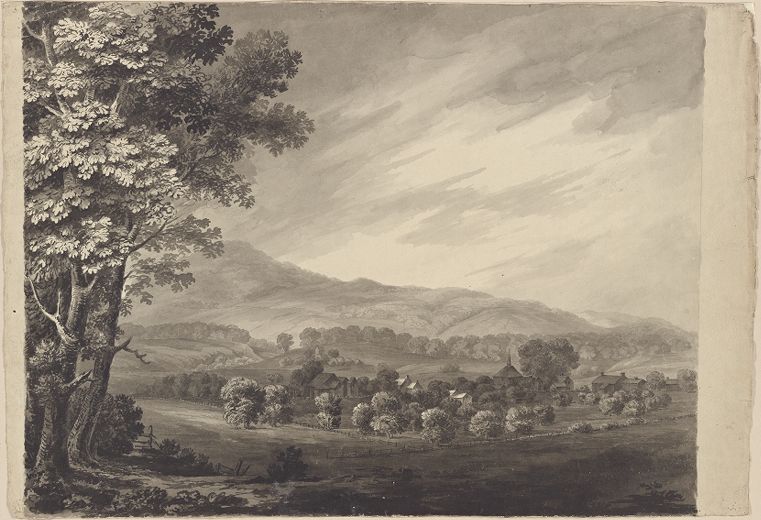 "View of Tapan, or Orange Town taken 28th Septr. 1778 and
finished 15th June 1780 on board the Littledale Transport on
the passage from Charles Town to New York. A. R."
New York Public Library
"View of Tapan, or Orange Town taken 28th Septr. 1778 and
finished 15th June 1780 on board the Littledale Transport on
the passage from Charles Town to New York. A. R."
New York Public Library
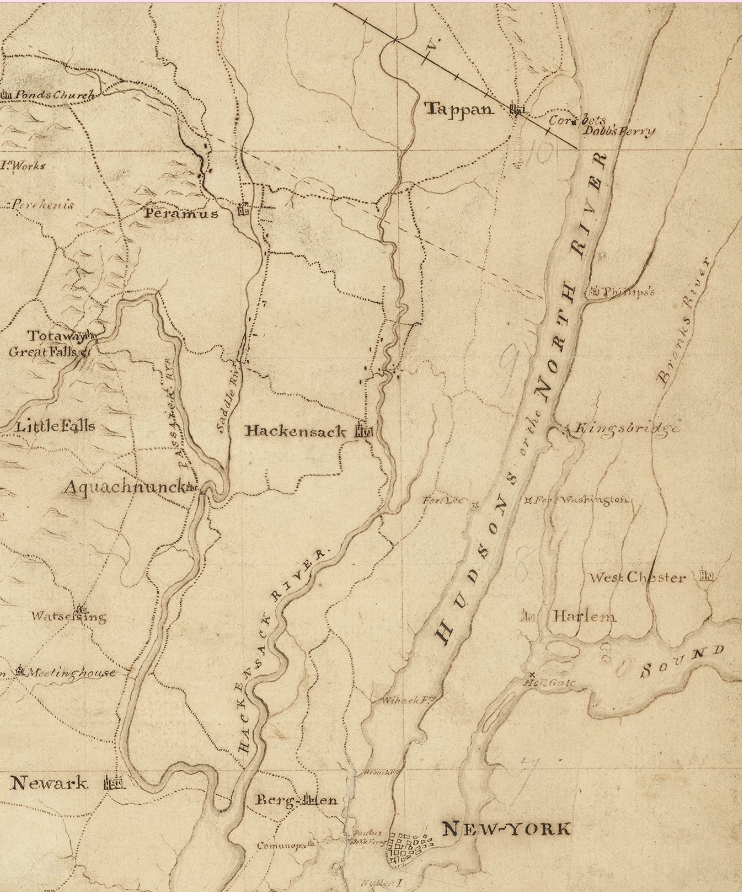 Robert Erskine's 1777 manuscript map of parts of New York,
New Jersey, and Pennsylvania, prepared from actual surveys for
General George Washington.
Ruderman Rare Maps
Robert Erskine's 1777 manuscript map of parts of New York,
New Jersey, and Pennsylvania, prepared from actual surveys for
General George Washington.
Ruderman Rare Maps
Despite its modest size, Tappan occupied an important strategic position during the Revolutionary war. Connected by roads leading to West Point, New Jersey, and British-occupied New York City, the village frequently served as a staging area for the Continental Army. During the summer of 1780, thousands of American soldiers under Major General Nathanael Greene camped in the surrounding countryside, transforming the peaceful farming community into a busy military encampment. Few could have imagined that within a matter of weeks this quiet village would become the setting for one of the most dramatic episodes of the American Revolution.
Remarkably, many of the places that witnessed those extraordinary events still stand today. Just a short walk from André's prison (the Old '76 House) stands the DeWint House, where General George Washington established his headquarters several times during the Revolutionary War. Located down the street from André's Prison, the Reformed Church of Tappan served as the site of André's military trial, while beyond the village lies the field where he was executed and initially buried.
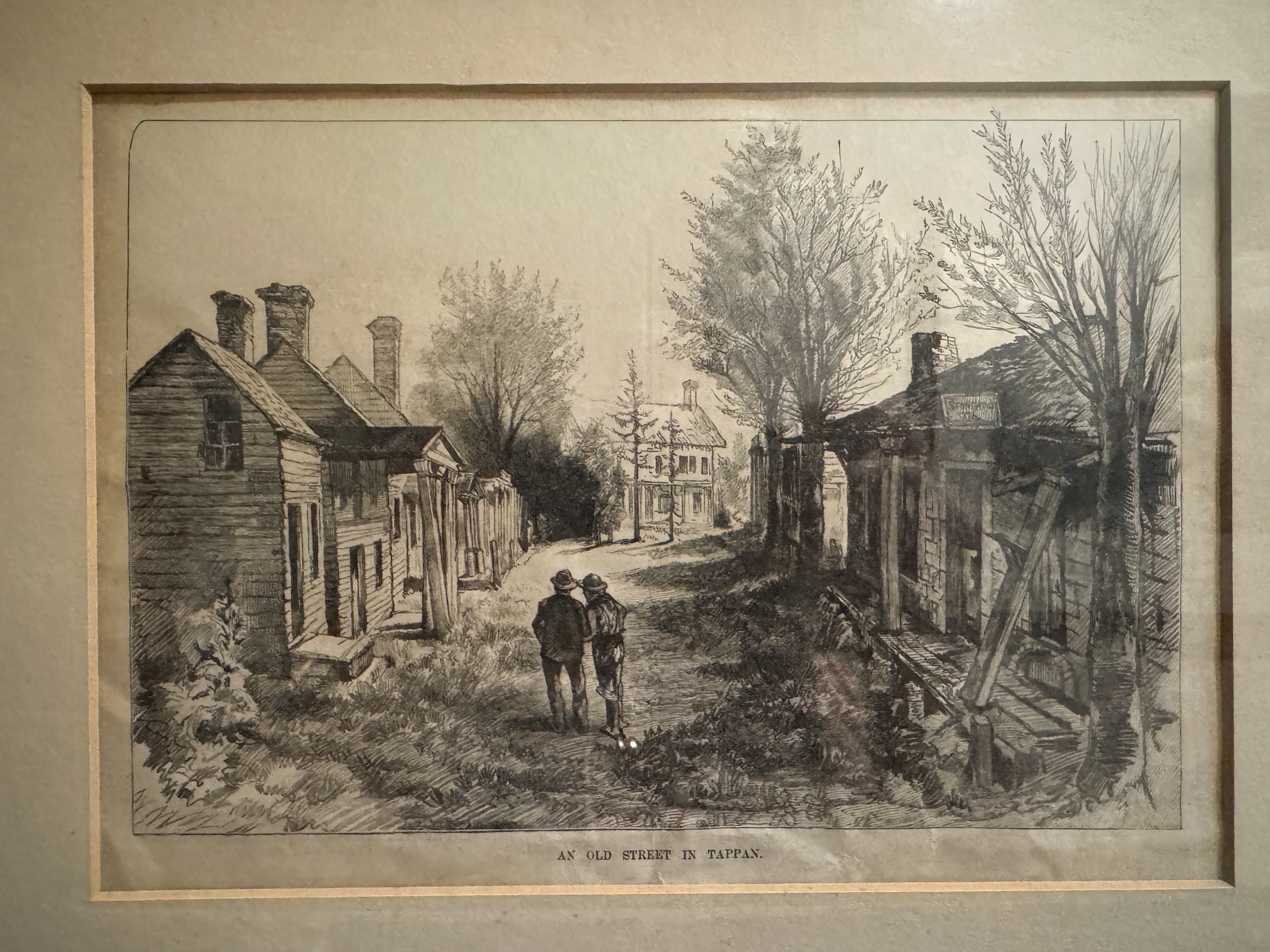 A sketch of Old Tappan hangs in the Old '76 House. The original "André Prison"
is on the right of the image.
A sketch of Old Tappan hangs in the Old '76 House. The original "André Prison"
is on the right of the image.
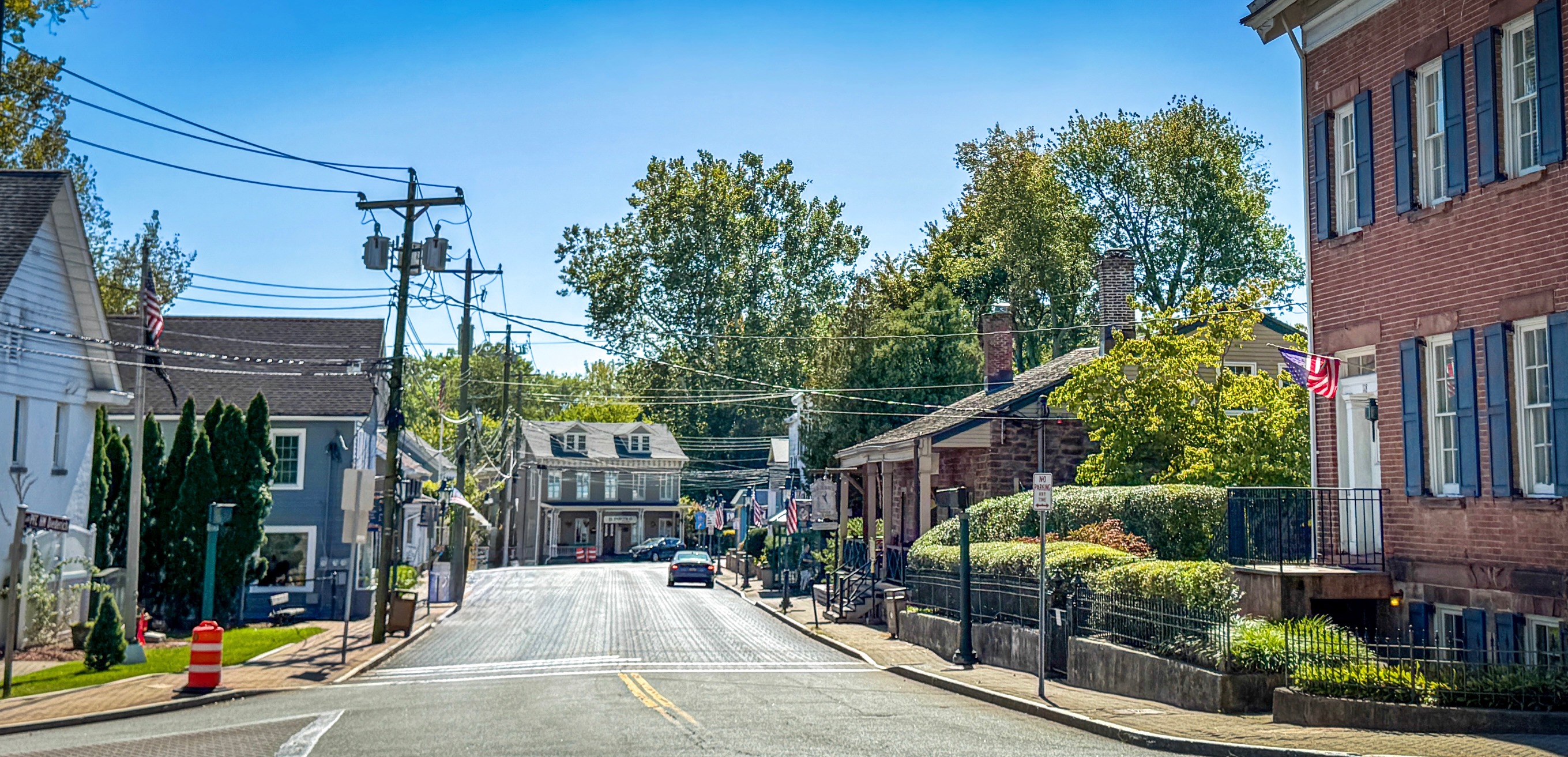 Same view of Tappan with the Old '76 House ("André's Prison") located
on the right. P Marlin 2025
Same view of Tappan with the Old '76 House ("André's Prison") located
on the right. P Marlin 2025
After a long ride from North Castle, Major Benjamin Tallmadge and his prisoner finally arrived at the village of Tappan. Passing the centuries-old Dutch Reformed Church and graveyard, where André would soon stand trial, they stopped before a sturdy sandstone building known as the House of Casparus Mabie or Mabie's House or Tavern. Likely constructed between 1753 and 1755, it was a sturdy Dutch Colonial house built of thick local red sandstone and distinctive red brick trim around its windows and doors. Originally designed as a center-hall residence, the house contained only two rooms on each floor separated by a narrow hallway, with a broad front stoop welcoming travelers from Main Street.
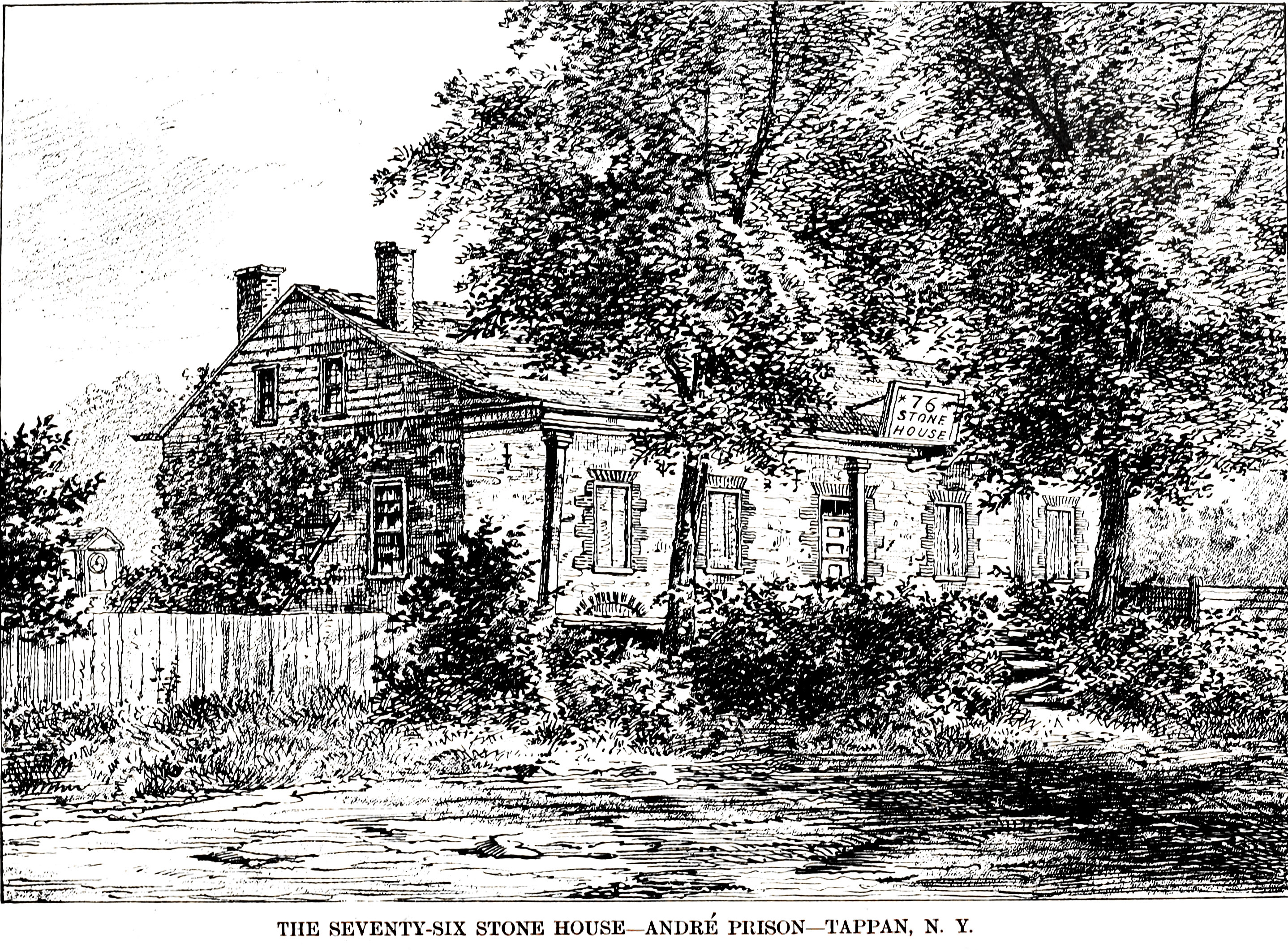 A Sketch of the House of Casparus Mabie (Old '76 House).
Historical Marker Database
A Sketch of the House of Casparus Mabie (Old '76 House).
Historical Marker Database
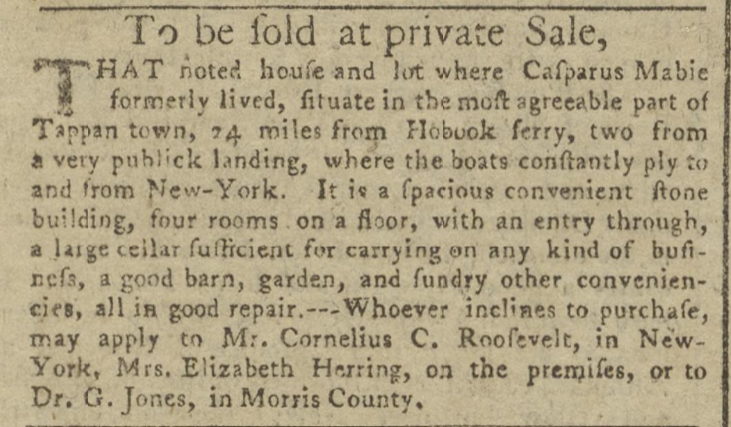 Historic deeds and newspaper advertisements confirm
that Casparus Mabie owned the property and operated it
as a well-known tavern. Although he sold the building before
the Revolutionary War.
2
The New-York Gazette, and the Weekly Mercury (New-York), June 24, 1776
Library of Congress
Historic deeds and newspaper advertisements confirm
that Casparus Mabie owned the property and operated it
as a well-known tavern. Although he sold the building before
the Revolutionary War.
2
The New-York Gazette, and the Weekly Mercury (New-York), June 24, 1776
Library of Congress
During his stay at the Mabie House, André occupied two rooms on the ground floor on the north side of the building, using the front room to receive visitors and the smaller chamber behind it as his bedroom. General George Washington instructed Tallmadge to treat his distinguished prisoner "with all the lenity his situation will admit," ensuring he was comfortably lodged and well cared for. At the same time, Washington left nothing to chance. Sentries guarded every door and window around the clock, while American officers remained constantly with André inside the house.
During the four days that followed, André's prison became an unlikely setting for mutual respect between enemies. His meals were sent from Washington's own table at the DeWint House, and visitors such as Alexander Hamilton and Benjamin Tallmadge found themselves impressed by the prisoner's intelligence, courtesy, and calm acceptance of his fate.
While André remained confined at Mabie House, his fate was being decided only a short distance away at Tappan's Dutch Reformed Church, where a board of senior Continental Army officers, including Nathanael Greene, Henry Knox, the Marquis de Lafayette, Baron von Steuben, and others, conducted his military trial. As officers, aides, guards, and messengers moved constantly between Washington's headquarters, the church, and Mabie's House, the quiet village became the center of one of the most consequential military proceedings of the Revolutionary War.
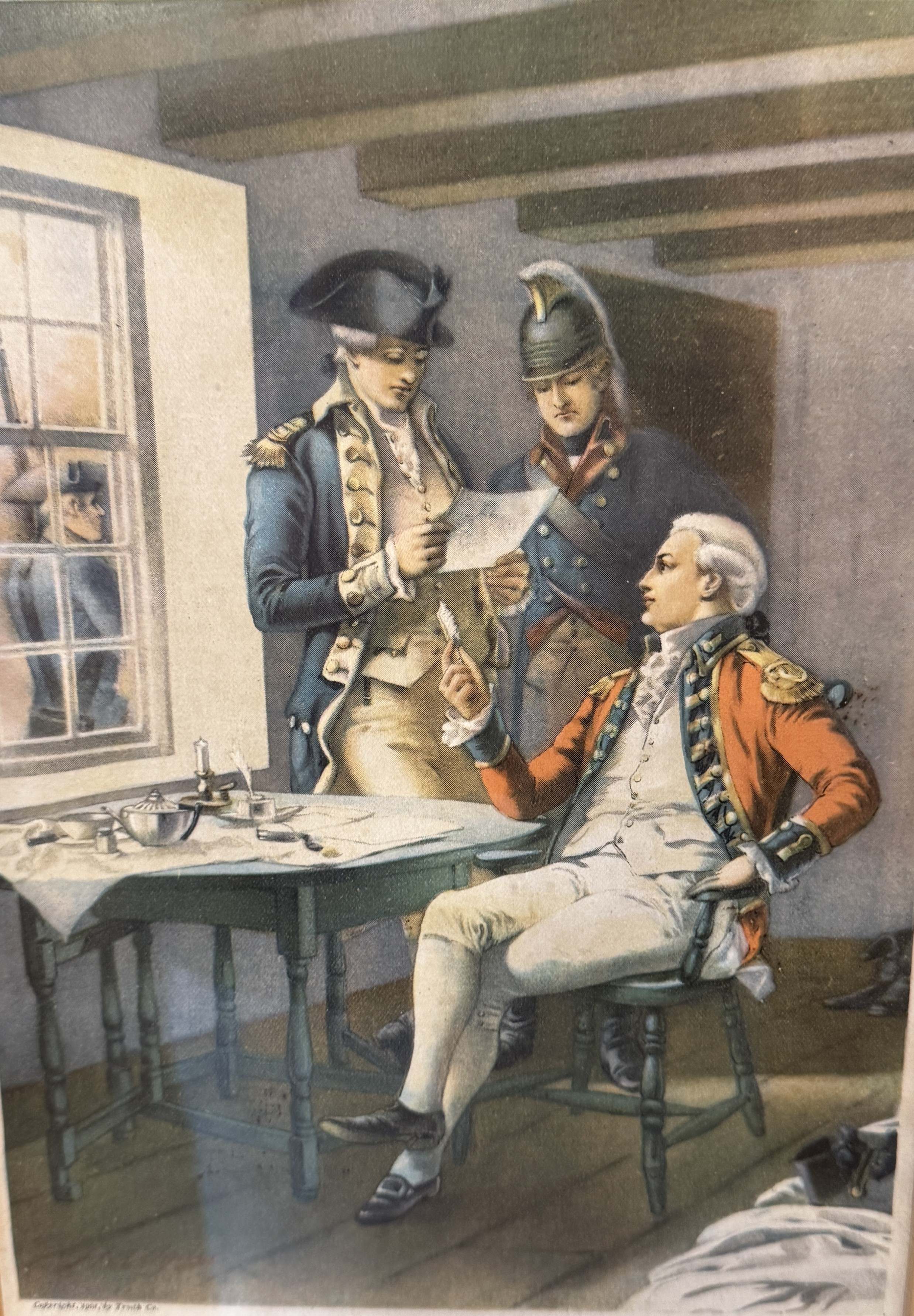 During his confinement, André spent his time writing letters and drawing sketches.
He also penned his famous appeal to George Washington, asking only that he be spared the
humiliation of the gallows and be allowed to die as a soldier before a firing squad. He also
wrote to his commander,
Sir Henry Clinton. Washington, determined to avoid even the appearance of personal influence, never
visited his prisoner.
A print of André in the Mabie House the day before execution from the DeWint House Museum.
During his confinement, André spent his time writing letters and drawing sketches.
He also penned his famous appeal to George Washington, asking only that he be spared the
humiliation of the gallows and be allowed to die as a soldier before a firing squad. He also
wrote to his commander,
Sir Henry Clinton. Washington, determined to avoid even the appearance of personal influence, never
visited his prisoner.
A print of André in the Mabie House the day before execution from the DeWint House Museum.
Long after the soldiers departed and the Revolution ended, the Mabie House, or the Old '76 House, as it had become known as, remained a familiar landmark in the village, passing quietly from one owner to the next. By 1800 it belonged to Philip Dubey, and nearly two decades later it attracted the attention of Captain Alden Partridge, the former Superintendent of West Point. Curious to see the room where André had spent his final days, Partridge carefully measured it, recording a chamber just 18 feet 6½ inches long, 11 feet 7½ inches wide, and barely 7½ feet high, lit by a single west-facing window and entered through one door.
As the nineteenth century progressed, the old house became a destination for travelers eager to stand where one of the Revolution's most dramatic stories had unfolded. Unfortunately, admiration often came at a cost. Visitors chipped away bricks, pried loose Dutch fireplace tiles, and carried off pieces of woodwork. When Dr. James Stephens acquired the property in the 1850s, he found himself the reluctant guardian of a landmark that was slowly deteriorating.
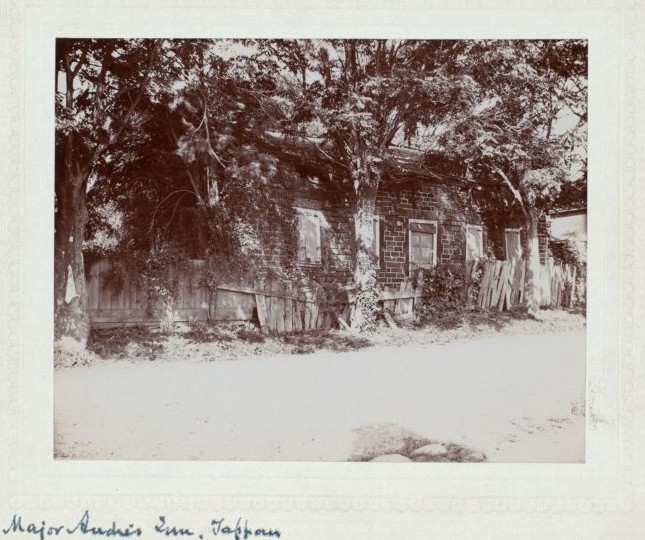 André's Prison. Year unknown.
Library of Congress
André's Prison. Year unknown.
Library of Congress
 A drawing of the interior by James Stephens. André's rooms were
on the north side of the building.1
A drawing of the interior by James Stephens. André's rooms were
on the north side of the building.1
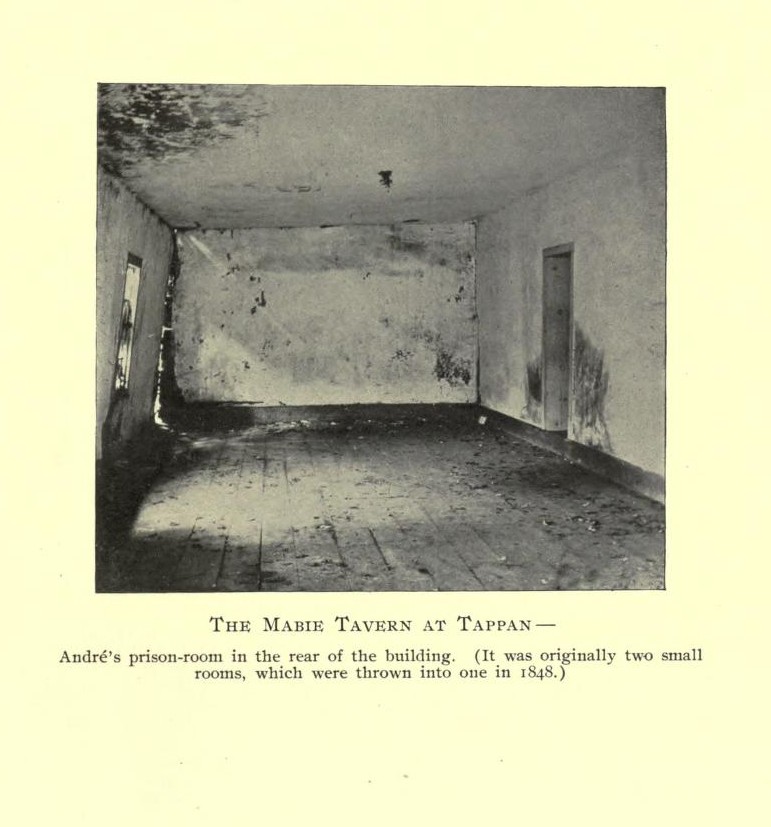 The room André slept in the north west corner of the building.
1
The room André slept in the north west corner of the building.
1
 Newspaper accounts published between the 1890s and early 1900s chronicled the deteriorating condition of André's prison in Tappan.
Full articles
Newspaper accounts published between the 1890s and early 1900s chronicled the deteriorating condition of André's prison in Tappan.
Full articles
Stephens owned the former Mabie House for more than forty years. Determined to preserve what remained, he refused to admit visitors, turning away tourists and history enthusiasts alike. Despite repeated appeals for New York State to preserve the landmark, little was done. By 1884, Stephens sadly noted that many of the rare Dutch fireplace tiles had been stolen. The old tavern, he feared, was disappearing one relic at a time.
Nature nearly accomplished what the relic hunters could not. In 1897, a violent windstorm caused much of the front wall to collapse, leaving the historic building on the brink of destruction. Faced with the loss of the building he had struggled to protect for decades, Stephens sold the property to Charles A. Pike. Pike was said to have rebuilt the damaged structure, enabling the old House of Casparus Mabie to survive into the 21st century and allowing generations of visitors to walk through the same doorway from which Major John André took his final steps in the autumn of 1780.
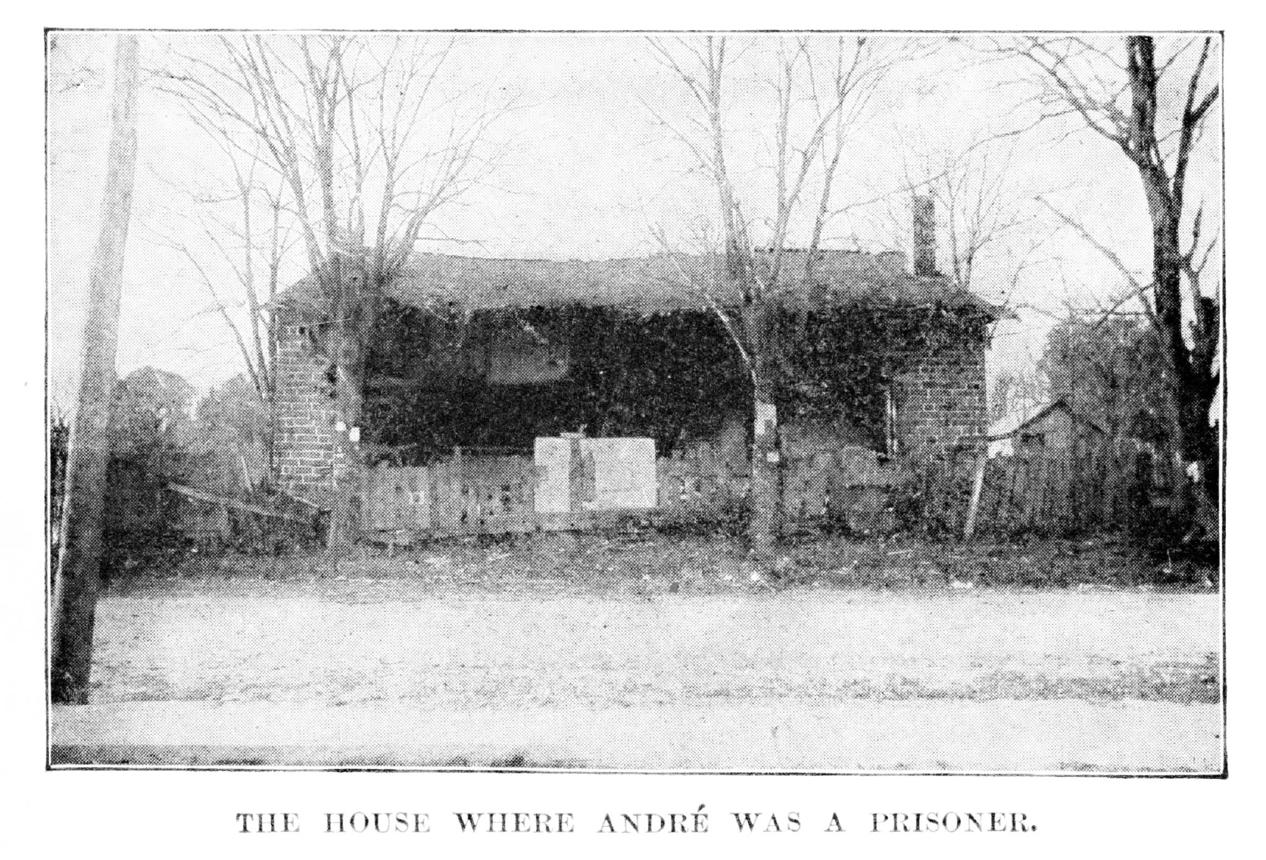 The Mabie House after the collapse of its front wall, likely
following the violent storm of 1897 as sourced in newspapers.
The Mabie House after the collapse of its front wall, likely
following the violent storm of 1897 as sourced in newspapers.
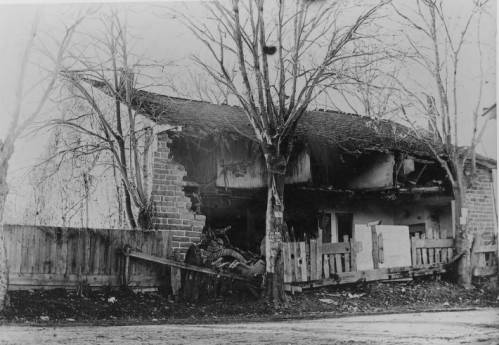 This intriguing photograph of the Mabie House
shows extensive structural damage like the above photo. The
image has been associated with an 1895 fire, although
I was unable to locate a contemporary newspaper account documenting the event.
It also reveals the building as a full two-story structure and may
provide a glimpse of a north wall fireplace where Andre greeted visitors.
New York Hertage Digital Collection
This intriguing photograph of the Mabie House
shows extensive structural damage like the above photo. The
image has been associated with an 1895 fire, although
I was unable to locate a contemporary newspaper account documenting the event.
It also reveals the building as a full two-story structure and may
provide a glimpse of a north wall fireplace where Andre greeted visitors.
New York Hertage Digital Collection
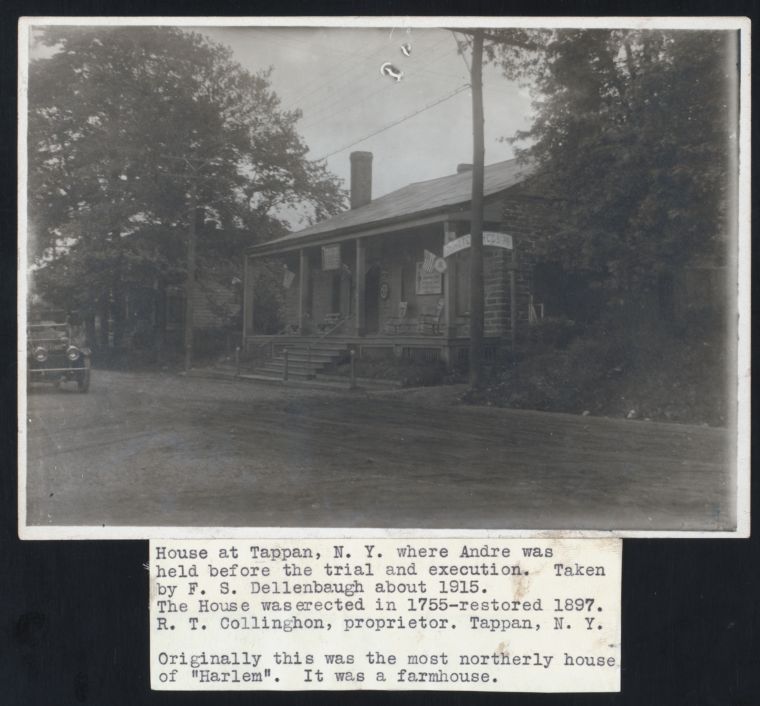 "House at Tappan, N.Y. where Andre was held"
New York Public Library
"House at Tappan, N.Y. where Andre was held"
New York Public Library
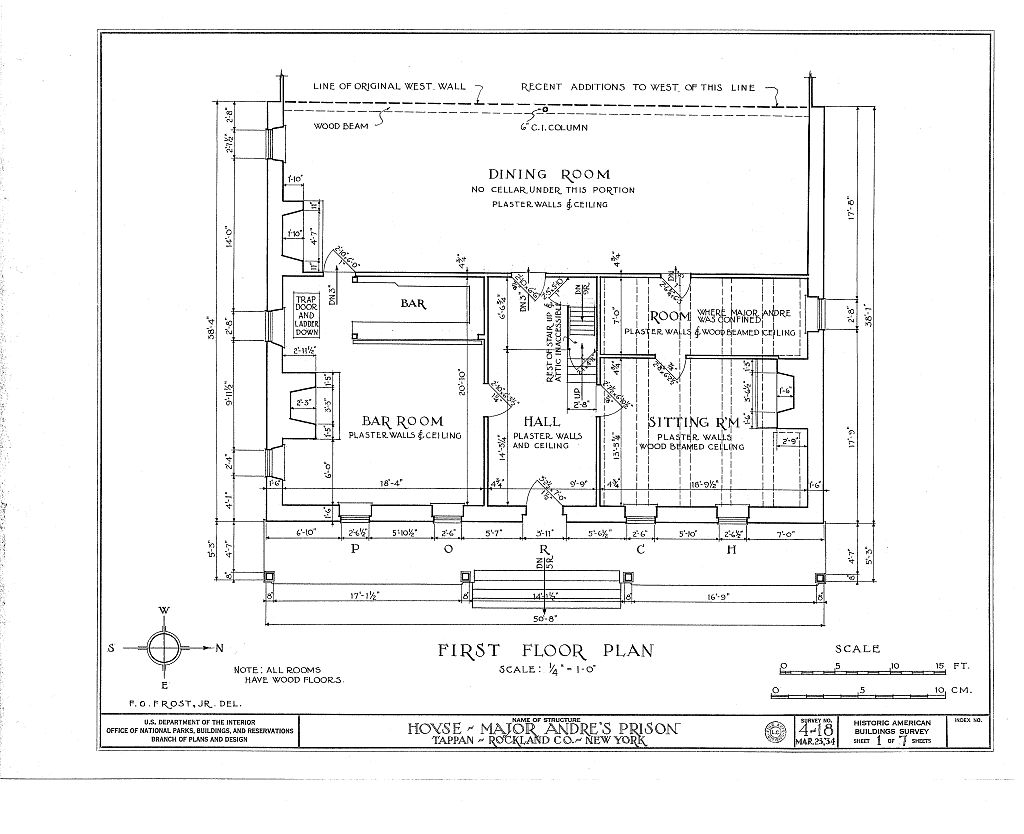 First-floor plan of the historic stone house in Tappan, New York,
where Major John André was confined from September 29 to October 2, 1780. This
Historic American Buildings Survey (HABS) drawing depicts André's Prison
(Old '76 House) as it loooed in 1934.
Library of Congress, Historic American Buildings Survey (HABS).
First-floor plan of the historic stone house in Tappan, New York,
where Major John André was confined from September 29 to October 2, 1780. This
Historic American Buildings Survey (HABS) drawing depicts André's Prison
(Old '76 House) as it loooed in 1934.
Library of Congress, Historic American Buildings Survey (HABS).
Stepping inside today's Old '76 House is a fascinating experience. Although the building has been extensively remodeled over the past two and a half centuries, it is still easy to imagine the extraordinary events that unfolded here in the autumn of 1780. At times, however, it can be difficult to distinguish original eighteenth-century features from later alterations.
One example is the large fireplace, now decorated with colorful Dutch tiles. It occupies the west wall of the room, but the original fireplace associated with the eighteenth-century house was likely located on the north wall, as suggested by the surviving exterior chimneys. Likewise, the original center-hall floor plan has largely disappeared. Visitors entering through the east front door in 1780 would have stepped into a narrow hallway with separate rooms on either side, whereas much of today's Old '76 House has been opened into larger dining spaces.
Throughout the restaurant, photographs, artifacts, and Revolutionary War memorabilia help tell the story of the building's remarkable past. Among the most famous displays is the upside-down portrait of Benedict Arnold. According to local tradition, George Washington himself turned the portrait after learning of Arnold's treason. While it is an entertaining story that has become part of the building's folklore, there is no historical evidence that Washington ever visited the house or personally inverted the portrait. When Washington was in Tappan, he spent most of his time at the nearby DeWint House.
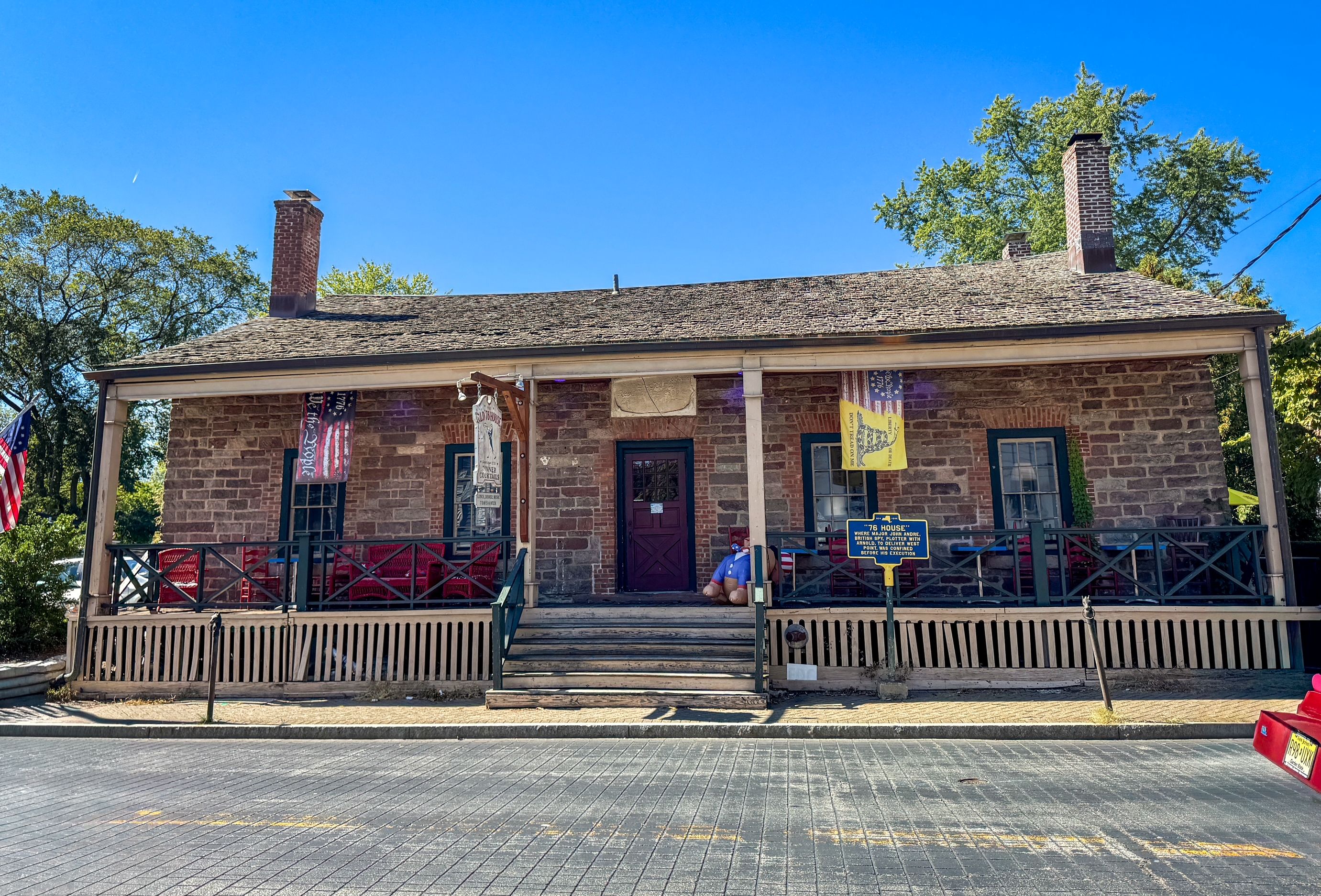 The Old '76 House (André's Prison). P Marlin 2025
 An old window on the south side of the building. The Old '76 House (André's Prison). P Marlin 2025
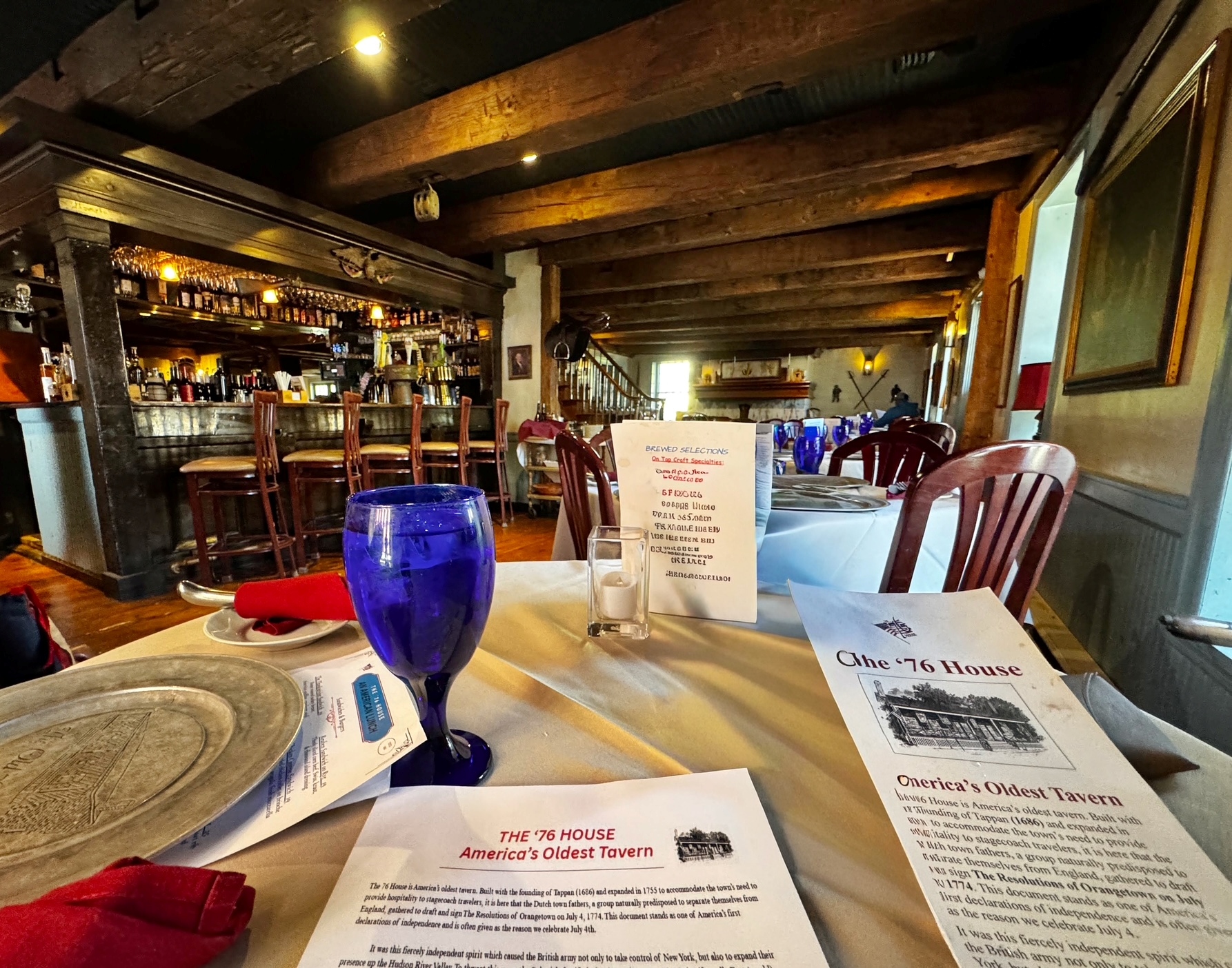 Today's view of the north side of the building where John André's would have
greeted guests and slept. This area was originally partitioned.
The Old '76 House (André's Prison). P Marlin 2025
Today's view of the north side of the building where John André's would have
greeted guests and slept. This area was originally partitioned.
The Old '76 House (André's Prison). P Marlin 2025
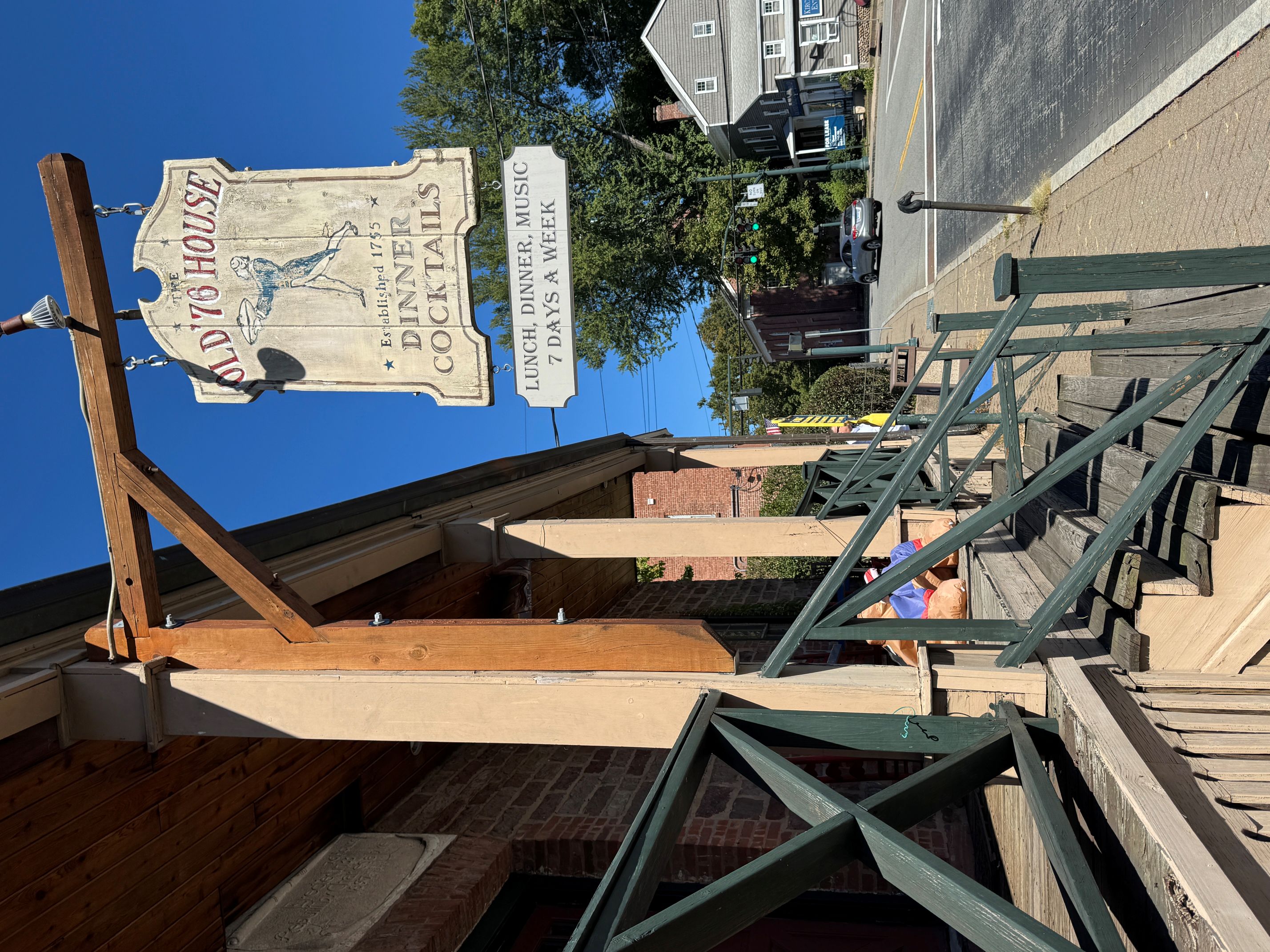 The Old '76 House (André's Prison), with the Reformed
Church of Tappan, where Major John André was tried, slightly visible in the distance.
THis street was traveled by many of the Continental Army's senior officers and
key figures during André's stay. P Marlin 2025
The Old '76 House (André's Prison), with the Reformed
Church of Tappan, where Major John André was tried, slightly visible in the distance.
THis street was traveled by many of the Continental Army's senior officers and
key figures during André's stay. P Marlin 2025
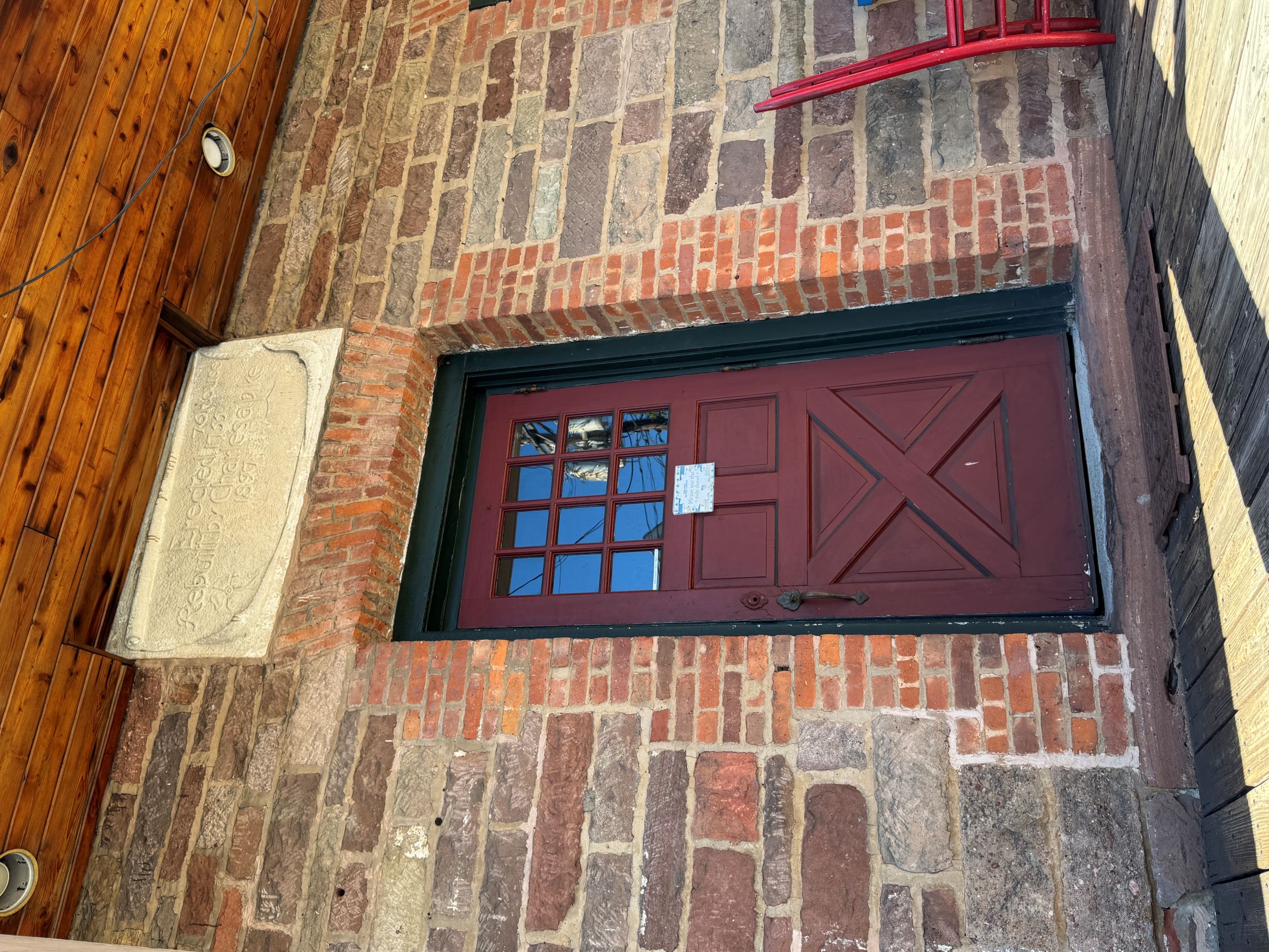 The Old '76 House (André's Prison). P Marlin 2025
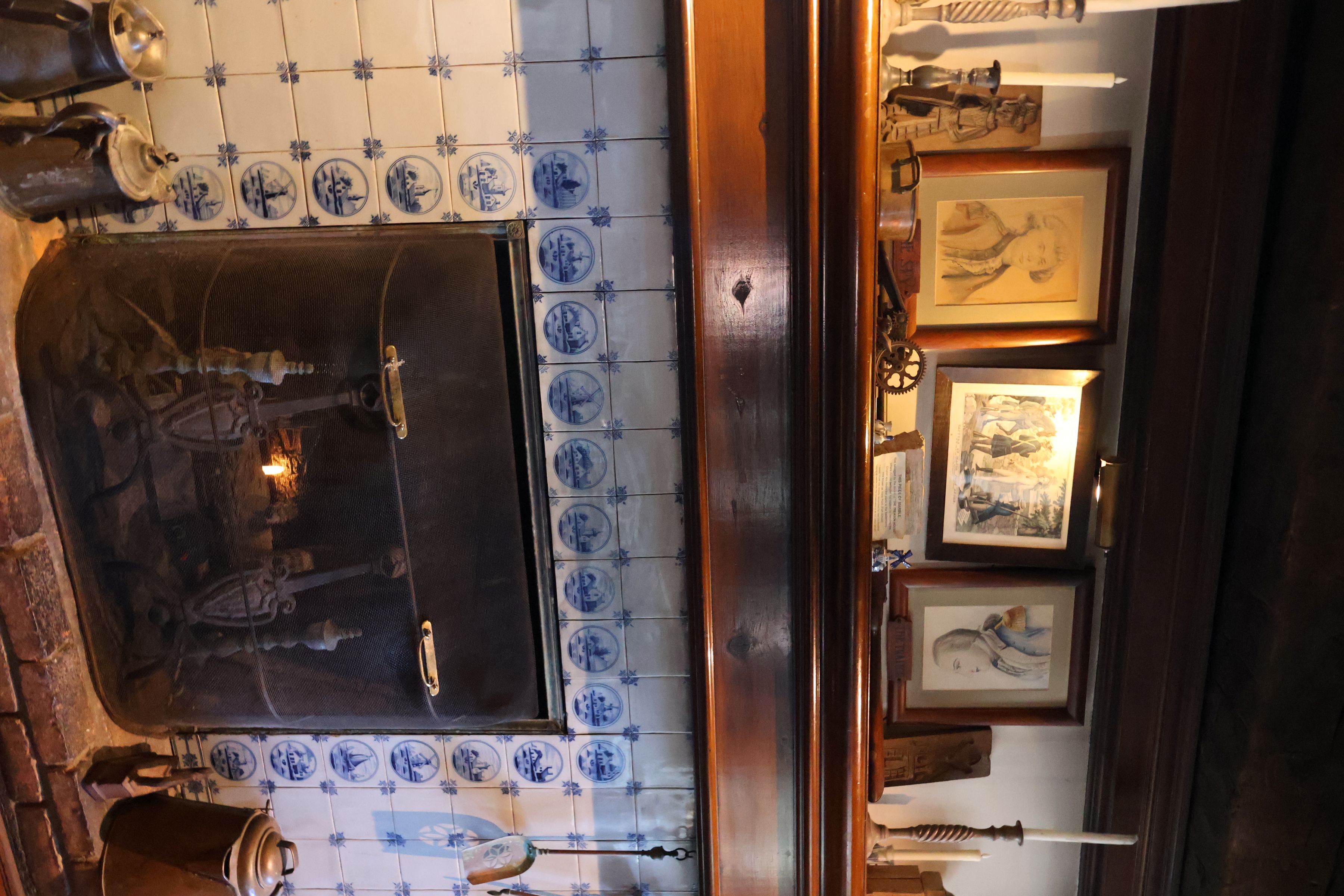 The fireplace on the west wall. The Old '76 House (André's Prison). P Marlin 2025
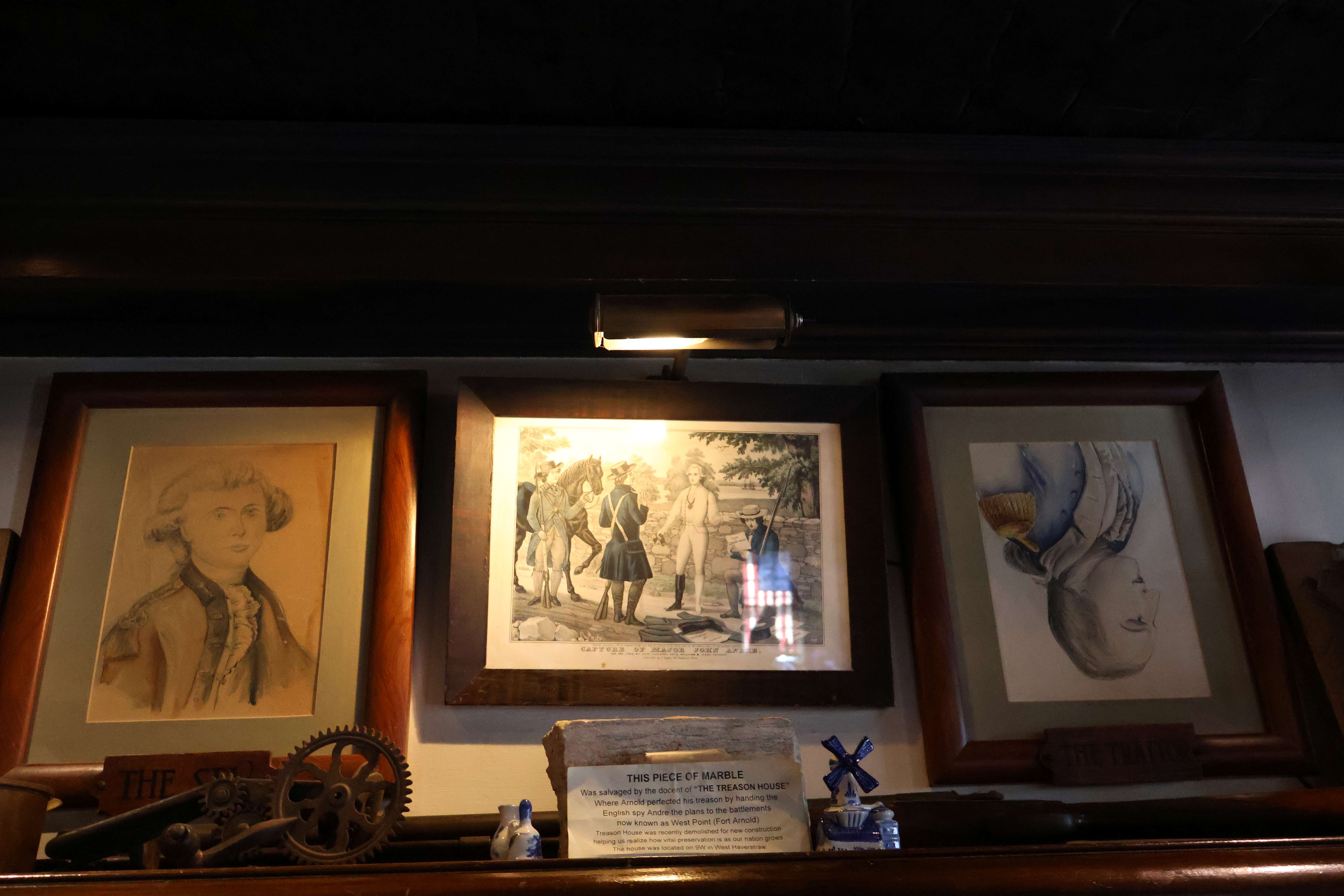 The foreplace mantle display with "The Spy" John André on
the left and the upside portrait of Benedict Arnold on the right. The Old '76 House (André's Prison).
P Marlin 2025
The foreplace mantle display with "The Spy" John André on
the left and the upside portrait of Benedict Arnold on the right. The Old '76 House (André's Prison).
P Marlin 2025
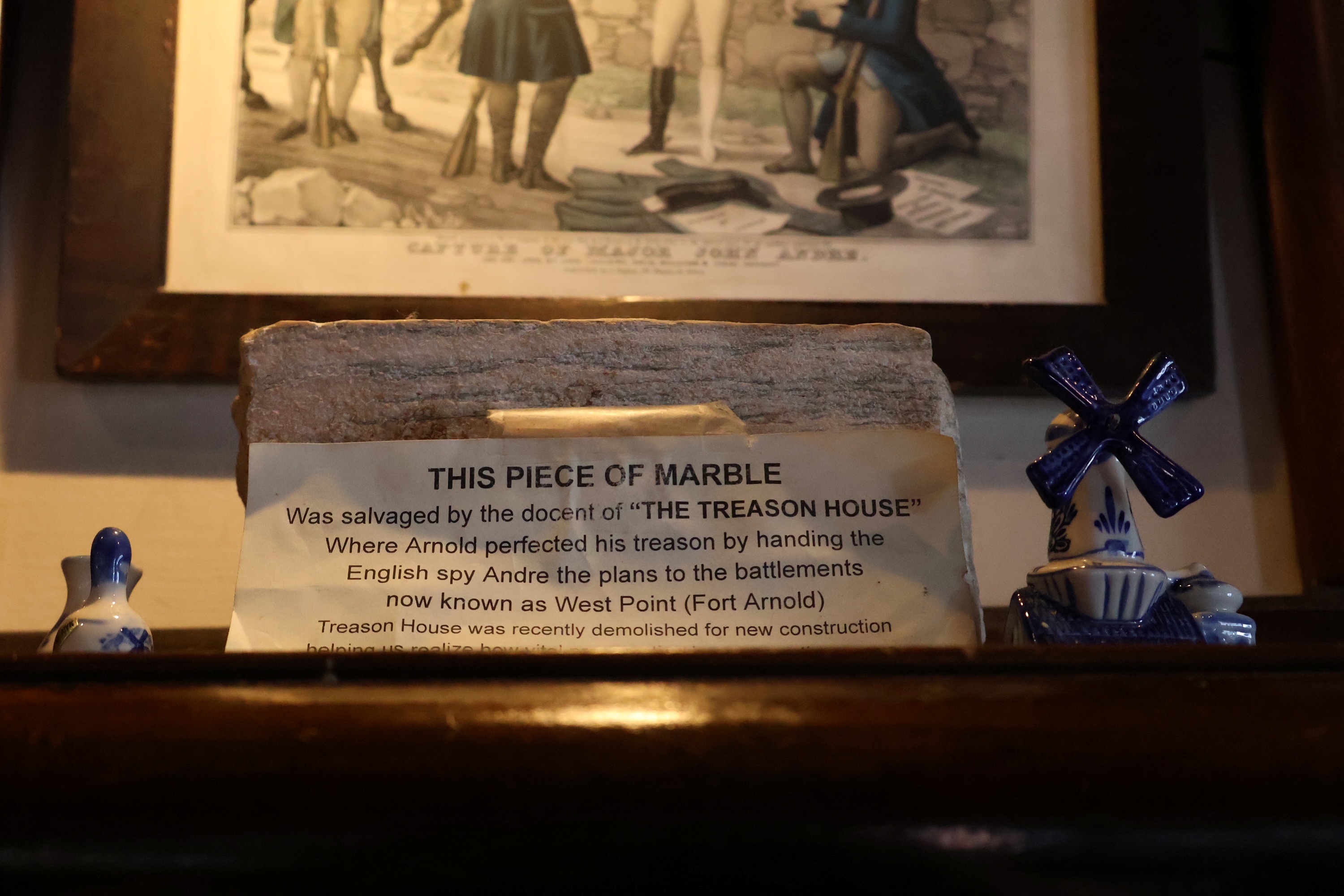 A piece of marble from the Joshua Hett Smith House (Treason House - referenced earlier)
on display in The Old '76 House (André's Prison). P Marlin 2025
A piece of marble from the Joshua Hett Smith House (Treason House - referenced earlier)
on display in The Old '76 House (André's Prison). P Marlin 2025
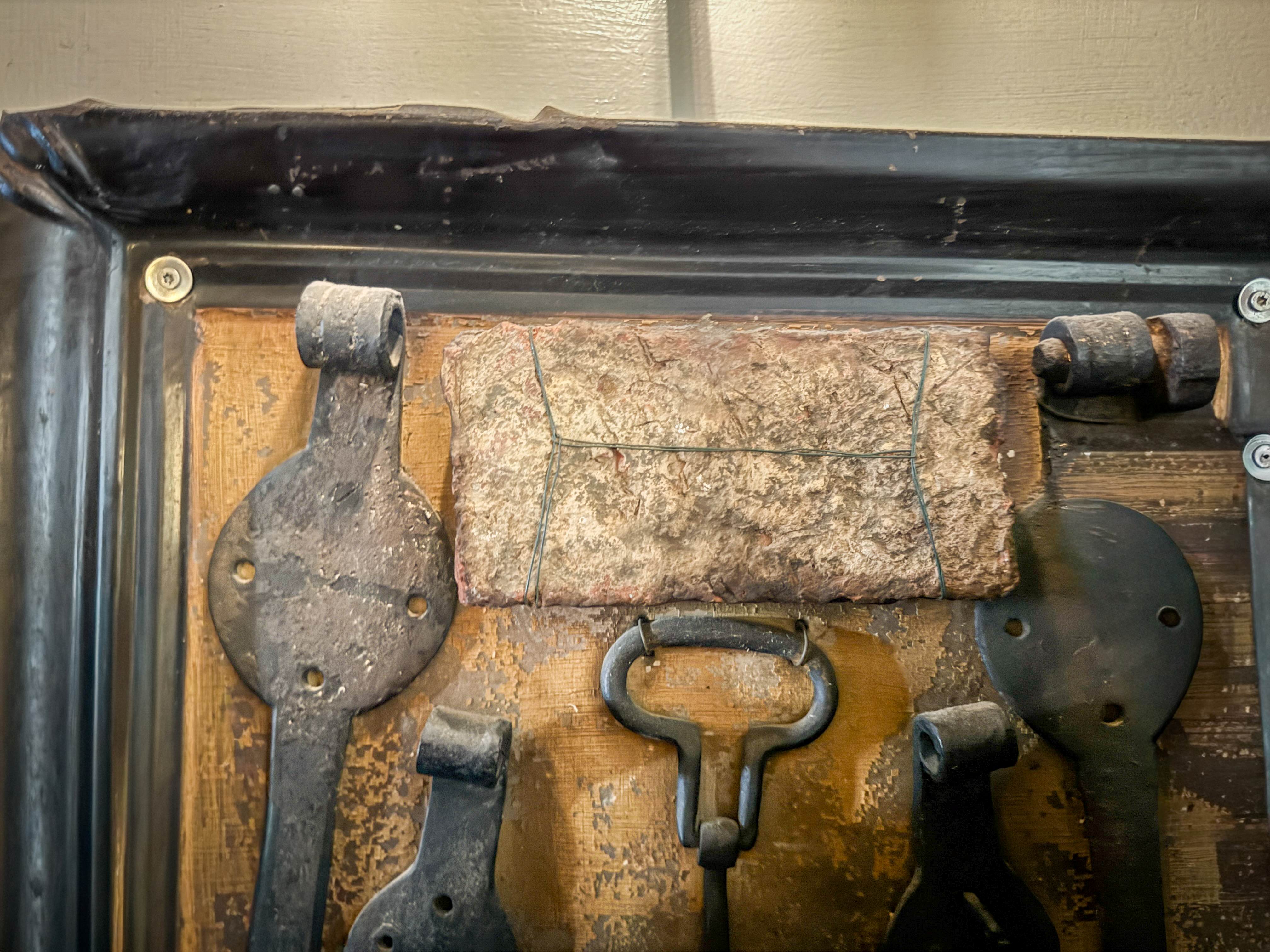 Though not labeled, maybe this display is remnants from
the original prison? The Old '76 House (André's Prison). P Marlin 2025
Though not labeled, maybe this display is remnants from
the original prison? The Old '76 House (André's Prison). P Marlin 2025
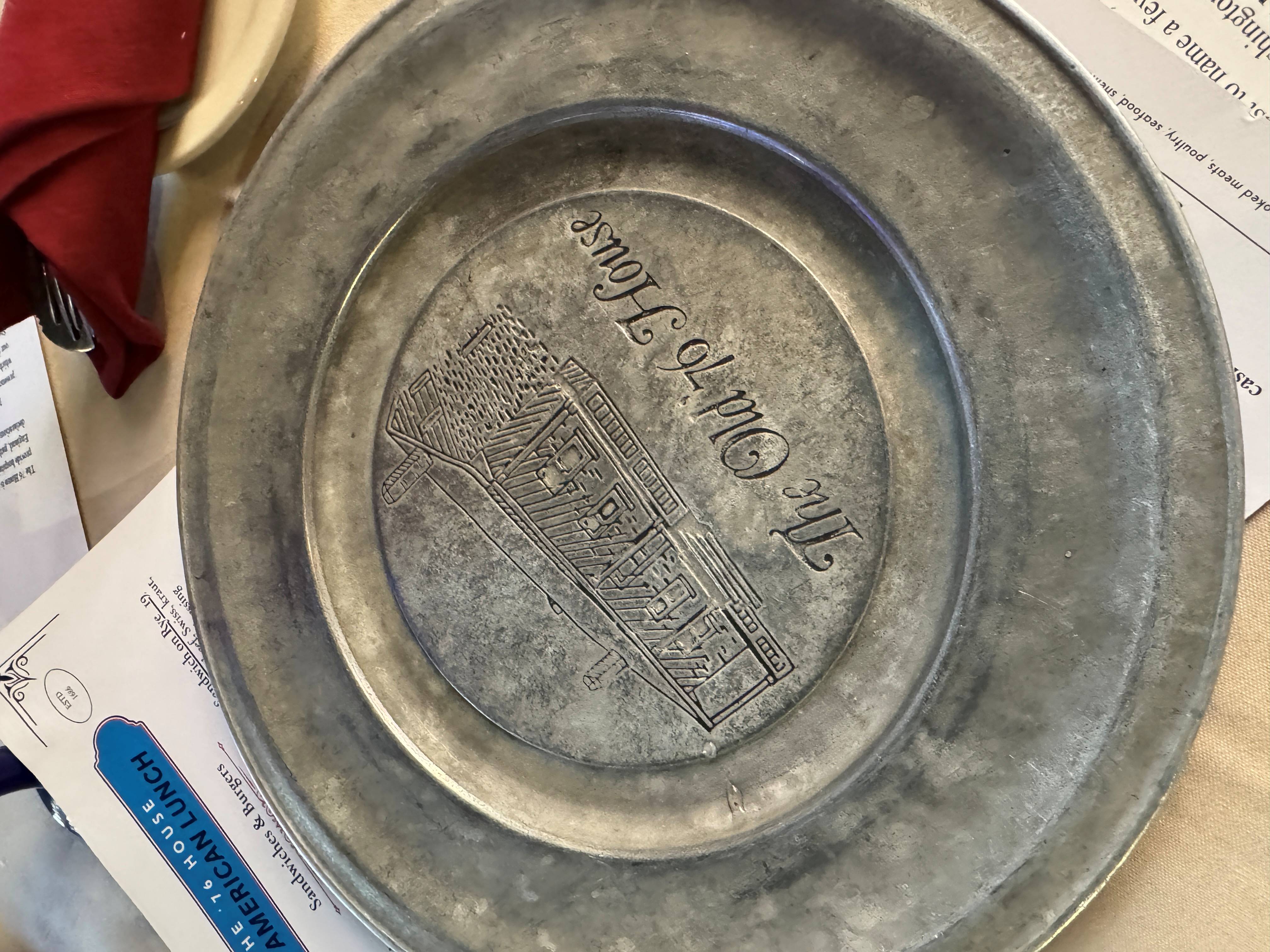 Table decor. The Old '76 House (André's Prison) in 2025. P Marlin
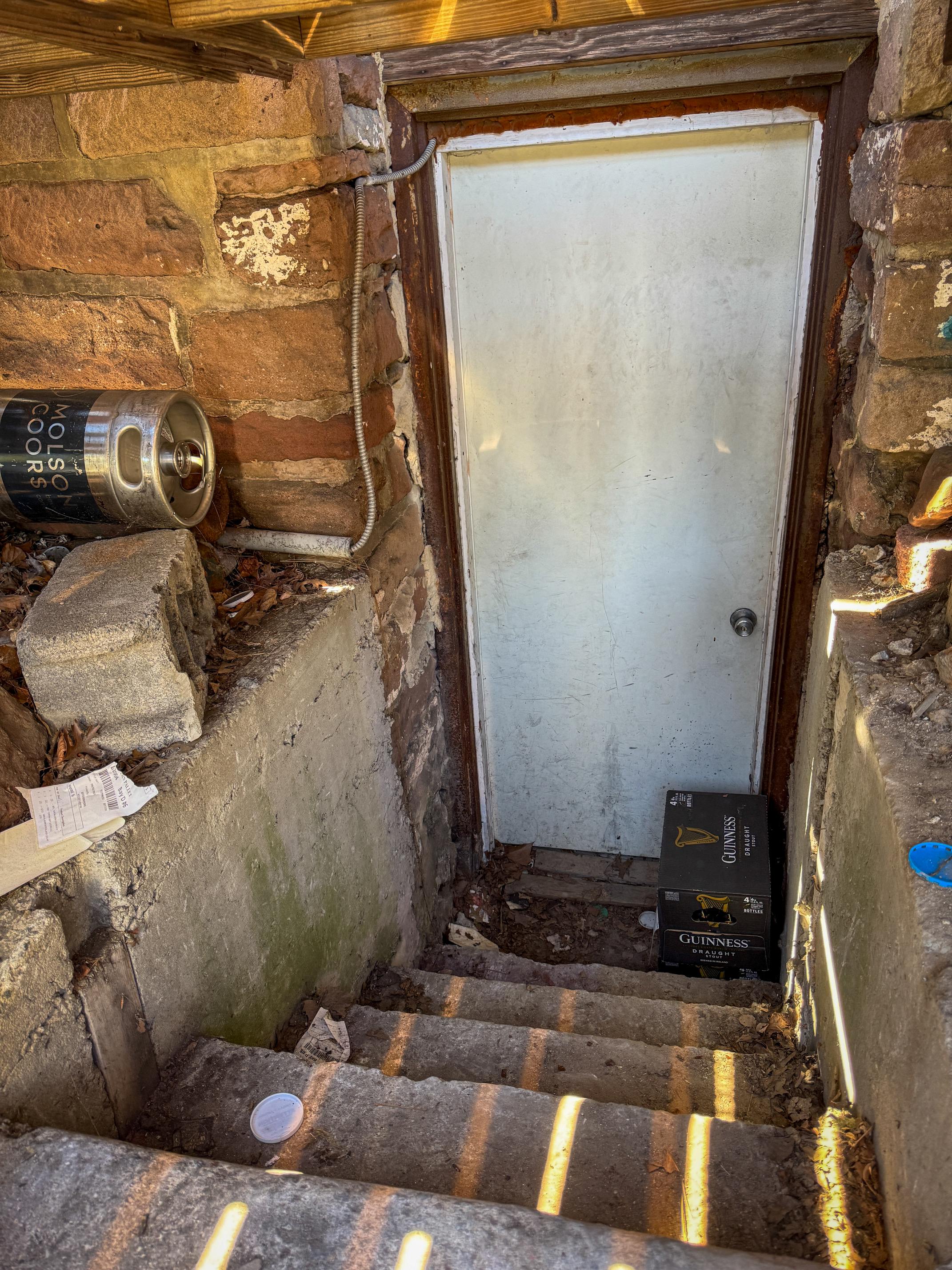 Cellar door of the Old '76 House (André's Prison). P Marlin 2025
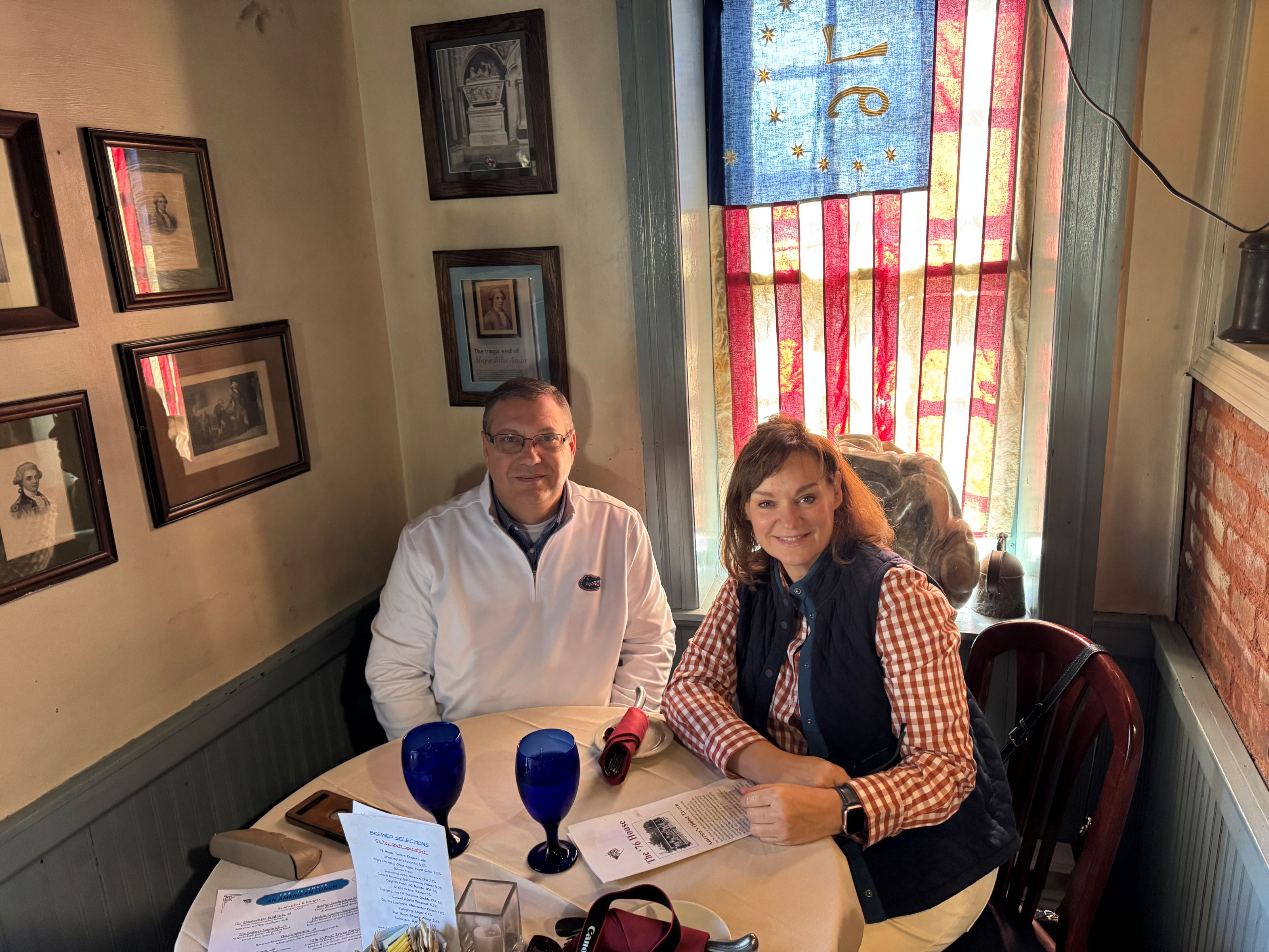 Our table ws located in the north east corner of the building,
where John André would have greated guests and wrote letters.
The Old '76 House (André's Prison). P Marlin 2025
Our table ws located in the north east corner of the building,
where John André would have greated guests and wrote letters.
The Old '76 House (André's Prison). P Marlin 2025
Built around 1700, the DeWint House located near the Old '76 House was already one of the oldest homes in the Hudson Valley when George Washington arrived in 1780. Constructed of local stone in the Dutch Colonial style, it was owned by patriot Johannes DeWint, whose family welcomed Washington on four occasions during the Revolutionary War. Today, it remains one of the finest surviving examples of early Dutch Colonial architecture in the Hudson Valley and the oldest house in Rockland County.
From September 28 through October 7, 1780, the DeWint House served as Washington's headquarters during the André crisis. Here he met with Alexander Hamilton, and other senior officers as they grappled with the consequences of Benedict Arnold's treason. Although Washington acknowledged Major André's courage, he denied the British officer's request to die before a firing squad, approved the sentence required under the laws of war for a captured spy, and signed André's death warrant in the DeWint House.
The South Room of the house still retains its original wide pine floorboards, worn smooth by more than three centuries of footsteps. It requires little imagination to picture Washington and his commanders crossing those same boards as they debated one of the most difficult decisions of the Revolution. Standing in this room today, it is easy to appreciate the burden Washington must have carried during one of the darkest moments of the Revolutionary War.
Adjacent to the DeWint House, the historic carriage house serves as a small museum. Its exhibits display artifacts uncovered during archaeological excavations, including fragments of porcelain, pottery, glass, and other household items used by the DeWint family, alongside exhibits interpreting George Washington's headquarters and the dramatic events surrounding Benedict Arnold's treason and Major John André's final days.
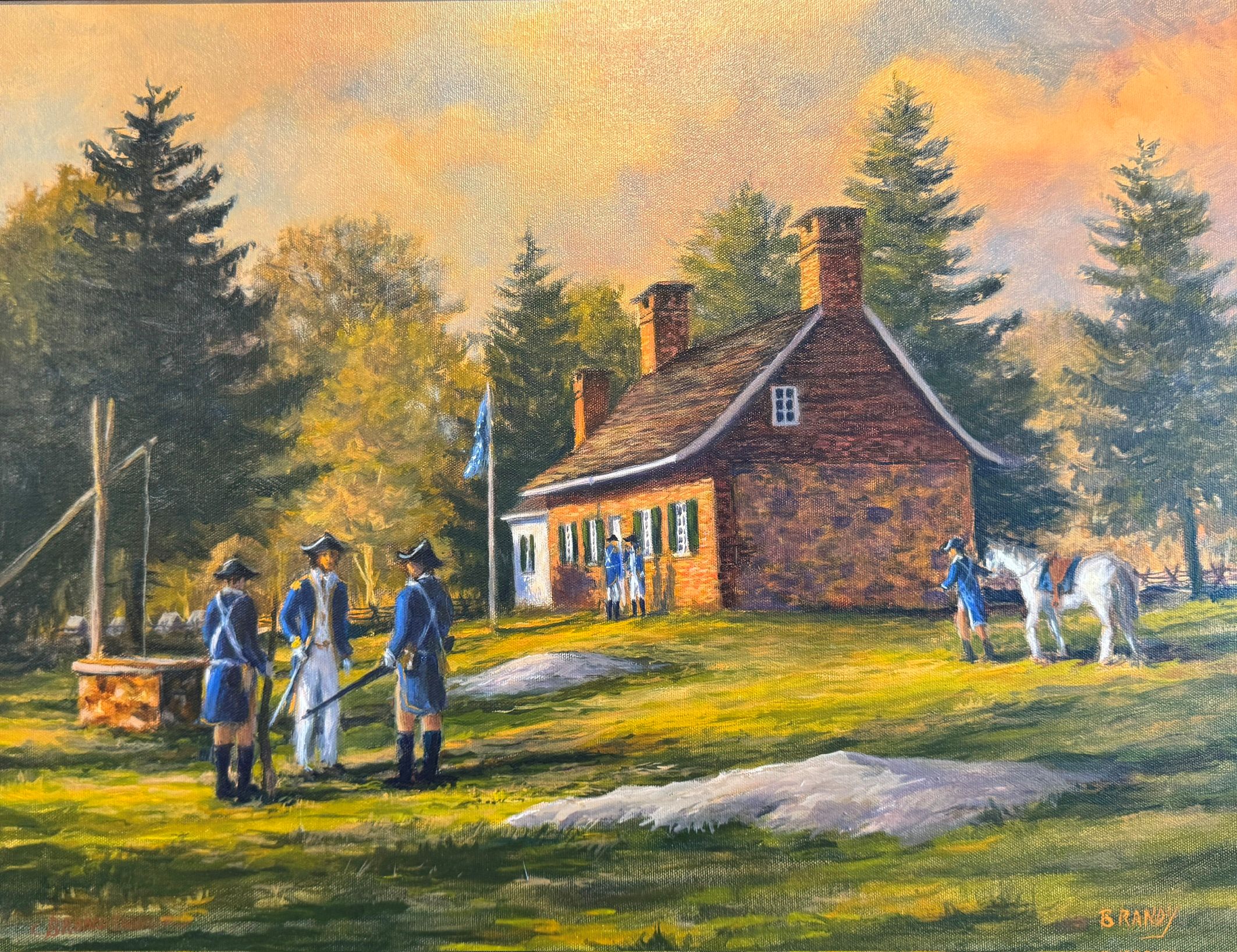 A colonial painting of the DeWint House in the DeWint house museum. P Marlin
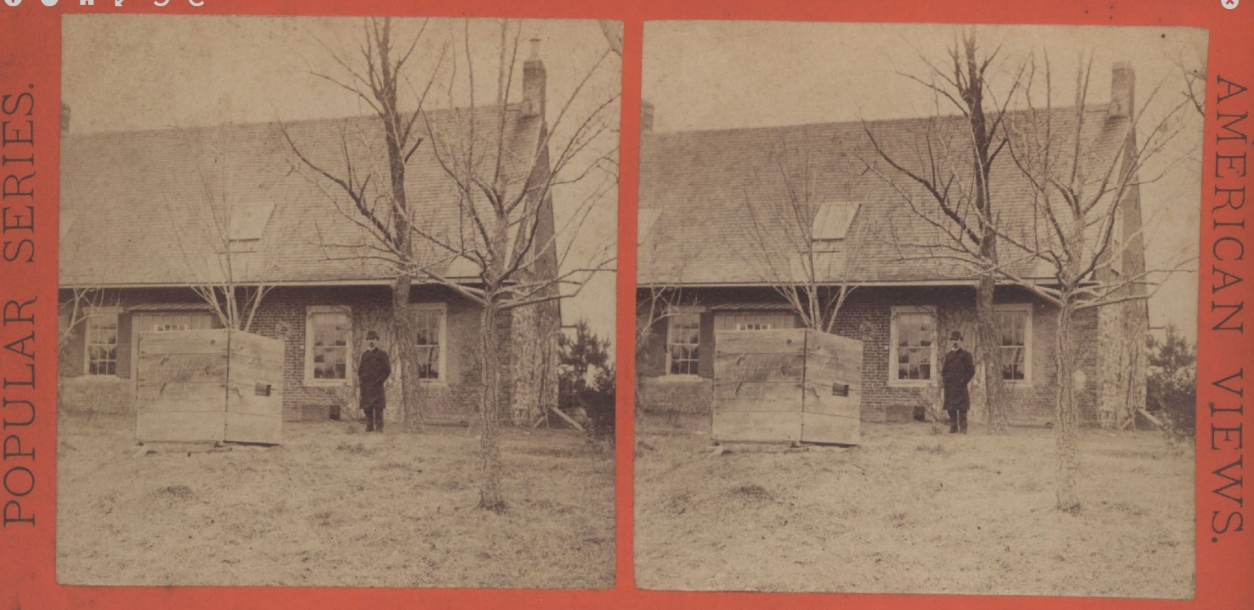 The DeWint House in 1876 (?).
New York Digital Collections
The DeWint House in 1876 (?).
New York Digital Collections
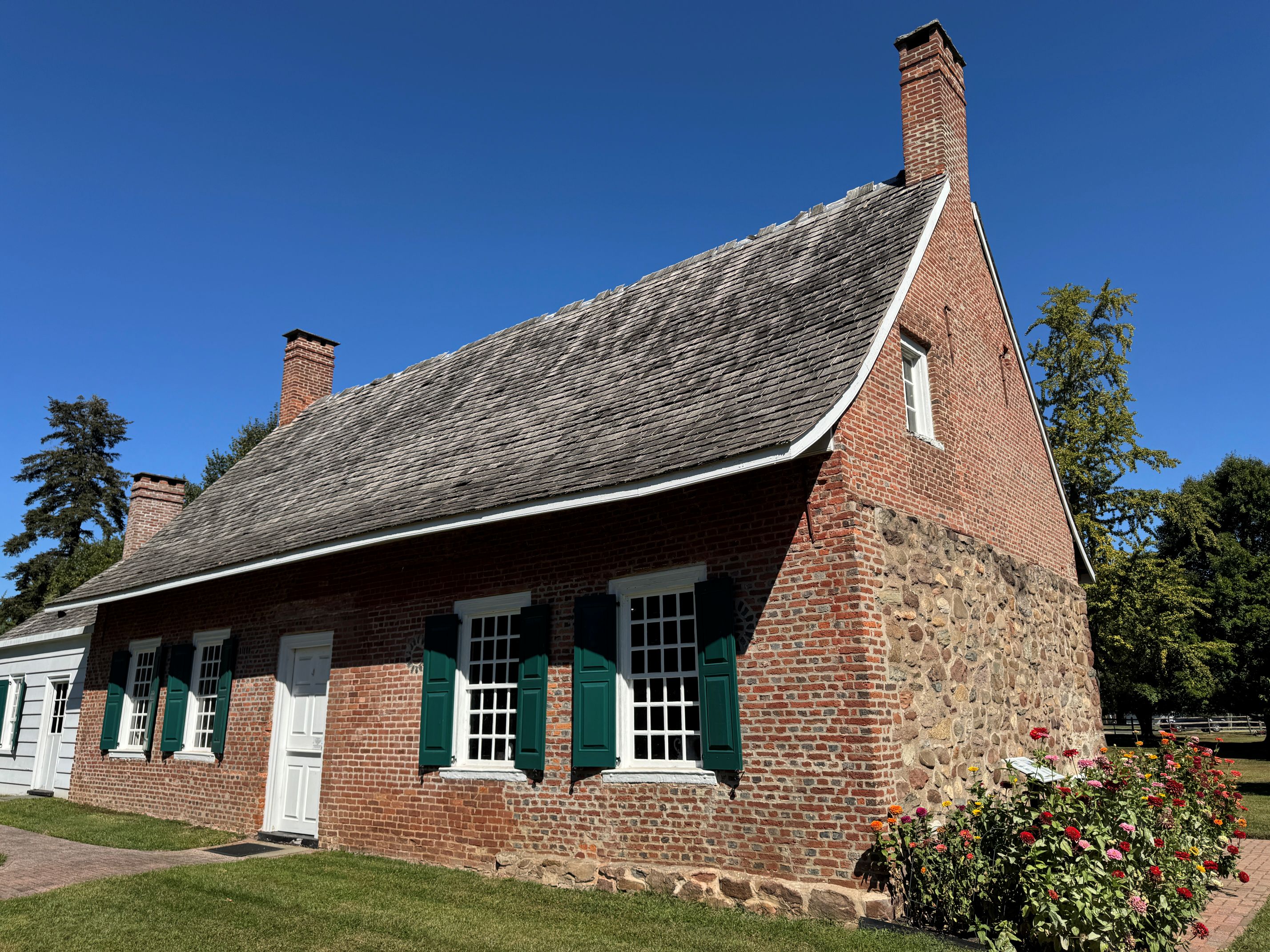 The DeWint House. P Marlin
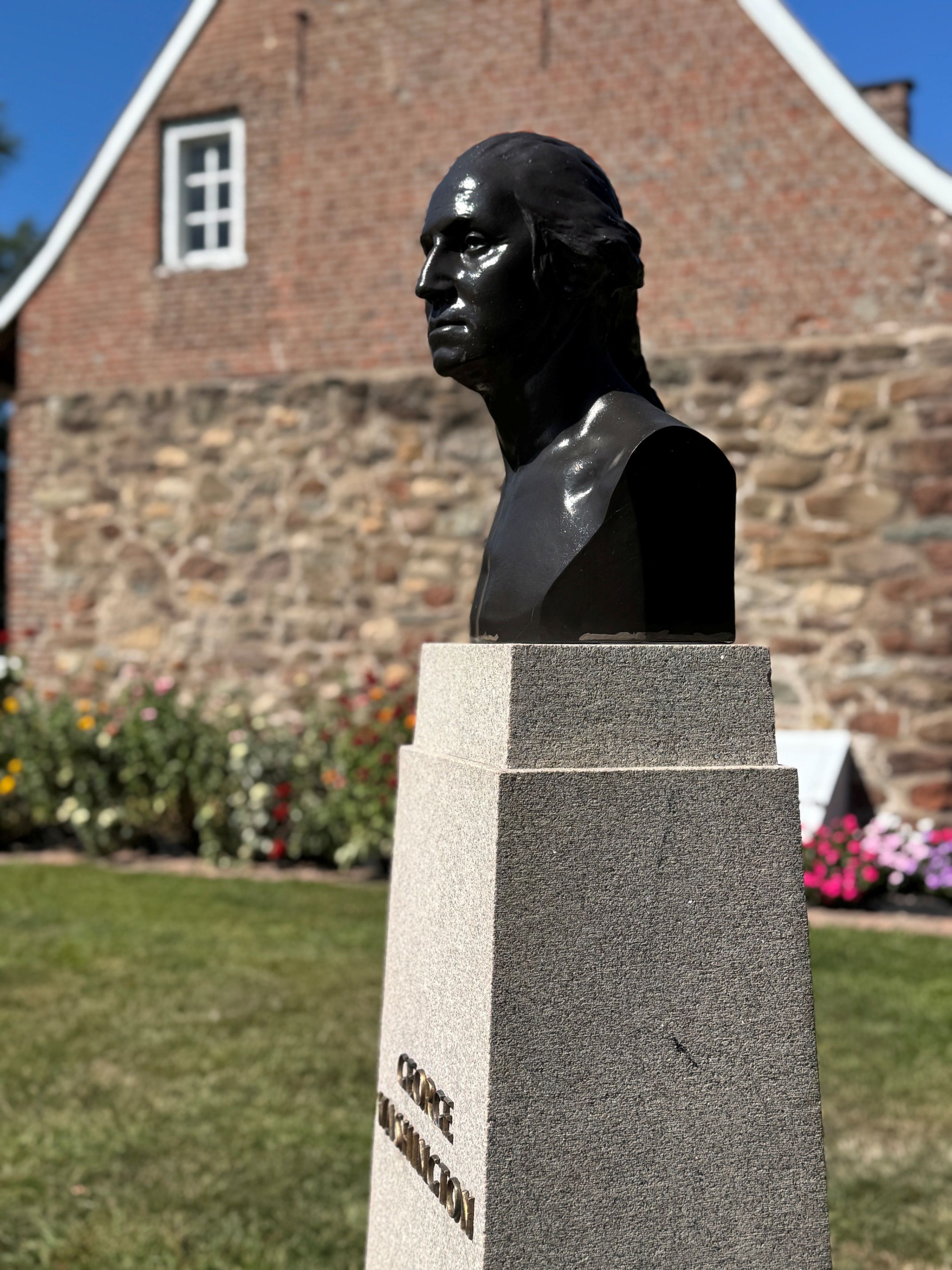 The DeWint House. P Marlin
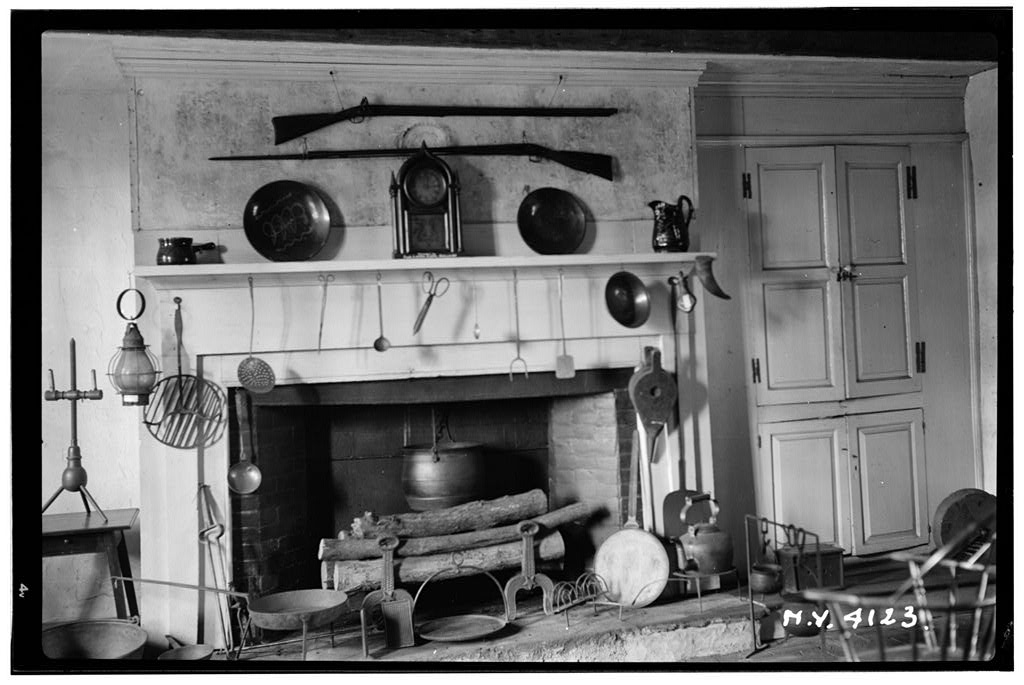 The Kitchen of the DeWint House in 1936.
Library of Congress
The Kitchen of the DeWint House in 1936.
Library of Congress
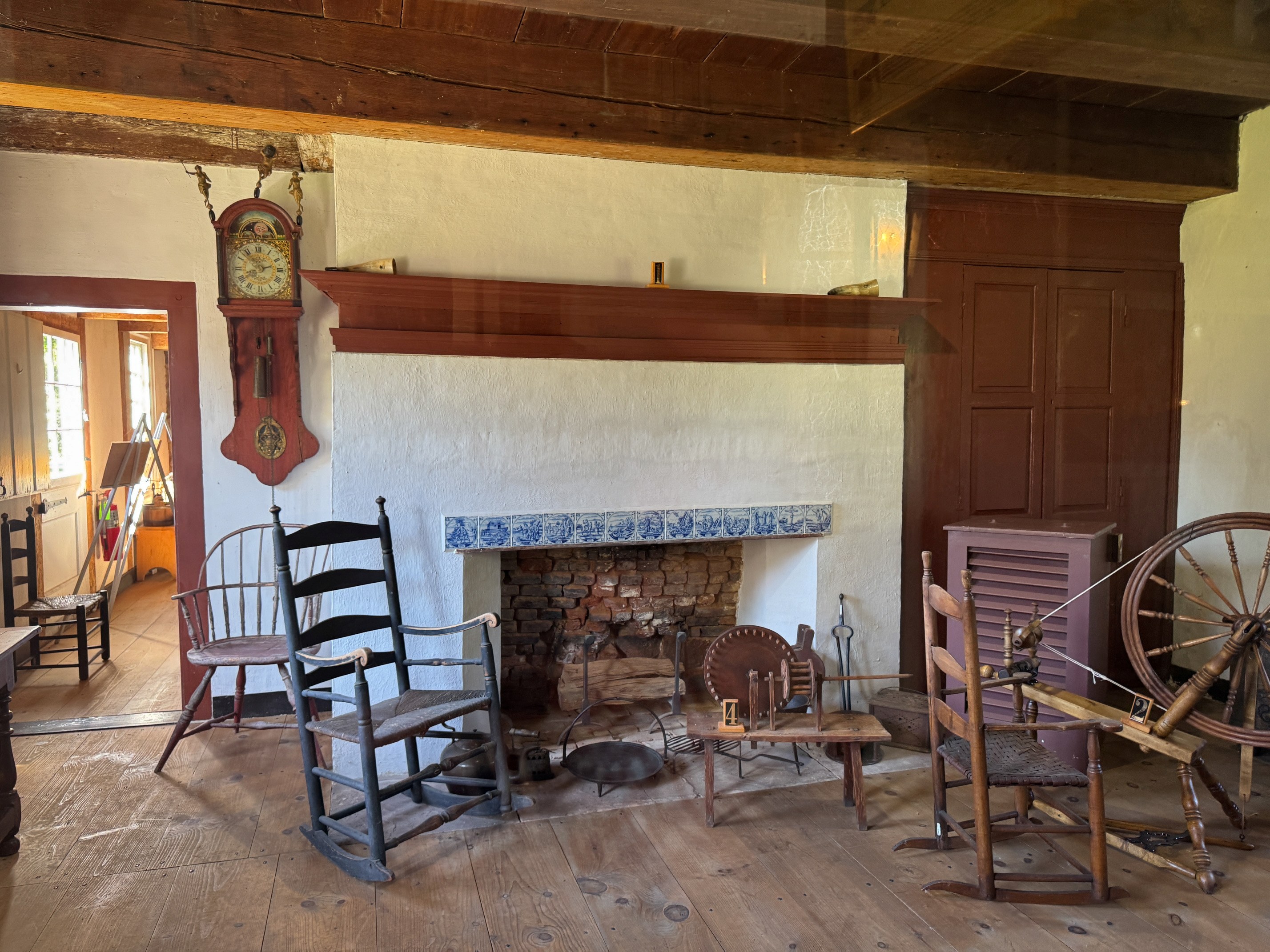 The Kitchen of the the DeWint House in 2025. P Marlin
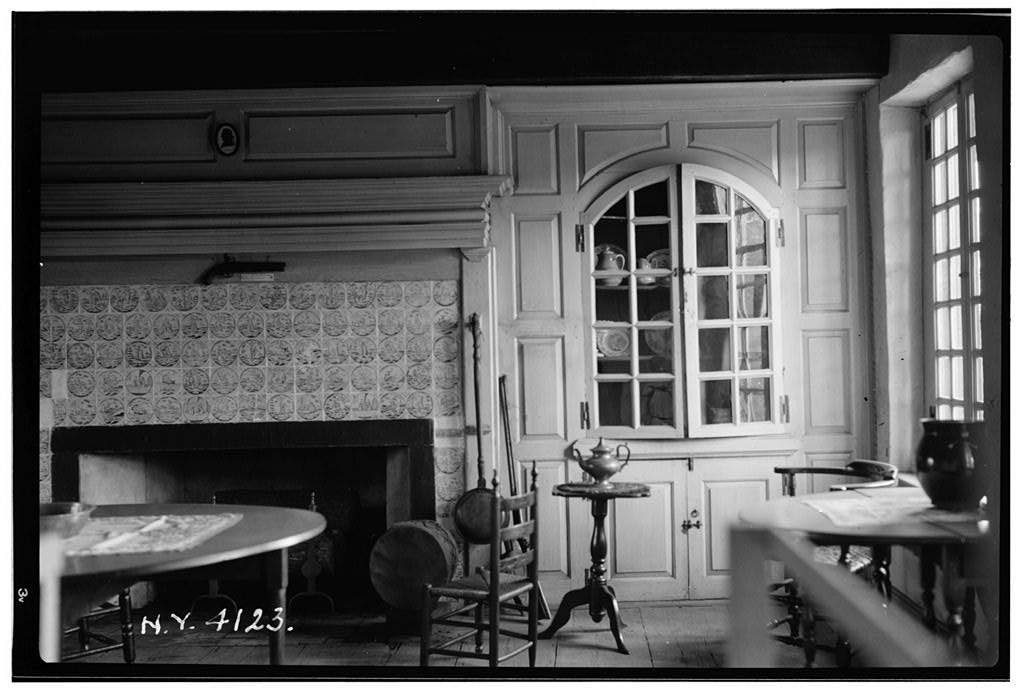 The South Room of the DeWint House in 1936.
Library of Congress
The South Room of the DeWint House in 1936.
Library of Congress
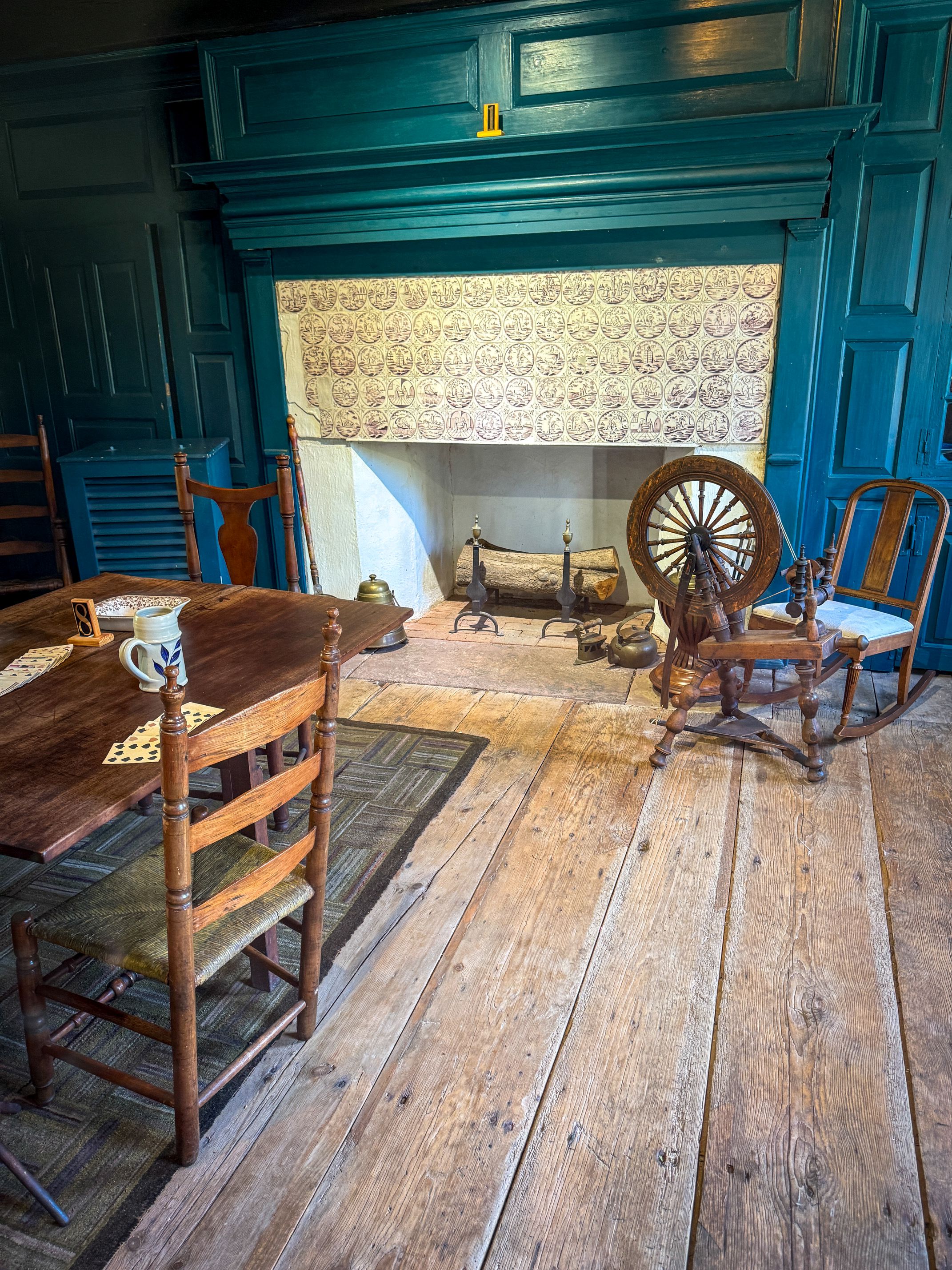
 The South Room of the DeWint House in 2025. This room saw most
of the activity when Washington was in residence. P Marlin 2025
The South Room of the DeWint House in 2025. This room saw most
of the activity when Washington was in residence. P Marlin 2025
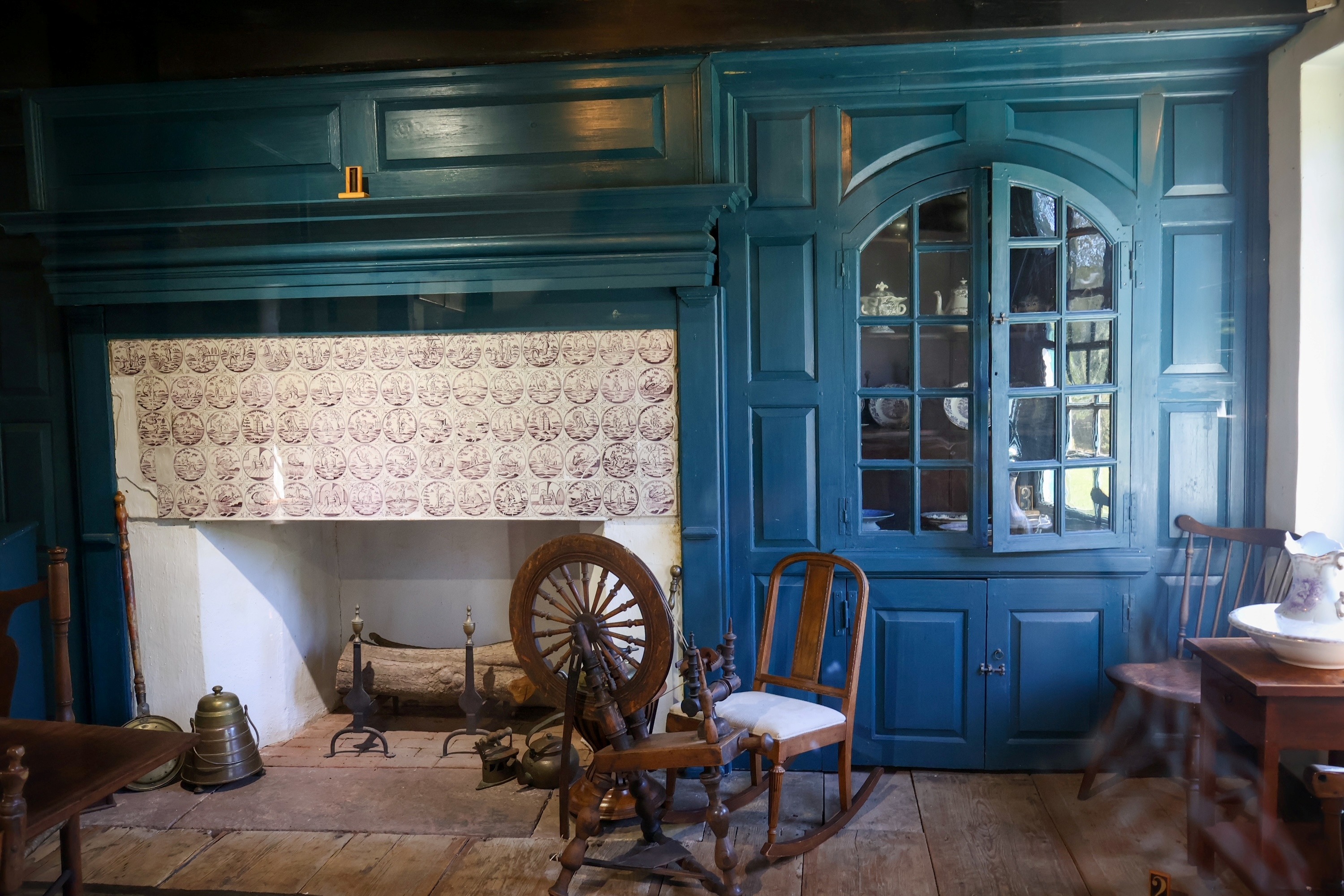
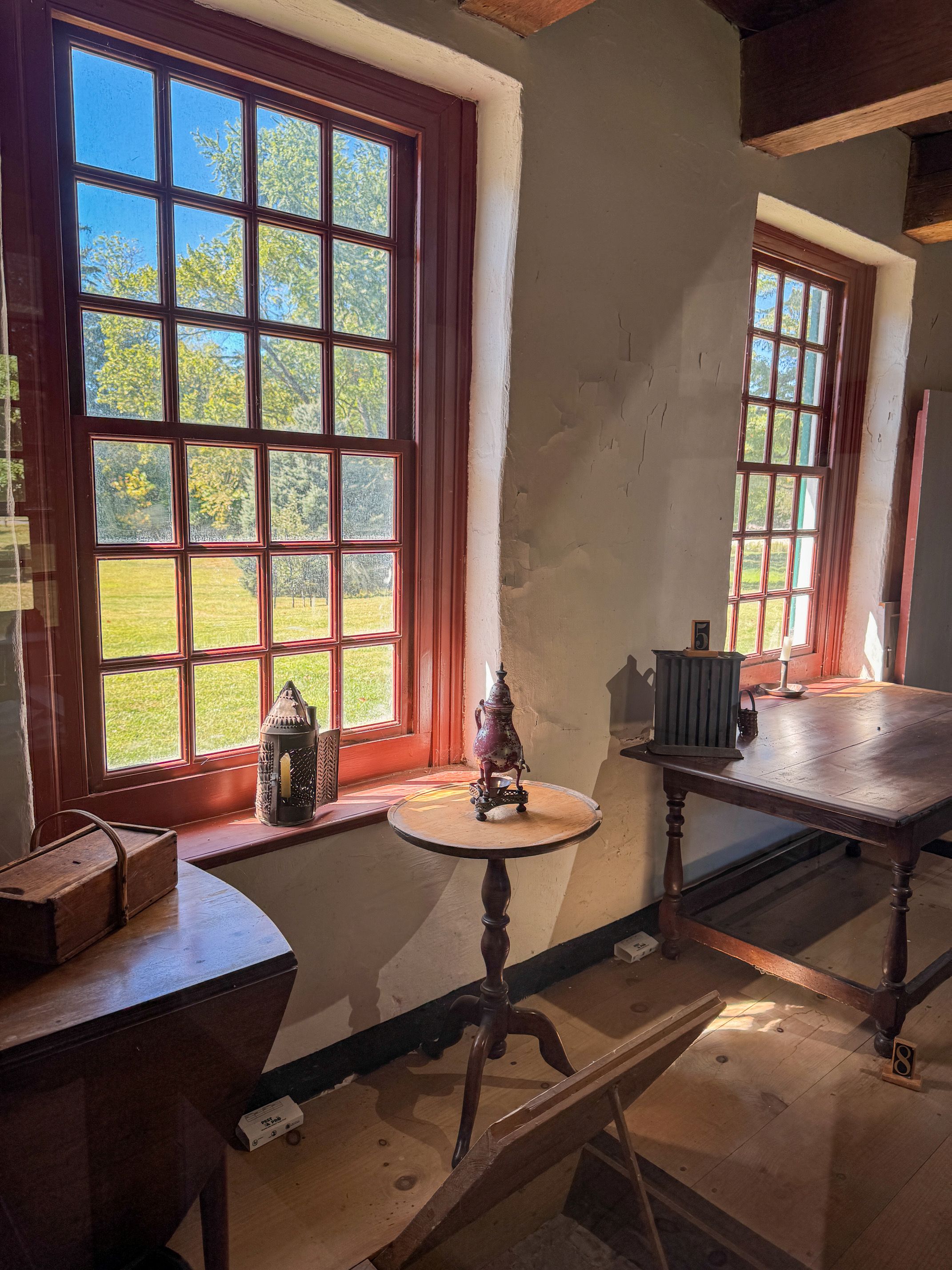 The South Room of the DeWint House. P Marlin 2025
 A close up of the floorboards of the DeWint House's South Room. P Marlin 2025
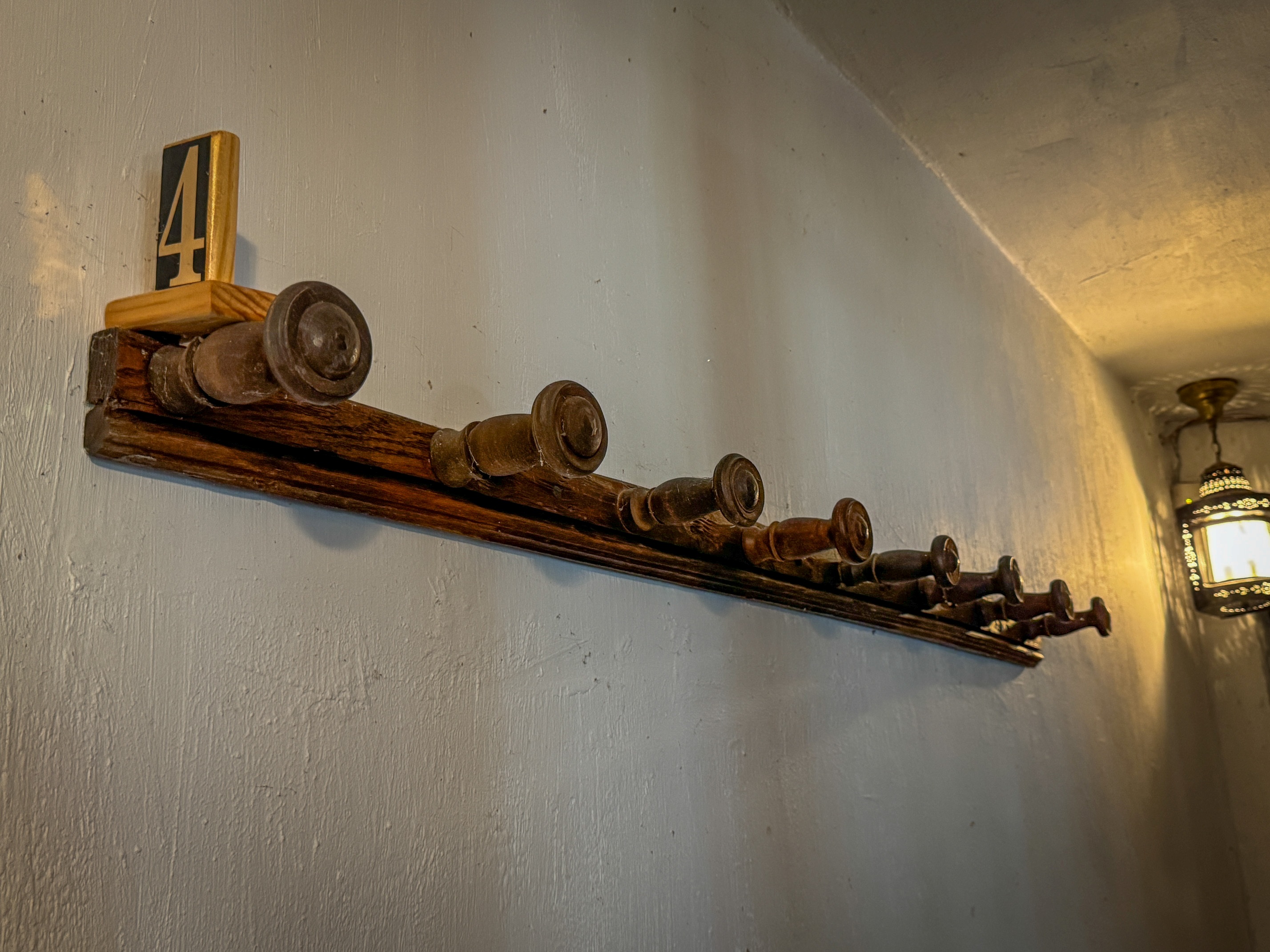 According to the DeWint House history, this rack has hung in the
hallway of the DeWint house since George Washington was in residence. P Marlin 2025
According to the DeWint House history, this rack has hung in the
hallway of the DeWint house since George Washington was in residence. P Marlin 2025
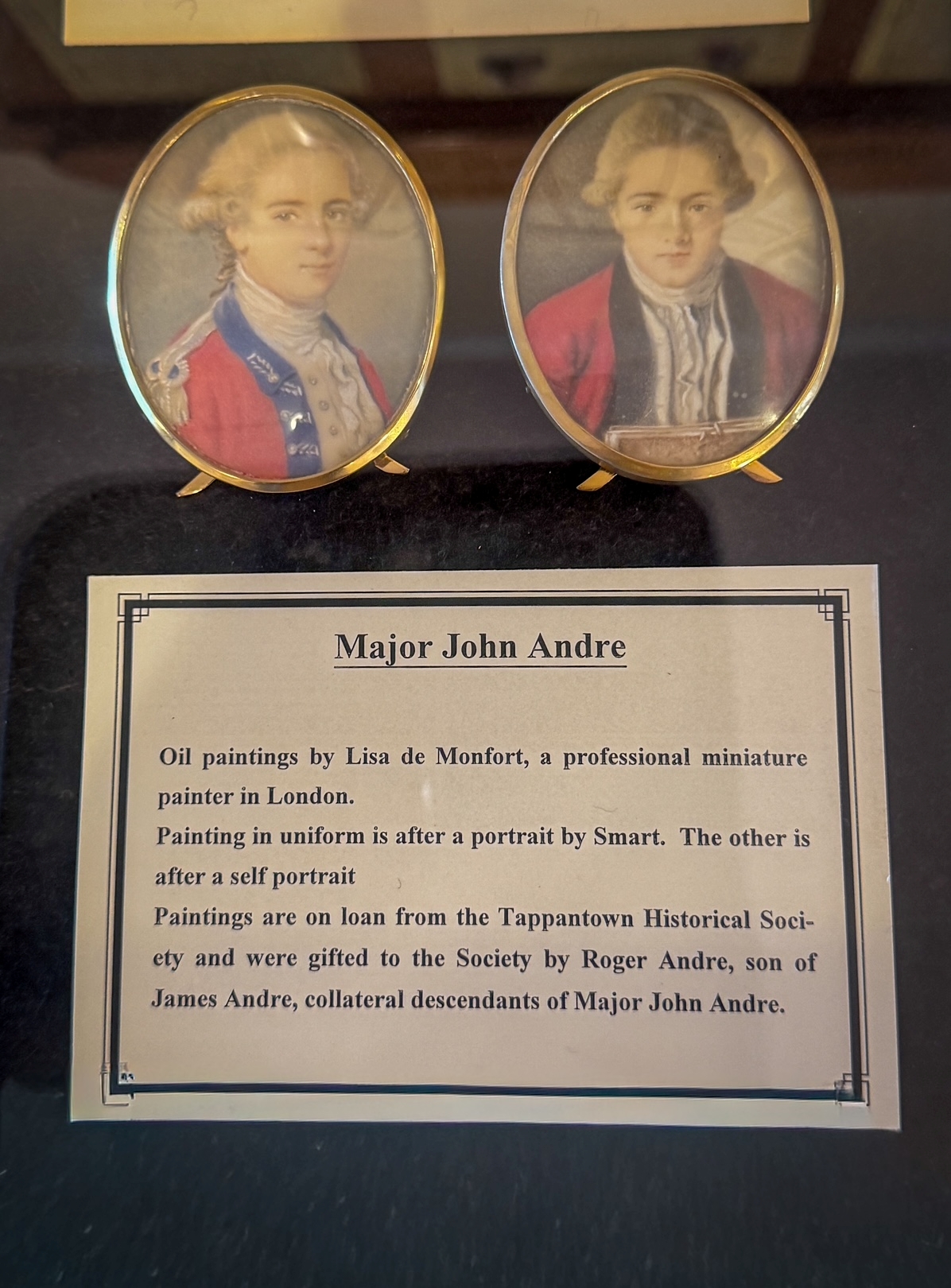 The DeWint House museum display. P Marlin 2025
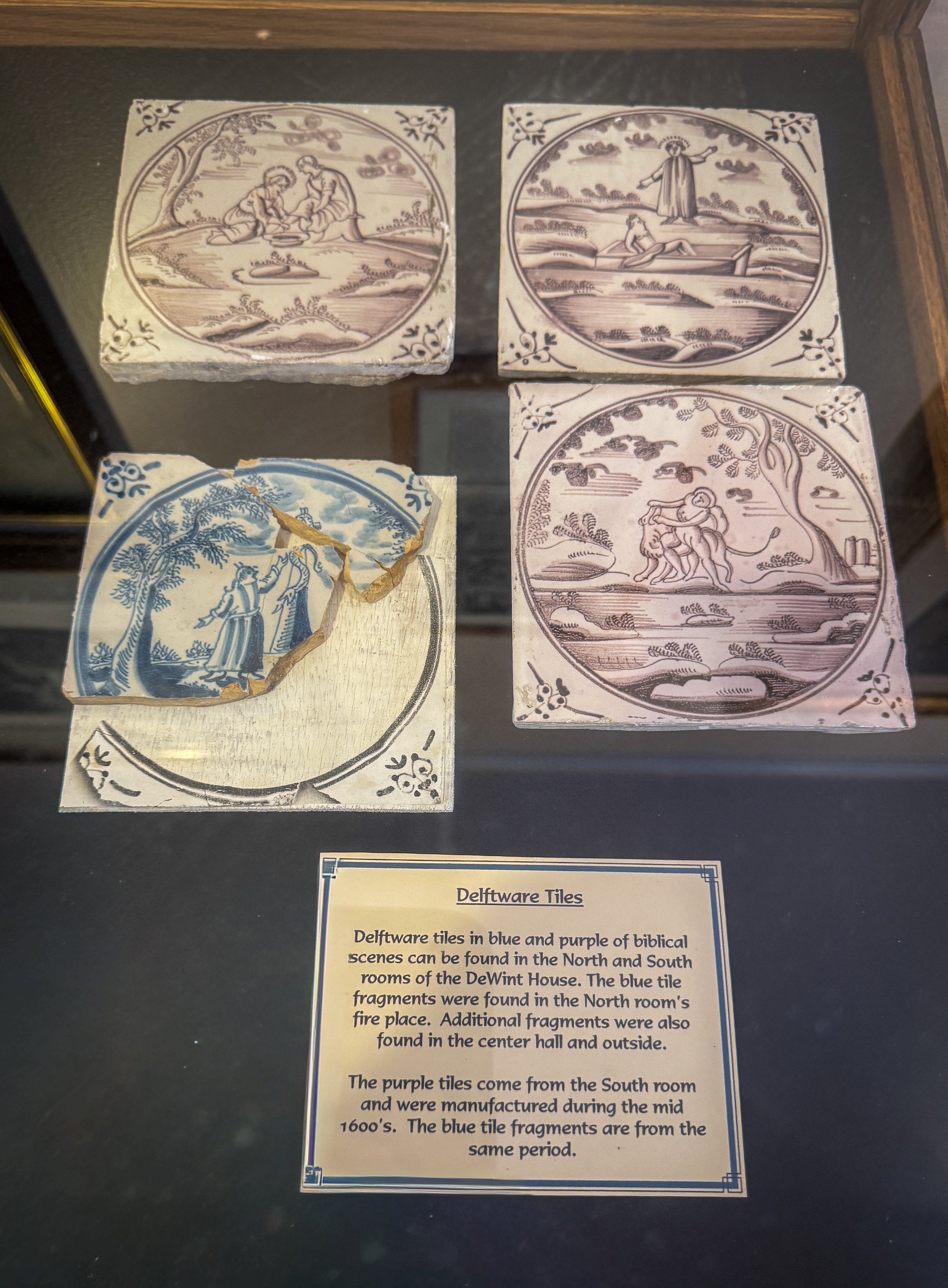 The DeWint House museum display. P Marlin 2025
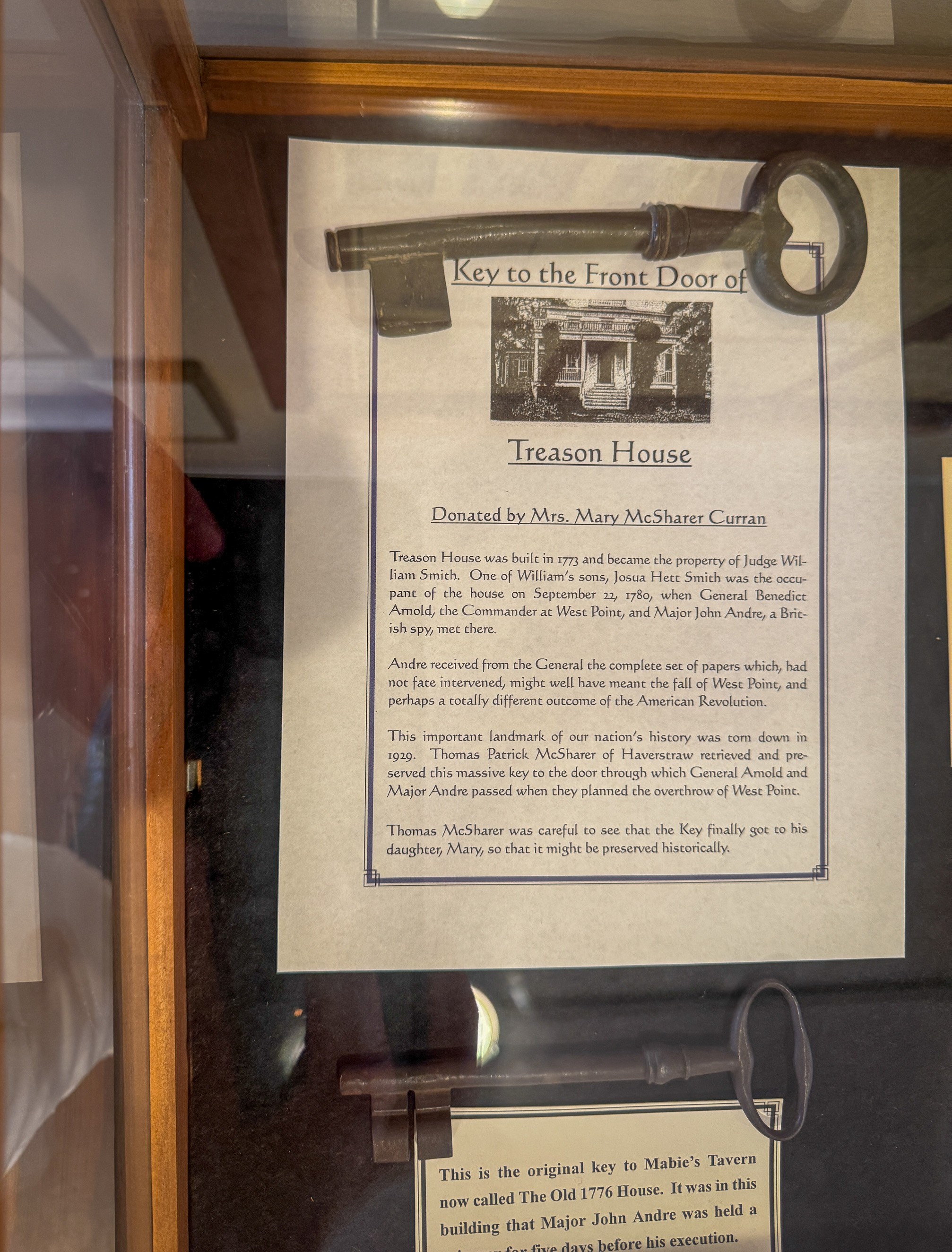 The DeWint House museum display of the origin keys of the Treason House and
the Mabie House Tavern. P Marlin 2025
The DeWint House museum display of the origin keys of the Treason House and
the Mabie House Tavern. P Marlin 2025
Only a short walk from both the Old '76 House and the DeWint House stands the Reformed Church of Tappan, one of the oldest congregations in New York. Although the present Federal-style church dates to 1835, it occupies the site of the original stone church built in 1716. That earlier building became one of the most important locations in Revolutionary War history, serving at various times as a military hospital, prison, and, most famously, the site of Major John André's military trial. Today, the church and surrounding cemetery remain contributing landmarks within the Tappan Historic District.
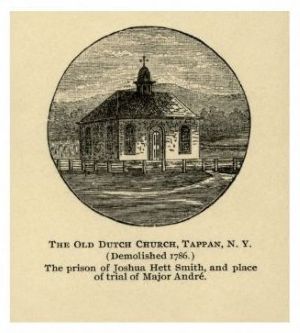 On September 29, 1780, a board of senior Continental Army officers
assembled inside the church to determine André's status under the laws of war.
Presided over by Major General Nathanael Greene, the board included many of Washington's
most trusted commanders, among them the Marquis de Lafayette, Henry Knox, Baron von Steuben,
Arthur St. Clair, and Benjamin Lincoln. Although Washington ordered the proceedings,
he deliberately stayed away, determined that the verdict would be reached independently
by his officers rather than influenced by his personal wishes.
On September 29, 1780, a board of senior Continental Army officers
assembled inside the church to determine André's status under the laws of war.
Presided over by Major General Nathanael Greene, the board included many of Washington's
most trusted commanders, among them the Marquis de Lafayette, Henry Knox, Baron von Steuben,
Arthur St. Clair, and Benjamin Lincoln. Although Washington ordered the proceedings,
he deliberately stayed away, determined that the verdict would be reached independently
by his officers rather than influenced by his personal wishes.
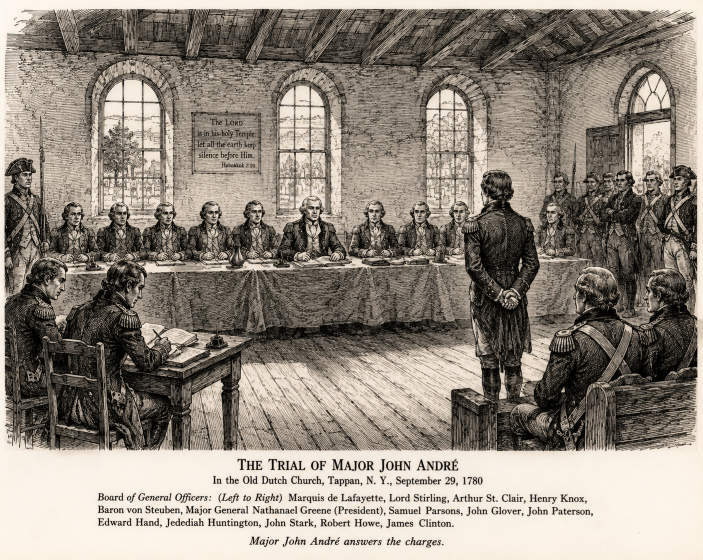 A depiction of the trial proceedings.
The surviving transcript reveals a proceeding that was remarkably brief, respectful, and professional. André openly acknowledged that he had entered American lines under an assumed name, traveled in civilian clothing, carried incriminating papers concealed in his boots, and intended to return to the British army with the information. He emphasized that he had acted under orders and had never intended to disguise himself until circumstances beyond his control forced him to travel overland. After carefully considering the evidence, the board unanimously concluded that André had acted as a spy "agreeably to the law and usage of nations" and therefore ought to suffer death. Washington approved the sentence at the nearby DeWint House several days later.
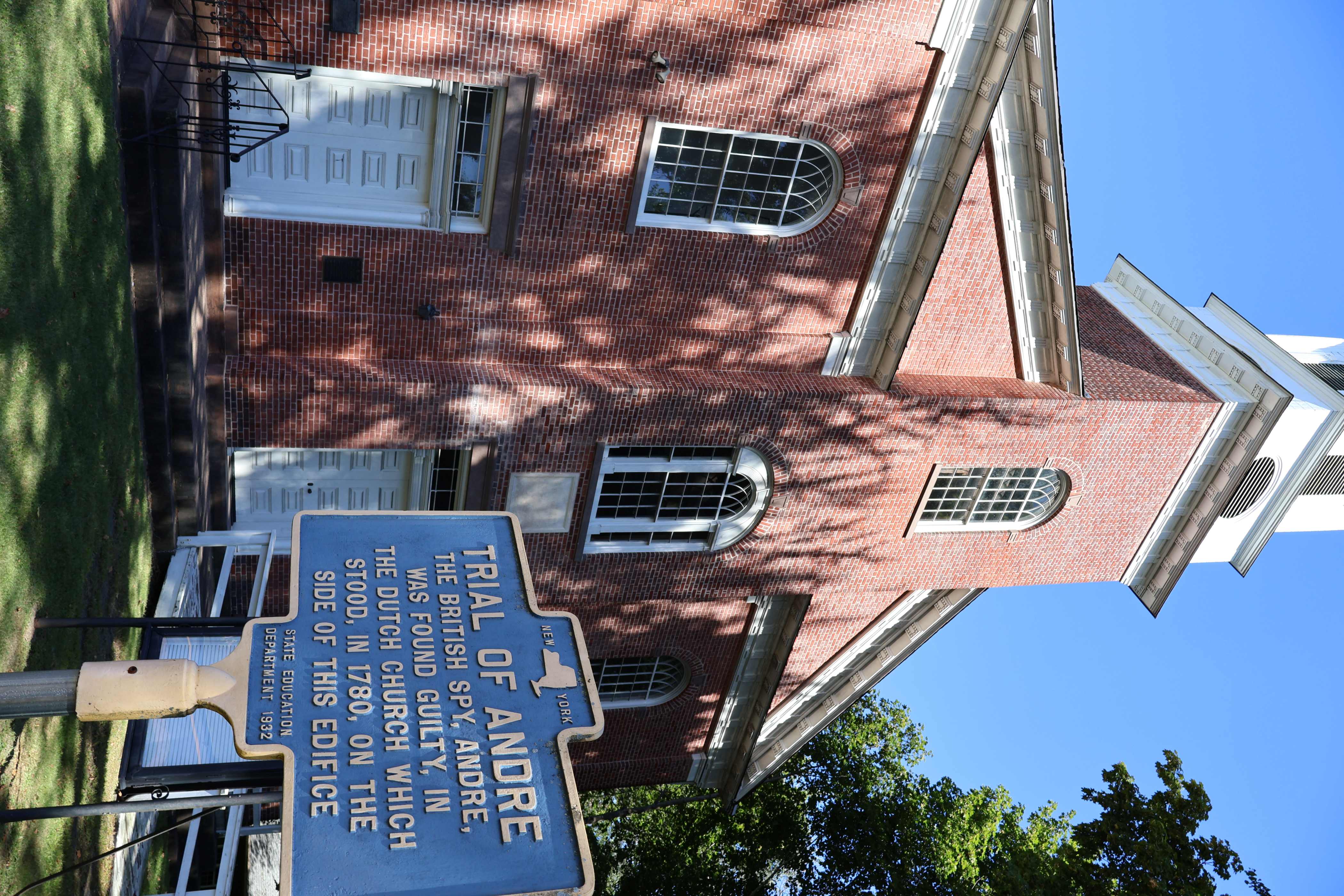 Reformed Church of Tappan. P Marlin 2025
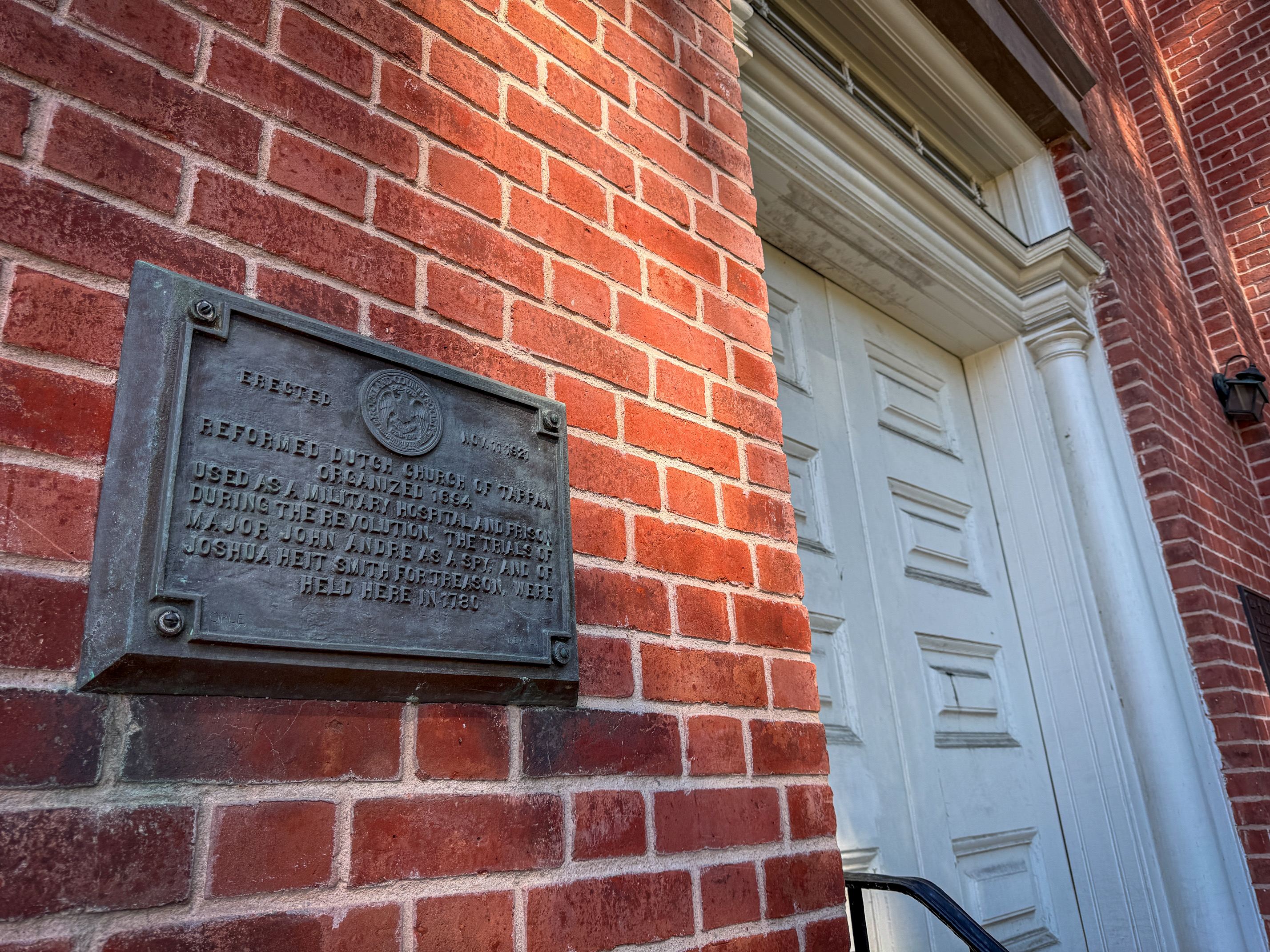 Reformed Church of Tappan. P Marlin 2025
On the morning of October 2, André's servant, Peter Laune, helped him dress one final time in the elegant uniform of a British staff officer, a scarlet coat trimmed with gold lace and green facings, worn over a buff waistcoat and matching knee breeches. As Laune completed his master's attire, he broke down in tears. André admonished him to "show yourself more manly." Moments later, André stepped through the doorway of the old stone house, arm in arm with two American officers, and began the short walk toward the execution ground. The building behind him would forever be remembered not simply as a colonial tavern, but as the prison from which one of the Revolutionary War's most tragic figures took his final steps.
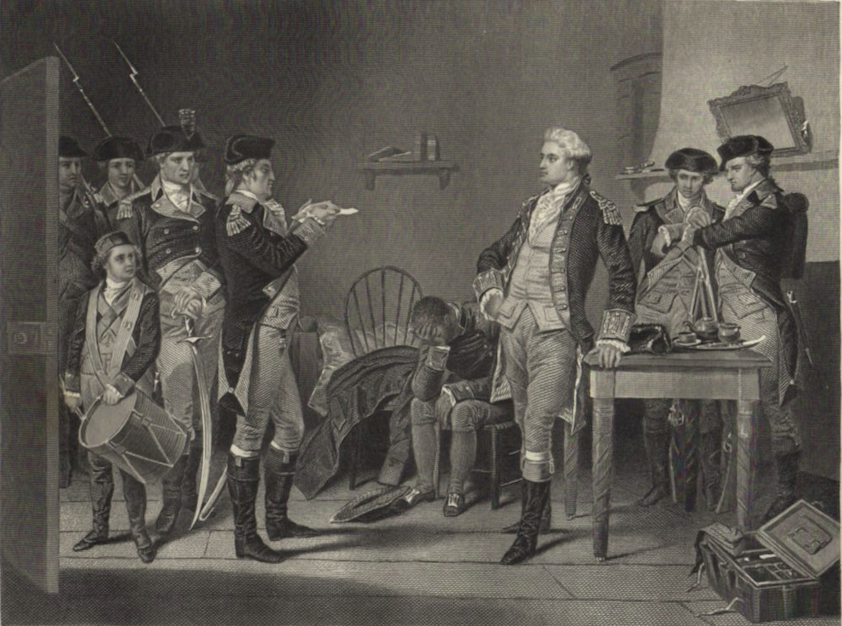 Andre receives execution orders in the Mabie House.
Abe Books
Andre receives execution orders in the Mabie House.
Abe Books
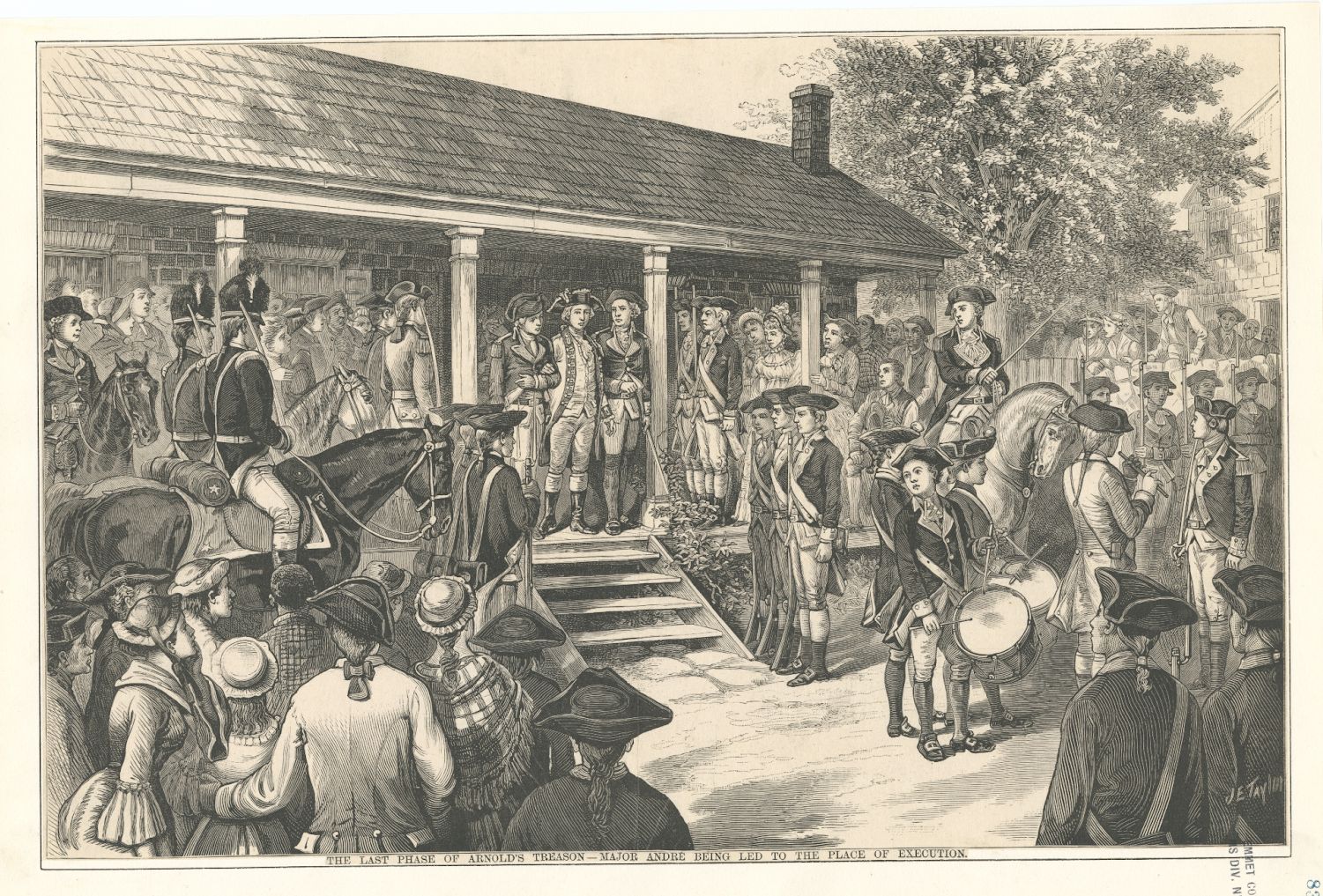 The last phase of Arnold's treason - André being led to execution.
Although André had repeatedly appealed to George Washington to be granted a soldier's death before a firing squad, his request was denied. Captured behind American lines in civilian clothing while carrying secret military papers, André had been convicted as a spy under the accepted laws of war. Washington believed the sentence had to be carried out. Granting an exception risked undermining the laws of war and the military discipline upon which the Continental Army depended.
Until the final moments, André still hoped Washington had granted his request to die before a firing squad. But as the procession turned and the gallows came into view beside a black-painted coffin, he faltered for the first time. "How hard is my fate!" he exclaimed before quickly regaining his composure. "I am reconciled to my death," he said, "but I detest the mode." As André passed the DeWint House, George Washington remained inside. Determined to preserve the impartiality of the military tribunal, he had never visited his prisoner and did not witness the execution.
Standing upon his own coffin beneath the gallows, André listened to the execution order being read. Asked if he had any final words, he lifted the handkerchief from his eyes and declared, "I pray you to bear me witness that I meet my fate like a brave man." Refusing the assistance of the executioner, he calmly removed his own neckcloth, loosened his collar, placed the noose around his own neck, and tied a white silk handkerchief over his eyes. After handing the hangman a second handkerchief to bind his arms, the wagon was drawn away, bringing a swift end to the life of the twenty-nine-year-old British officer. His body remained hanging for about half an hour before being buried at the foot of the gallows.
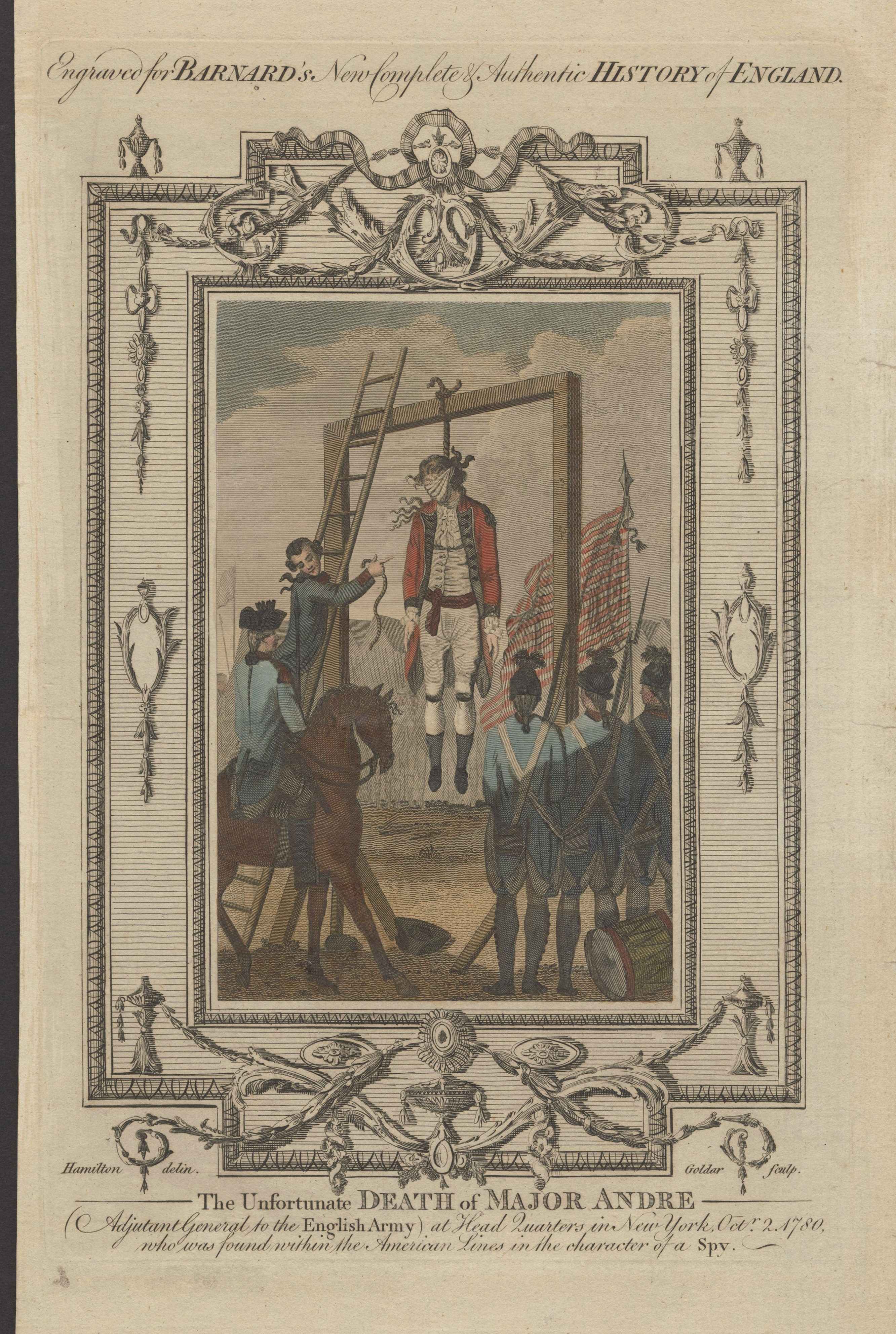 The Unfortunate Death of Major John André, by John Goldar
(engraver), after William Hamilton (painter), for Edward Barnard’s
The New, Comprehensive, Impartial and Complete History of England (London, 1783)
William L. Clements Library
The Unfortunate Death of Major John André, by John Goldar
(engraver), after William Hamilton (painter), for Edward Barnard’s
The New, Comprehensive, Impartial and Complete History of England (London, 1783)
William L. Clements Library
Today, a granite monument marks the spot where Major John André was executed on October 2, 1780. The memorial was erected in 1879 by philanthropist Cyrus W. Field, who hoped to preserve one of the Revolution's most significant historic sites. Yet the monument itself soon became the center of controversy. Many Americans viewed any tribute to André as an affront to George Washington and the patriot cause, and the monument was repeatedly attacked by vandals. It was blown up with dynamite multiple times, toppling the granite shaft and shattering its base.
Although the monument was restored after each attack, much of its original base was lost forever. Today, standing quietly beside the road in Tappan, the monument serves as a reminder not only of André's tragic fate, but also of the passions that his story continued to evoke more than a century after the Revolution.
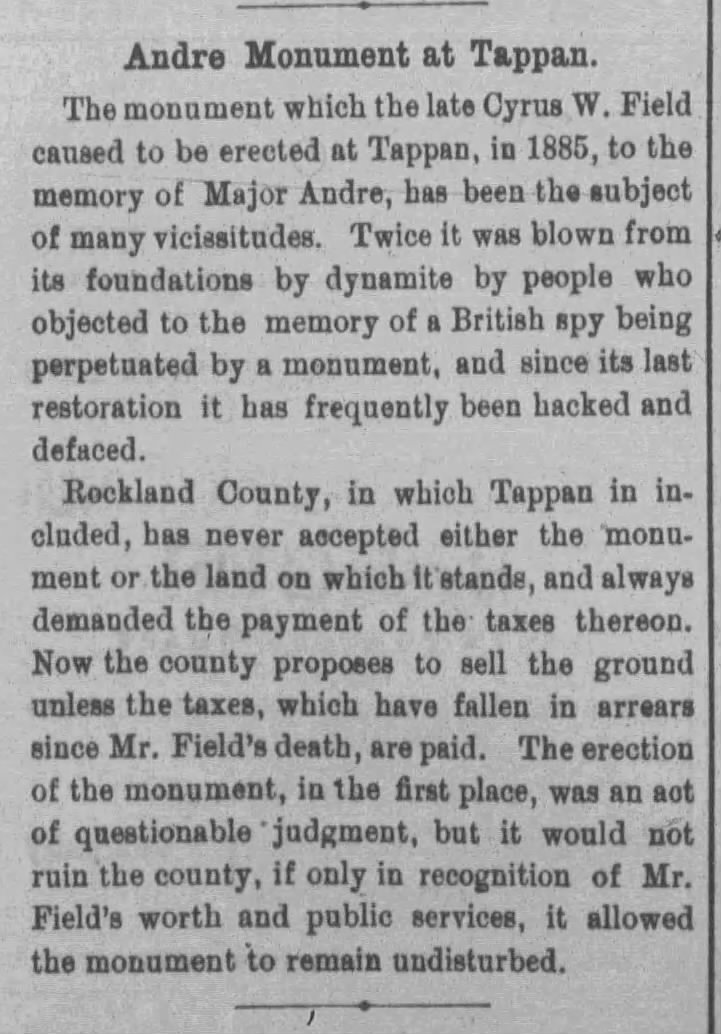 The Yonkers Statesman Yonkers, New York Monday, November 22, 1897
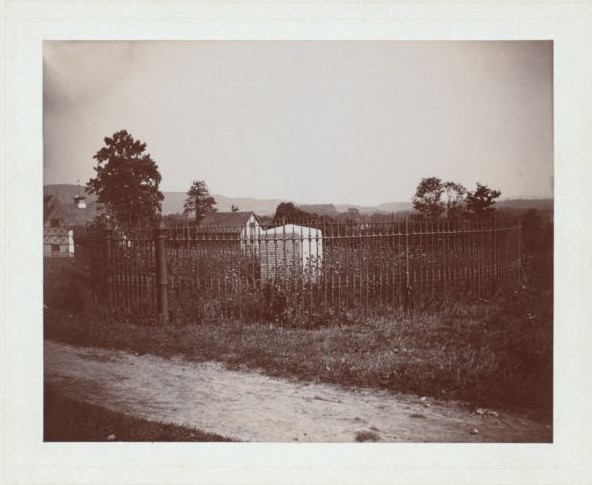 Location of André's grave with monument.
New York Digital Collections
Location of André's grave with monument.
New York Digital Collections
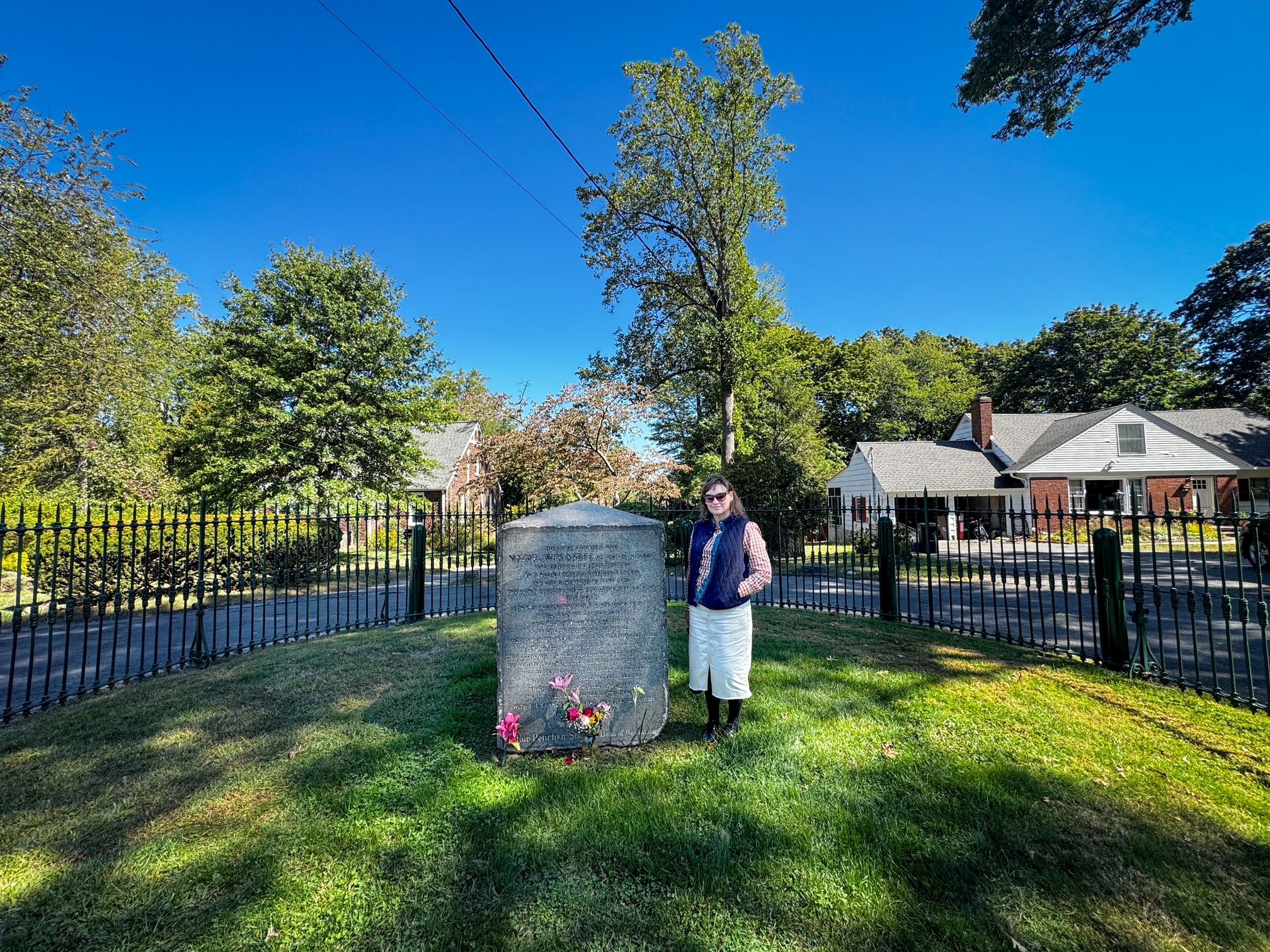 Standing next to the monument in 2025.
Another aspect of Andre's execution was his exhumation in 1821. After rested in his humble grave at Tappan for more than forty years. Buried at the foot of the gallows where he had been executed on October 2, 1780, his remains lay undisturbed as the United States grew from a fragile republic into a thriving nation.
In 1821, the British government, acting under the direction of the Duke of York, resolved to bring André home. James Buchanan, the British Consul in New York, traveled to Tappan to oversee the exhumation. Not everyone welcomed the effort. Some local residents insisted that honoring André dishonored George Washington and threatened to disrupt the proceedings. Buchanan deftly avoided a confrontation by treating the loudest protesters to generous rounds of drinks at a nearby tavern, leaving the workmen free to continue their solemn task in peace.
As the grave was opened, workers uncovered a remarkable sight. A peach tree, planted years earlier by a sympathetic local woman at the head of André's grave, had sent its roots downward until they completely encircled his skull like a delicate woven net. The scene deeply impressed those present. André's remains were carefully gathered and placed in an elaborate mahogany sarcophagus trimmed in crimson and black velvet—the colors chosen to recall the scarlet and green uniform he had worn on the day of his execution. Even the peach tree was carefully uprooted and sent to England, where it was replanted in the King's garden behind Carlton House.
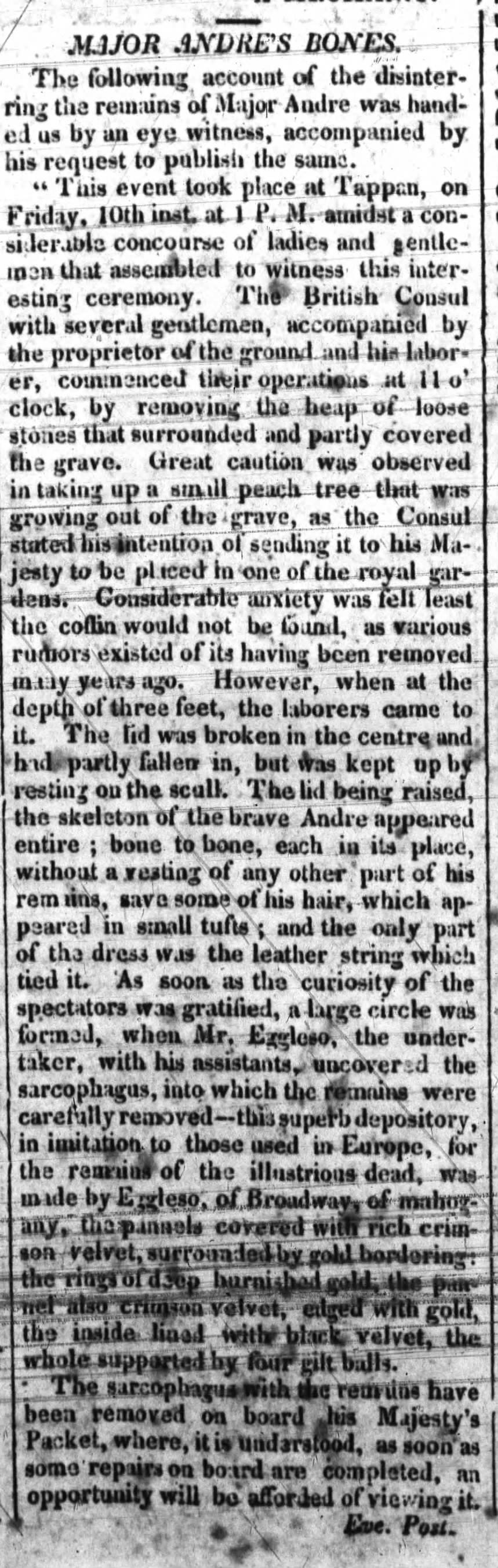 Eyewitness newspaper account of Major John André's exhumation at Tappan, New York,
in August 1821. Edenton Gazette (Edenton, N.C.), August 27, 1821.
Full article
Eyewitness newspaper account of Major John André's exhumation at Tappan, New York,
in August 1821. Edenton Gazette (Edenton, N.C.), August 27, 1821.
Full article
The journey home attracted extraordinary attention. As the ornate sarcophagus was carried through the streets of New York City to the waiting British frigate Phaeton, crowds gathered in respectful silence, covering the bier with flowers and garlands. After crossing the Atlantic, André's remains were reinterred with full military honors in Westminster Abbey on November 28, 1821, where they rest today beneath a monument honoring his courage and sacrifice. It was a remarkable reversal of fortune. The young officer once buried as a disgraced spy beneath a lonely gallows ultimately found his final resting place among Britain's most celebrated heroes.
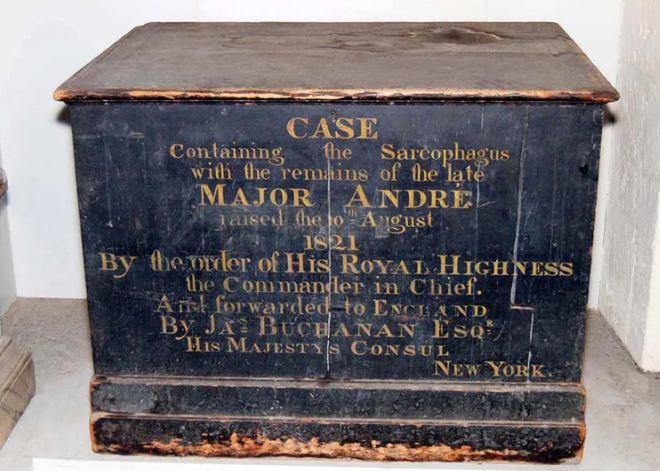 The chest used to return Major John André's remains to England in 1821,
where he was reinterred with military honors in Westminster Abbey.
Westminster Abbey
The chest used to return Major John André's remains to England in 1821,
where he was reinterred with military honors in Westminster Abbey.
Westminster Abbey
During my visit to Westminster Abbey in 2015, I asked one of the guides if I could see the final resting place of Major John André. At the time, the area around his grave was roped off to visitors, but the guide kindly escorted me to the spot. Photography was not permitted inside the Abbey, so I managed to capture only a few quick, rather poor-quality photographs. I would have loved to see the wooden chest that carried André's remains back to England in 1821, but it remains in the Abbey's collection and is not on public display.
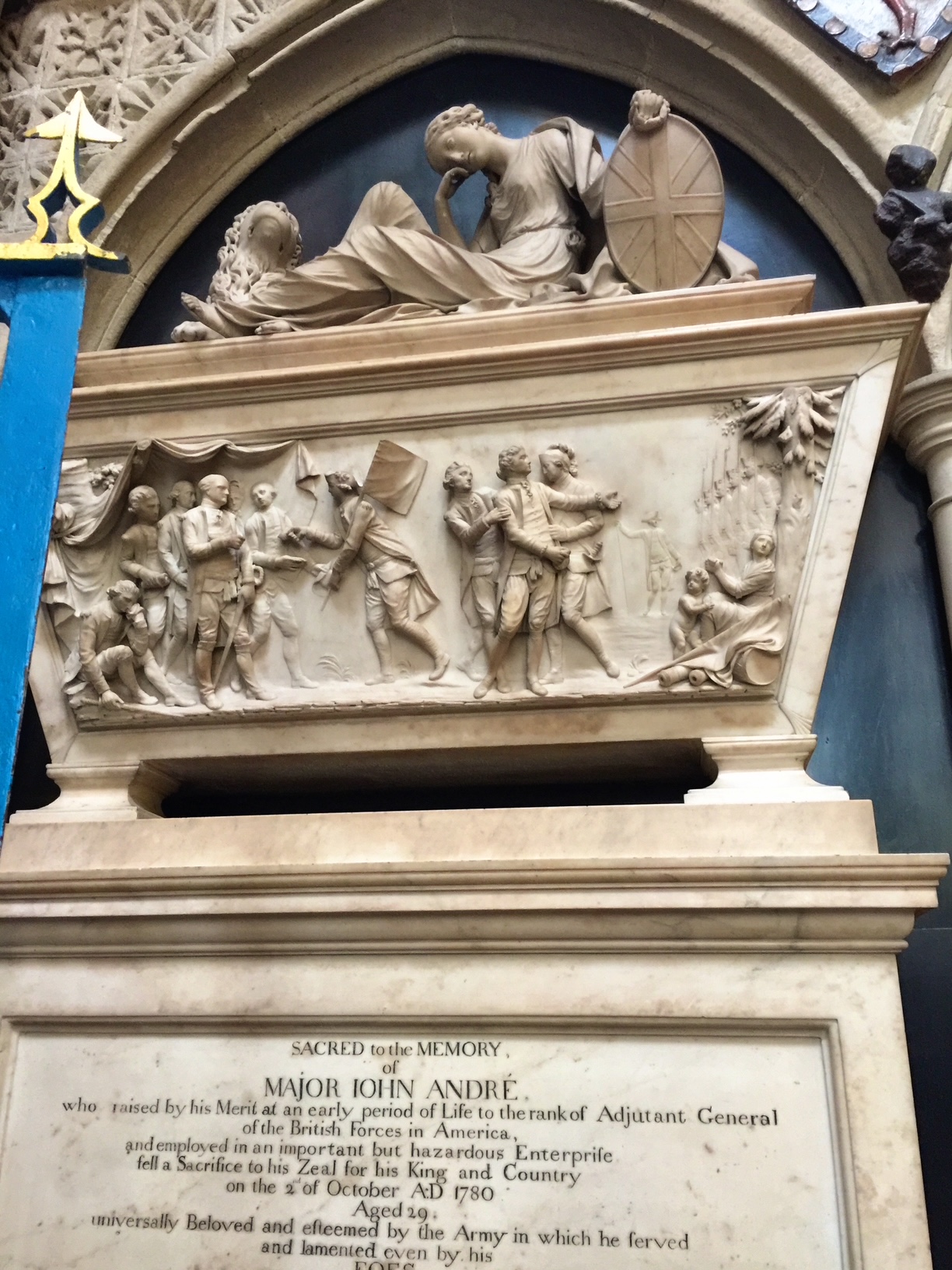 Major John Andre monument in Westminster Abbey. P Marlin 2015
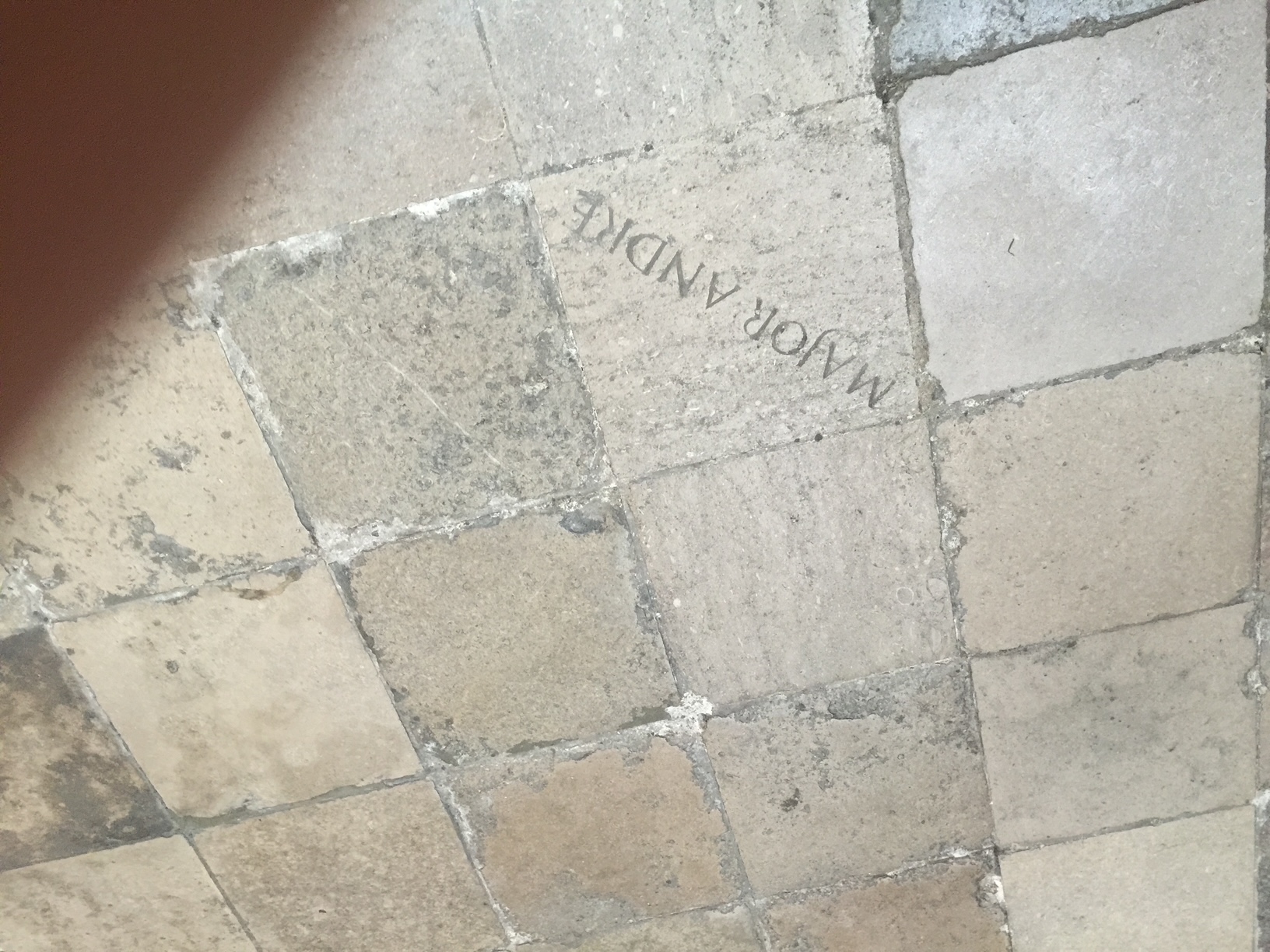 Major John Andre burial site in Westminster Abbey. P Marlin 2015
These remarkable life masks are the only authenticated likenesses of André's three captors, John Paulding, Isaac Van Wart, and David Williams. New York sculptor John Henri Isaac Browere made the casts from life over a period of twelve years: Paulding in 1817, Van Wart in 1826, and Williams in 1829. Because none of the three men ever sat for formal portraits during their lifetimes, Browere's plaster casts preserve their actual appearances nearly fifty years after the capture of Major André.
The reputations of the three captors later became the subject of controversy. Major Benjamin Tallmadge, who had escorted André to Tappan and greatly admired his courage, later suggested that the men had first intended to rob André before realizing his importance. George Washington reached a very different conclusion. In his contemporary report to Congress, he praised their honesty and steadfastness, noting that they had rejected André's repeated offers of money and had acted with "great virtue." Congress accepted Washington's assessment, awarding each man a silver medal and a lifetime pension for their service.
 The only authenticated likenesses of Major John André's three captors.
Sculptor John Henri Isaac Browere made these life masks from life between
1817 and 1829:
Browere's Life Masks of Great Americans
The only authenticated likenesses of Major John André's three captors.
Sculptor John Henri Isaac Browere made these life masks from life between
1817 and 1829:
Browere's Life Masks of Great Americans
Standing today in the quiet streets of Tappan, it is difficult to imagine the extraordinary events that unfolded here during the autumn of 1780. Within the span of a few days, the village became the stage upon which the fate of the American Revolution hung in the balance. Major John André, admired by friend and foe alike for his intelligence, charm, and remarkable composure, became the unwilling face of one of history's greatest acts of treason. As Alexander Hamilton later wrote of André, "Never, perhaps, did any man suffer death with more justice, or deserve it less." Benjamin Tallmadge, who escorted André to Tappan and came to know him during those final days, admitted that he had never become so attached to any man in so short a time. Yet despite the sympathy André inspired, George Washington never allowed personal feelings to interfere with military necessity.
Washington's conduct throughout the affair revealed the steady judgment that defined his leadership. Although he deliberately avoided meeting André during his imprisonment or attending his execution, he was far from indifferent to the young officer's fate. He repeatedly sought to save André's life by proposing an exchange for Benedict Arnold, insisting that the traitor, not the captured British officer, was the man he truly wanted. Washington even authorized a secret mission in hopes of luring Arnold back into American hands. One cannot help but wonder how history might have changed had that remarkable plan succeeded. Would Arnold have stood before the same gallows on the hill above Tappan? We can never know.
More than two centuries later, André's story continues to fascinate because it refuses to fit neatly into the categories of hero and villain. He was an honorable officer carrying out a dishonorable mission, a gifted young man whose courage in defeat earned the admiration of those charged with condemning him. Perhaps no one summarized the tragedy more eloquently than Washington himself, who reflected that André was "more unfortunate than criminal." Those words, spoken by the man who ultimately signed the death warrant, remain one of the Revolution's most remarkable expressions of justice tempered by humanity. They remind us that history is rarely as simple as victory and defeat. It is often, as this journey through Tappan has shown, the story of good people caught at the crossroads of extraordinary events.
Benedict Arnold escaped the gallows that claimed John André, but he never escaped the consequences of his betrayal. Commissioned as a brigadier general in the British Army, he led raids against his former countrymen before eventually settling in London. Yet the honor and acceptance he sought never fully materialized. Americans remembered him as the Revolution's greatest traitor, while many of his British comrades regarded him with suspicion.
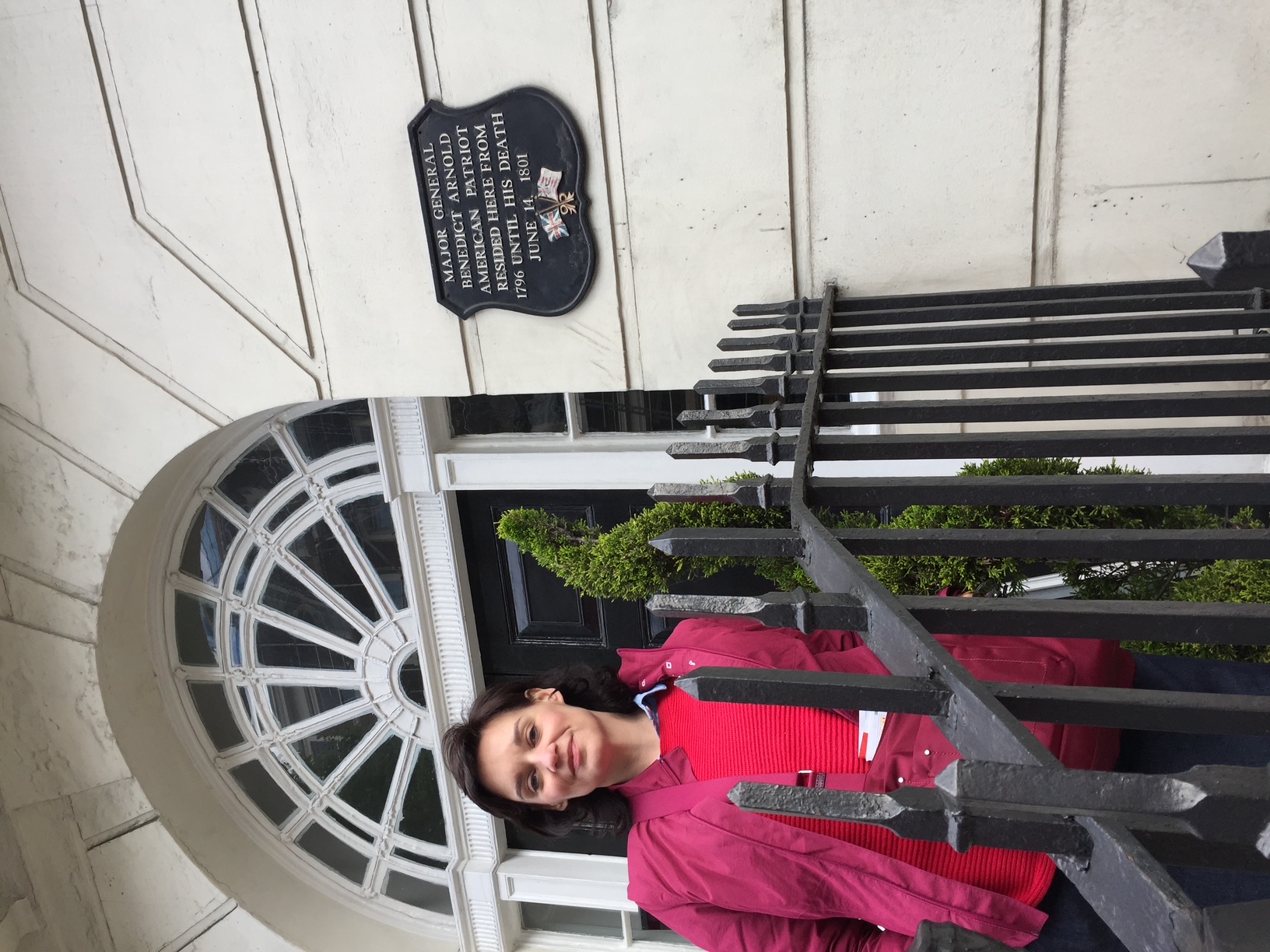 Benedict Arnold's London residence, where he lived from 1796 until his death in 1801.
The commemorative plaque refers to him as an "American Patriot." Benedict Arnold died in this
house. P. Marlin, 2015.
Benedict Arnold's London residence, where he lived from 1796 until his death in 1801.
The commemorative plaque refers to him as an "American Patriot." Benedict Arnold died in this
house. P. Marlin, 2015.
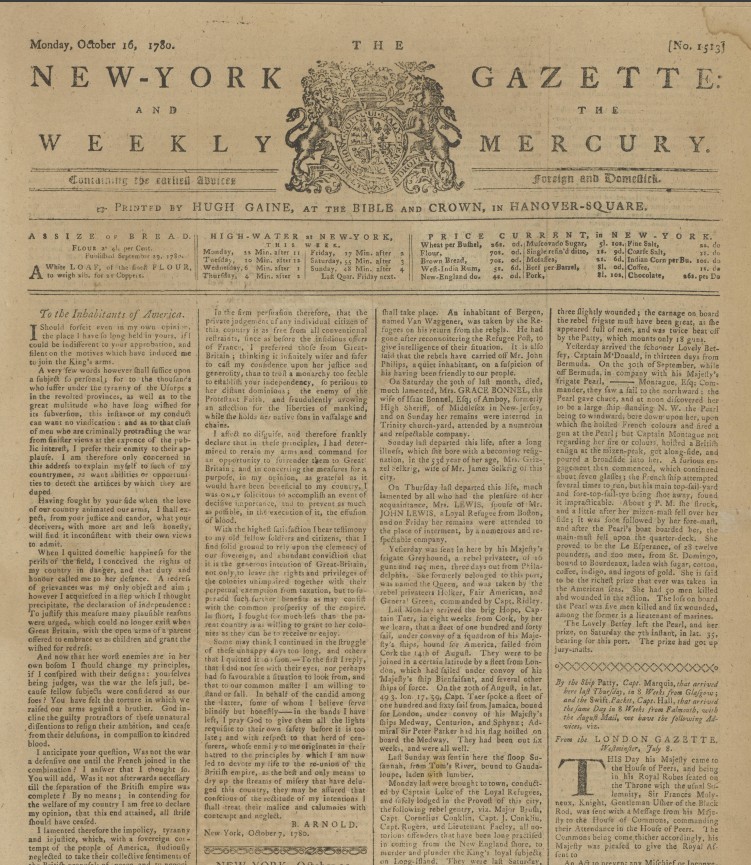 "To the Inhabitants of America" was written by Benedict Arnold after he reached British lines in New York following his escape on September 25, 1780. Dated October 7, 1780, it was published in the New-York Gazette and Weekly Mercury on October 16, 1780.
Full article
Library of Congress
"To the Inhabitants of America" was written by Benedict Arnold after he reached British lines in New York following his escape on September 25, 1780. Dated October 7, 1780, it was published in the New-York Gazette and Weekly Mercury on October 16, 1780.
Full article
Library of Congress
On October 7, 1780, less than two weeks after reaching British lines, Arnold issued an address titled "To the Inhabitants of America." In it, he attempted to justify his defection by arguing that he had remained faithful to the Revolution's original purpose rather than betraying it. He claimed he had taken up arms to defend the colonists' constitutional rights, not to seek independence, and contended that once Britain offered generous peace terms, the war should have ended. Arnold accused Congress of prolonging the conflict for political ambition, condemned the alliance with France as dangerous and self-serving, and argued that reconciliation with Great Britain offered the best hope for peace, liberty, and prosperity.
The address also reflected a recurring pattern that had marked much of Arnold's military career. He frequently portrayed himself as the victim of jealous rivals, political intrigue, and an ungrateful Congress, believing his sacrifices had gone unrecognized while others received the credit. Rather than accepting responsibility for his actions, Arnold consistently defended them as honorable and principled. His appeal persuaded few Americans, but it remains the clearest statement of how he justified one of history's most infamous acts of treason.
Arnold died in London on June 14, 1801, and was buried in the crypt of St. Mary's Church in Battersea. Today, the commemorative plaque on his London home identifies him as an "American Patriot," acknowledging the remarkable service he rendered before 1780. History, however, reached a far different verdict. Benedict Arnold, despite his earlier heroism, became the enduring symbol of treason, while André's tragic fate secured his place as one of the Revolution's most honorable adversaries. Their stories, forever intertwined, demonstrate that while history may forgive failure, it rarely forgives betrayal.
Books
1 Abbatt, William. The Crisis of the Revolution: Being the Story of Arnold and André. 1899.
Alper, M. Victor. America's freedom trail: a tour guide to historical sites of the colonial and Revolutionary War period.
Bailey, Rosalie Fellows. Pre Revolutionary Dutch Houses And Families In Northern New Jersey And Southern New York.
Blauvelt, Louis L. The Blauvelt family genealogy: a comprehensive compilation of the descendants of Gerrit Hendricksen (Blauvelt) 1620-1687, who came to America in 1638.
Claghorn, Charles Eugene. Women patriots of the American Revolution: a biographical dictionary.
Cole, David. History of the Reformed Church of Tappan, N.Y.
Covert, Adrian. Taverns of the American Revolution.
2 Fabend, Firth Haring. ’76 House, Tappan, NY.
Green, Frank Bertangue. The history of Rockland County.
Harvey, Cornelius Burnham. Genealogical history of Hudson and Bergen counties, New Jersey.
Hatch, Robert McConnell. Major John André: a gallant in spy's clothing.
Hine, Charles Gilbert. The west bank of the Hudson River, Albany to Tappan.
Koke, Richard J. Accomplice in treason; Joshua Hett Smith and the Arnold conspiracy.
Marselus, N. J. The gospel ministry and its results: a sermon.
McMahon, Richard. The court-martial of Benedict Arnold.
Mitchell, Craig. George Washington's New Jersey: a guide to the crossroads of the American Revolution.
New York (State) Comptroller's Office. New York in the revolution as colony and state.
Pelletreau, William Smith. Abstracts of wills on file in the Surrogate's office: City of New York.
Proceedings of A Board of General Officers Respecting Major John Andre. New York: Privately Printed, 1867.
Sargent, Winthrop. The Life and Career of Major John André, Adjutant-General of the British Army in America. Edited by William Abbatt. New York: William Abbatt, 1902.
Smith, Horace W. Andreana. Containing the trial, execution and various matter connected with the history of Major John Andre, adjutant general of the British army in America, A.D. 1780. Philadelphia: Horace W. Smith, 1865.
Zimmermann, Linda. Ghost Investigator: 10th Anniversary Special Edition.
Newspaper Articles & Periodicals
"Sacrilege at Westminster Abbey." Aberdeen Evening Express, June 10, 1884.
Bell's Weekly Messenger (London), October 15, 1821.
The Bombay Gazette, April 17, 1822.
"The 'Seventy-Six House.'" The Brooklyn Eagle, August 14, 1850.
The Dublin Weekly Register, October 6, 1821.
"Historic Tappan." Harper's Weekly 28, no. 1427 (April 26, 1884).
The Knickerbocker News (Albany, NY), October 2, 1975.
Lancaster Gazette, September 8, 1821.
The Morning Chronicle (London), September 19, 1821.
"Major Andre." The New Times (London), September 29, 1821.
"Dance at Old Andre Prison." The New York Herald (Undated clipping).
"Gone to Ruin." The New York Press (Undated clipping).
"Andre's Prison." New-York Tribune, April 29, 1900.
"Andre's Prison." New York World (Undated clipping).
"The Andre Prison." Rockland County Journal, December 15, 1883.
"The '76 Stone House." Rockland County Journal, November 6, 1897.
The Statesman (London), December 17, 1821.