
Pam Hawley Marlin September 2026
Hawley Family Ancestry. In January 2026, I received my Dad’s "Big Y-700" DNA test results from Family Tree DNA. In the short time since, I’ve been deeply immersed in the data, learning, relearning, and sometimes wrestling with the basics of genetics and Y-DNA structure. What has already emerged is both affirming and surprising: Dad is unquestionably of the Hawley paternal line, but he may descend from a different Hawley ancestor than I originally expected. These results have opened a new path of discovery, pointing toward deeper layers of Hawley history yet to be uncovered. I strongly encourage other Hawley men to join in this effort. If you are considering DNA testing, save your money and go straight to the Big Y-700 test.
At the October 2026 Hawley Society Reunion in New Haven, Connecticut, I presented an overview of how Y-DNA testing is helping us explore Hawley paternal ancestry.
My interest in family history began at a very young age. My great-grandmother, Emma Elizabeth Hawley, regaled me with tales of her childhood adventures, which inevitably prompted questions, especially about the origins of the Hawley family. As she talked, I taped together several pieces of 8×10 paper and, with pen and ruler in hand, dutifully drew my first family tree. That modest effort marked the beginning of a lifelong passion for all things historical, with the search for my Hawley ancestors always at the forefront.
 Fast forward to the mid-1990s, when my research efforts received an unexpected boost with the arrival of the
internet. Suddenly, genealogy could be pursued from my own living room, without the cost of time and travel.
As the internet grew, so did my excitement at the sheer number of resources becoming available online. While
my true passion remained handling aged documents and photographs in person, online research made the process faster
and more efficient. The scattered pieces of my genealogical puzzle could now be gathered and fitted together, with far greater
ease.
Fast forward to the mid-1990s, when my research efforts received an unexpected boost with the arrival of the
internet. Suddenly, genealogy could be pursued from my own living room, without the cost of time and travel.
As the internet grew, so did my excitement at the sheer number of resources becoming available online. While
my true passion remained handling aged documents and photographs in person, online research made the process faster
and more efficient. The scattered pieces of my genealogical puzzle could now be gathered and fitted together, with far greater
ease.
It was not long until online research revealed that I was not the only person interested in this particular Hawley line. Another relative had already tackled it in the 1950s, producing a multi-page document that traced my branch of the Hawley family back to Joseph Hawley of Connecticut, the Hawley family patriarch. It was an extraordinary find! All that remained, I thought, was to verify the work with primary sources and a solid paper trail. That confidence proved short-lived, however. While much of the tree appeared carefully researched and remarkably accurate, a troubling disconnect emerged around 1787, at the parentage of my fifth great-grandfather, John Hawley. It was an obstacle I could not resolve. I had encountered what every genealogist dreads: a brick wall.
Alongside the growth of the internet, advances were also being made in DNA analysis. First used in criminal investigations in the 1980s, DNA testing eventually became available to consumers. Almost without realizing it, my genealogical journey had progressed from handwritten charts to online records, and now to DNA. Suddenly, I had thousands of genetic relatives and yet another powerful clue in my ongoing effort to break through my now decades old Hawley family brick wall.
Through my work with the Society of the Hawley Family (now entering its second century!), I was encouraged to test my father, R. Hawley's, Y-DNA through Family Tree DNA (FTDNA). Unlike autosomal DNA, which blends genetic material from both parents, the Y chromosome stands alone, passed virtually unchanged from father to son and preserving a stable record of paternal ancestry.
Based on the known lines of Joseph Hawley of Stratford, Connecticut (1603 - 1690), and his brother Thomas Hawley of Roxbury, Massachusetts (1609-1676), the Society maintains a FTDNA Hawley Surname Project, which focuses on tracing the paternal lines of the Hawley brothers.
Faced with my Hawley family brick wall, I decided to indulge in FTDNA's most expensive test, the Big Y-700. The Big Y-700 is the most comprehensive Y-DNA test available, designed to build a highly detailed picture of a man’s direct paternal line. Little did I know this choice would plunge me into a tangled world of STRs, SNPs, and genetic distances. Undeterred, I was, and still am, determined to make sense of it all.
The complexity of DNA testing can feel overwhelming. To better understand Dad’s results, I turned to Blaine T. Bettinger’s The Family Tree Guide to DNA Testing and Genetic Genealogy, David Vance’s The Genealogist’s Guide to Y-DNA Testing for Genetic Genealogy, and FamilyTreeDNA’s educational resources. What follows reflects what I have learned as I work to understand our Hawley paternal line and its origins.
FamilyTreeDNA’s Big Y-700 examines two types of markers on the Y chromosome: short tandem repeats (STRs) and single nucleotide polymorphisms (SNPs, pronounced “snips”). Both provide clues about paternal ancestry, but they measure different kinds of DNA changes.
STRs are short DNA sequences that repeat. The test counts how many times a sequence repeats at particular locations. Those repeat counts can increase or decrease as DNA passes from father to son. Comparing the patterns between men helps identify potential paternal relatives and provides clues about how closely they may be related.
SNPs are changes in individual DNA letters at particular positions. Once inherited, these changes generally remain stable across generations. Shared SNPs help define branches on the paternal DNA tree, known as haplogroups. Some branches reach far into ancient ancestry, while others distinguish more recent family lines within the period covered by genealogical records.
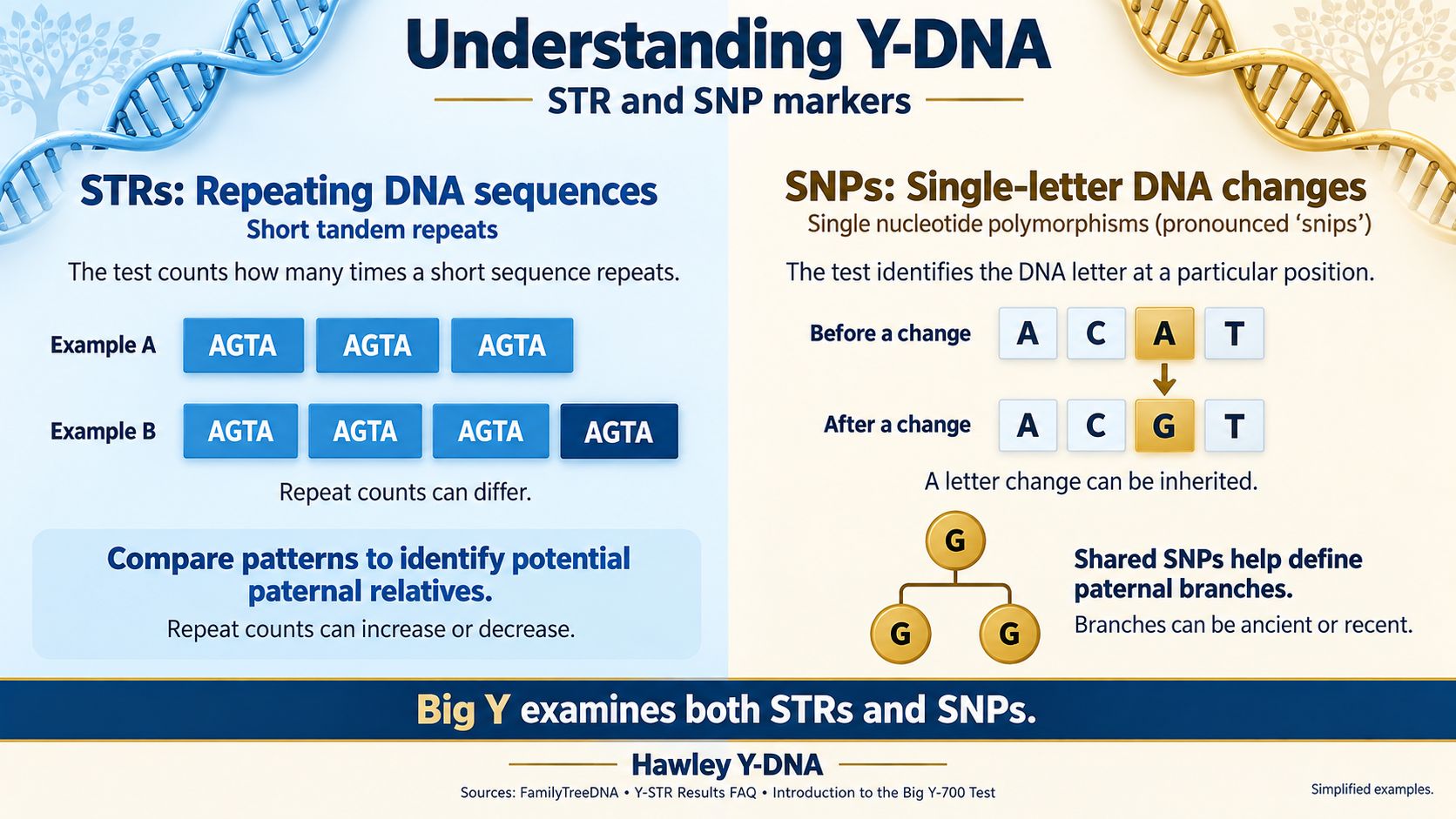 STRs compare repeating DNA patterns; SNPs help define paternal branches, both ancient and recent. Big Y examines both.
Big Y brings these comparisons together. Its STR results help identify potential connections, while its SNP results help place men on the paternal tree. FamilyTreeDNA also uses the results to estimate when a shared paternal ancestor may have lived, the time to the most recent common ancestor (TMRCA). These estimates provide a range of possible dates to consider alongside historical records.
For my research, the questions were personal: Did Dad share a paternal ancestor with the Hawley families represented in the project, and where did his line fit among theirs? More specifically, would the DNA evidence support the earlier paper-based research tracing our family to Joseph Hawley of Stratford, Connecticut? Answering those questions would require comparing Dad’s results with other testers and carefully examining their documented paternal lines.
The first results to arrive from Dad’s FamilyTreeDNA Big Y test were the STR results. Comparing Dad’s repeat patterns with those of other men gave me an initial list of possible paternal connections, including several Hawley matches to investigate.
Traditional Y-STR tests examine panels of 12, 25, 37, 67, or 111 markers at specific locations along the Y chromosome. Each marker has a name, often beginning with DYS, and a value showing how many times a short DNA sequence repeats at that location. For example, Dad has a value of 16 at DYS570, meaning the sequence repeats 16 times. This marker appears again in the Hawley comparisons below.
Together, a man’s repeat counts across the tested STR markers form his Y-STR haplotype. Results are often displayed in a table, with marker names across the top and each man’s repeat counts below. This profile is not necessarily unique to one person: men can share the same haplotype at the markers tested. Comparing more markers generally gives a clearer picture of how closely two men may be related.
STR repeat counts can increase or decrease over generations and sometimes return to an earlier value. Similar patterns can also arise independently in different paternal lines. A match is therefore a useful clue, but it needs to be considered alongside SNP results and documented family trees.
The test reports also include Genetic Distance (GD) which summarizes the differences between two men’s STR values at a particular marker level. When comparing the same markers, fewer differences generally suggest a more recent shared paternal ancestor. FamilyTreeDNA uses these comparisons to estimate the time to the most recent common ancestor (TMRCA), providing a range of possible dates.
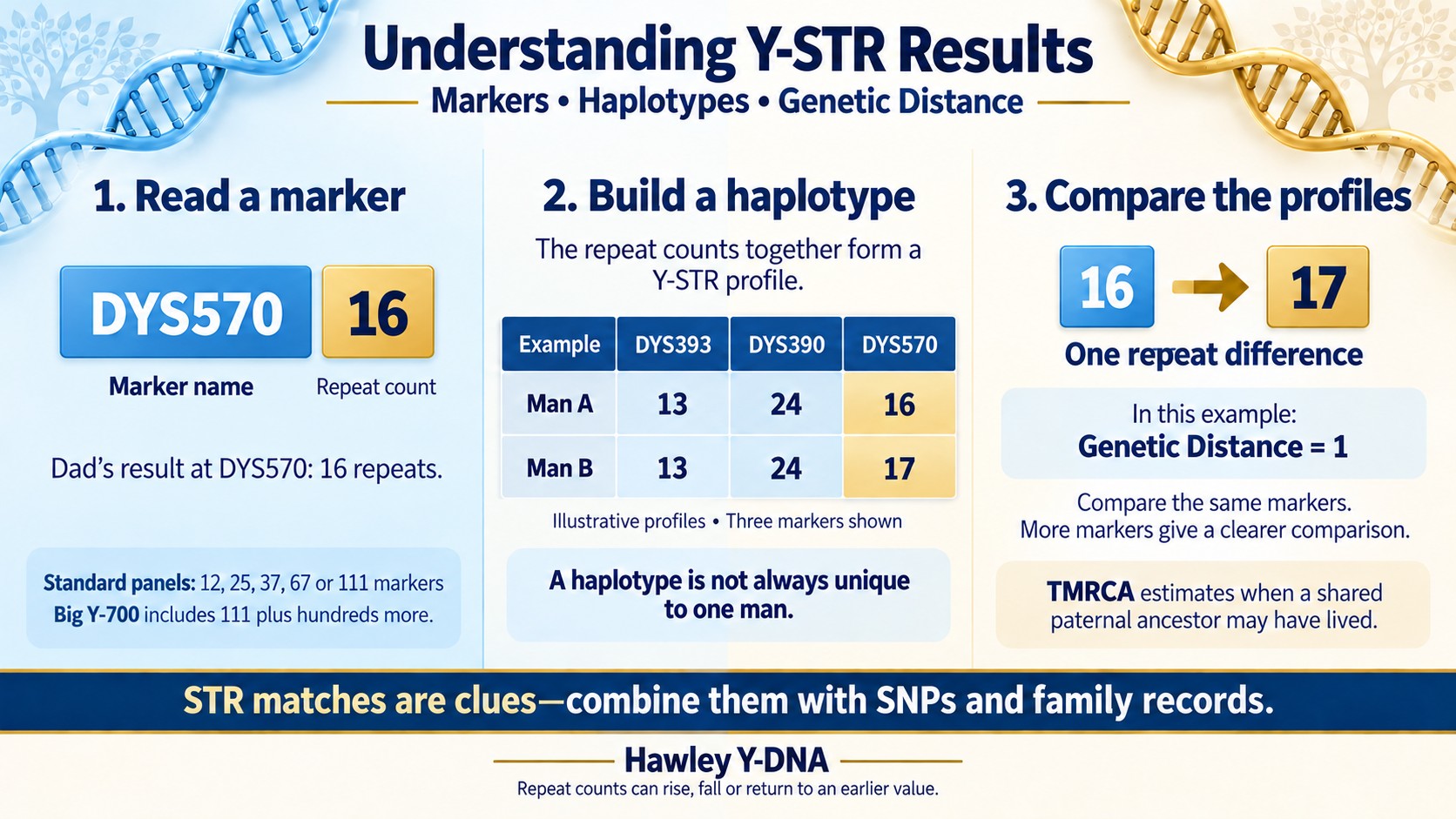 Reading Y-STR results: Each marker’s repeat count contributes to a man’s haplotype.
Comparing these profiles reveals genetic distance and provides clues to shared
paternal ancestry, considered alongside SNP results and family records.
Reading Y-STR results: Each marker’s repeat count contributes to a man’s haplotype.
Comparing these profiles reveals genetic distance and provides clues to shared
paternal ancestry, considered alongside SNP results and family records.
FamilyTreeDNA applies different genetic-distance limits at different matching levels. Falling outside a matching limit does not rule out a shared paternal ancestor; the connection may simply be more distant than the matching criteria are intended to identify.
At the 37-marker level (Y-37), Dad initially matched two men I’ll call A-Hawley and B-Hawley, with a genetic distance of zero. This means there were no observed differences in the 37 markers compared. Dad also had a one-step difference with C-Hawley. These three men were his closest matches when I first reviewed the results.
When I looked at the 67-marker level (Y-67), only B-Hawley from those three initial matches had tested that many markers. Dad and B-Hawley remained an exact match. A-Hawley and C-Hawley had tested only 37 markers, so a higher-level comparison was not available; both men have since passed away. An upgrade for B-Hawley remains a potentially useful next step.
Since that initial review, two additional members of our family have taken Big Y-700: G-Hawley, Dad’s brother, and H-Hawley, their paternal uncle. As expected, both are exact matches with Dad at all 111 standard STR markers. Their results therefore also match Dad’s at the 37- and 67-marker levels. These known family relationships give us a documented comparison as we investigate the more distant Hawley connections.
 FamilyTreeDNA’s Y-DNA Matches dashboard, with tabs showing the different Y-DNA STR
comparison levels: 12, 25, 37, 67, and 111 markers. The 37-marker tab is
selected with referenced Hawley matches shown at this level.
FamilyTreeDNA’s Y-DNA Matches dashboard, with tabs showing the different Y-DNA STR
comparison levels: 12, 25, 37, 67, and 111 markers. The 37-marker tab is
selected with referenced Hawley matches shown at this level.
Given how closely A-Hawley, B-Hawley, and C-Hawley matched Dad, I began researching each of their family lines. Although they had posted simplified trees, I reconstructed them in greater detail using Ancestry.com. My records-based research traced all three to Thomas Hawley of Roxbury, Massachusetts.
These findings led me to investigate whether Dad’s line might descend from Thomas Hawley of Roxbury rather than Joseph Hawley of Stratford. The STR results and documented trees provided a promising research direction, but they did not settle that question.
It is worth noting that Dad, A-Hawley, B-Hawley, and another unnamed match whose documented paternal line descends from Thomas Hawley of Roxbury all shared a value of 16 at marker DYS570, compared with the reference modal value of 18. This shared pattern provided another clue to investigate, although a single STR value cannot establish a separate family branch on its own.
Tables A and B show Dad’s closest matches at the 37- and 67-marker level.
| Table A: 37-marker matches | Test | DYS570 | GD | STR-based TMRCA estimate | Haplogroup |
|---|---|---|---|---|---|
| Dad | Big Y-700 | 16 | N/A | N/A | R-FTJ12251 (terminal) |
| A-Hawley | Y-37 | 16 | 0 | 1600–1950 CE* (95% probability); reported estimate: 1800 CE | R-M269 (not Big Y) |
| B-Hawley | Y-67 | 16 | 0 | 1600–1950 CE (95% probability); reported estimate: 1800 CE | R-M269 (not Big Y) |
| C-Hawley | Y-37 | Unknown | 1 step | 1450–1900 CE (95% probability); reported estimate: 1750 CE | R-DF96 (not Big Y) |
| Hawley (unnamed) | Y-67 | 16 | 2 steps | 1250–1850 CE (95% probability); reported estimate: 1650 CE | R-M269 (not Big Y) |
| G-Hawley (Dad’s brother) | Big Y-700 | 16 | 0 | 1600-1950 CE (95% probability); reported estimate: 1800 CE (actual 1898) | R-FTJ12251 (terminal) |
| H-Hawley (Dad’s paternal uncle) | Big Y-700 | 16 | 0 | 1600-1950 CE (95% probability); reported estimate: 1800 CE (actual 1898) | R-FTJ12251 (terminal) |
| Table B: 67-marker matches | Test | DYS570 | GD | STR-based TMRCA estimate | Haplogroup |
|---|---|---|---|---|---|
| B-Hawley | Y-67 | 16 | 0 | 1700–1950 CE (95% probability); reported estimate: 1850 CE | R-M269 (not Big Y) |
| Hawley (unnamed) | Y-67 | 16 | 2 steps | 1450–1900 CE (95% probability); reported estimate: 1700 CE | R-M269 (not Big Y) |
| G-Hawley (Dad’s brother) | Big Y-700 | 16 | 0 | 1700-1950 CE (95% probability); reported estimate: 1850 CE (actual 1898) | R-FTJ12251 (terminal) |
| H-Hawley (Dad’s paternal uncle) | Big Y-700 | 16 | 0 | 1750-1950 CE (95% probability); reported estimate: 1850 CE (actual 1898) | R-FTJ12251 (terminal) |
*CE stands for Common Era and uses the same year numbering as AD. †The lower-level exact matches and DYS570 values for G-Hawley and H-Hawley follow from their exact 111-marker matches with Dad and Dad’s recorded DYS570 value of 16.
At the 111-marker level, Dad's matches narrowed to 19 compared to his 738 matches at the 12-marker level. Comparing this larger set of markers provides a more detailed picture of the similarities and differences between paternal lines. His matches include men with the Hawley surname as well as other surnames. Different surnames may reflect connections that predate their adoption, but they can also result from later surname changes or adoption.
Dad’s closest Y-111 matches are now G-Hawley, his brother, and H-Hawley, their paternal uncle, both exact matches with a genetic distance of zero. Before their testing, his closest match at this level was D-Hawley, whose documented paternal line descends from Joseph Hawley of Stratford, Connecticut.
At 37 markers, Dad and D-Hawley differed by three steps, with FamilyTreeDNA’s estimated common-ancestor date around 1500 CE. At 67 markers, their genetic distance remained three steps, while the estimated date shifted to approximately 1600 CE. At 111 markers, their genetic distance increased to six steps as additional differences became visible, with the estimated date remaining around 1600 CE.
 FamilyTreeDNA’s Y-DNA Matches dashboard, with tabs showing the different Y-DNA STR comparison levels
at 111 markers. The 111-marker tab is selected with referenced Hawley matches
shown at this level (F-Hawley not included).
FamilyTreeDNA’s Y-DNA Matches dashboard, with tabs showing the different Y-DNA STR comparison levels
at 111 markers. The 111-marker tab is selected with referenced Hawley matches
shown at this level (F-Hawley not included).
Among the other matches discussed here, E-Hawley and A-Reid each differ from Dad by seven steps at 111 markers, while F-Hawley differs by nine. FamilyTreeDNA’s matching threshold at this level extends to a genetic distance of ten.
Table C shows Dad’s select matches at the 111- marker level.
| Table C: 111-marker matches | Test | GD | STR-based TMRCA estimate |
|---|---|---|---|
| Dad | Big Y-700 | N/A | N/A |
| G-Hawley (Dad’s brother) | Big Y-700 | 0 — exact match | 1750-1950 CE (95% probability); reported estimate: 1850 CE (actual 1898) |
| H-Hawley (Dad’s paternal uncle) | Big Y-700 | 0 — exact match | 1750-1950 CE (95% probability); reported estimate: 1850 CE (actual 1898) |
| D-Hawley (Joseph Hawley descendant) | Big Y-700 | 6 steps | 1350–1800 CE (95% probability); reported estimate: 1600 CE |
| E-Hawley | Big Y-700 | 7 steps | 1200–1750 CE (95% probability); reported estimate: 1500 CE |
| A-Reid | Big Y-700 | 7 steps | 1200–1750 CE (95% probability); reported estimate: 1500 CE |
| F-Hawley | Big Y-700 | 9 steps | 950–1650 CE (95% probability); reported estimate: 1350 CE |
About a month after receiving Dad’s initial STR results, his Big Y SNP results arrived. While STR testing counts repeated DNA sequences, SNP testing examines individual DNA letters, A, T, C, and G, at specific positions on the Y chromosome. Big Y-700 examines millions of these positions to identify both known SNPs and potentially new variants.
A SNP, pronounced “snip,” is a variation in a single DNA letter. An ancestral result means the tester carries the earlier letter at that SNP; a derived result means he carries the changed letter. For example, if a SNP represents a change from A to T, A is ancestral and T is derived. The change may have occurred many generations ago and been passed from father to son.
SNPs are generally more stable than STRs: a change at an individual SNP position is much less frequent than a change in an STR’s repeat count (on average, a new Y-SNP mutation occurs roughly every 80 to 150 years). Once a SNP change occurs, it usually passes from father to son unchanged over many generations. This stability makes SNPs particularly useful for tracing paternal branches.
Shared SNPs help define branches on the Y-DNA haplotree, connecting men through both ancient ancestry and more recent family lines. A man’s terminal haplogroup is the most specific branch currently assigned to him. The SNP used to label that branch is often called his terminal SNP, although several shared SNPs may define the branch. Additional testing can reveal new branches and refine that placement.
Big Y reports include named variants, which have identifiers such as FT20553, and private variants, which have not yet been placed on a shared branch. “Private” does not necessarily mean unique to one man; others may carry the variant without having tested. Comparing results helps determine where these variants belong on the tree.
When Dad’s results first arrived, his terminal haplogroup was R-FT20553. His results also included a private variant at position 20,066,689. This gave us a reason to test additional members of our known paternal line: Dad’s brother, G-Hawley, and their paternal uncle, H-Hawley.
Their Big Y-700 results confirmed that the variant was shared. Now named FTJ76260, it is one of two SNPs defining our family’s more specific branch, R-FTJ12251. The updated Block Tree below shows FTJ12251 and FTJ76260 together, with FTJ12251 providing the branch’s label. Their order is not yet resolved; future testers may help reveal which mutation occurred first and distinguish further branches.
Dad, G-Hawley, and H-Hawley are now assigned to R-FTJ12251, beneath R-FT20553. All three still belong to the older branch. Their new terminal haplogroup gives them a more precise placement within it.
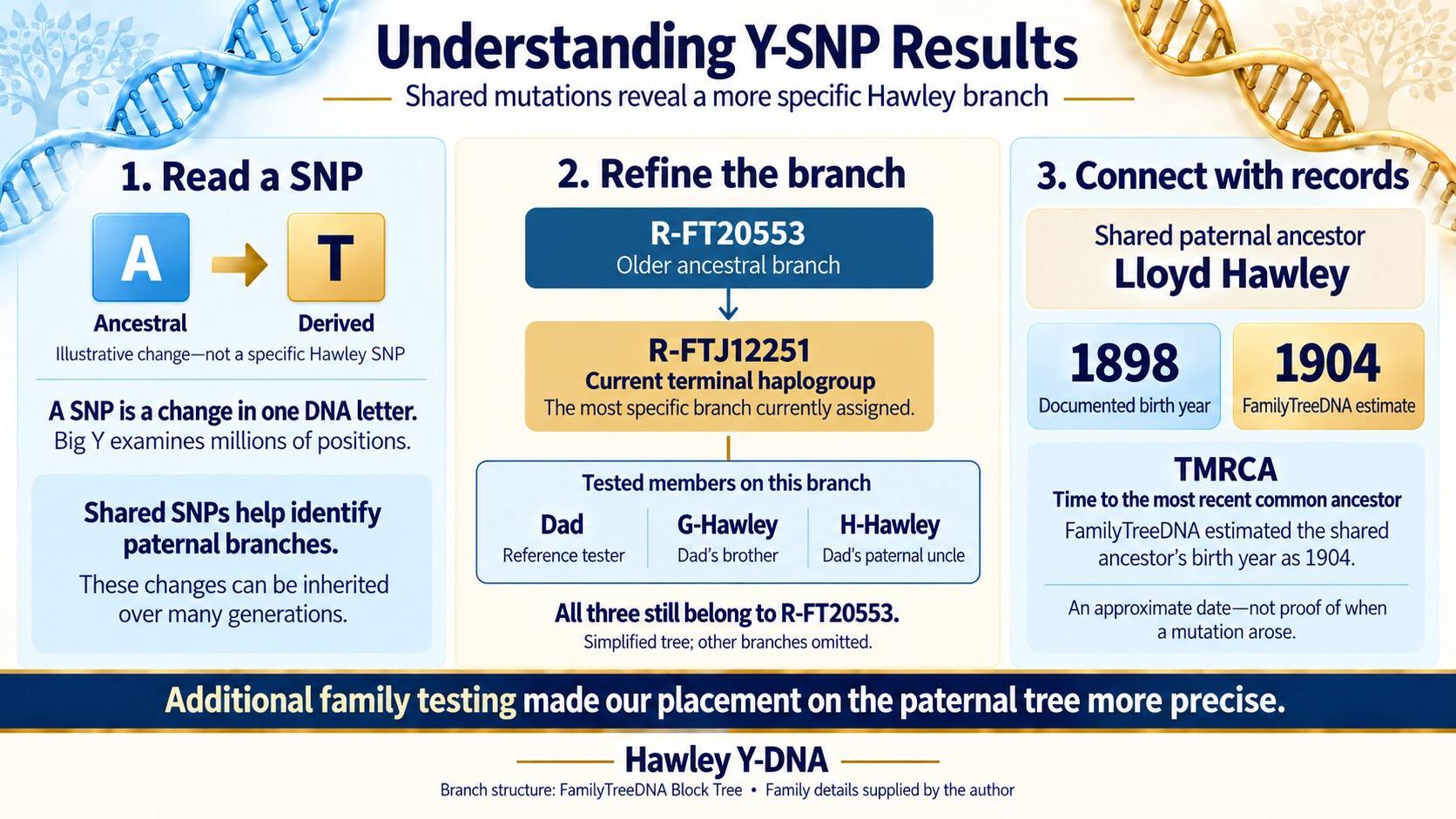 Shared SNPs placed Dad, his brother, and their paternal uncle on the
more specific R-FTJ12251 branch. FamilyTreeDNA’s estimated birth year of 1904 for
their most recent common ancestor closely aligns with the documented 1898 birth of
Lloyd Hawley.
Shared SNPs placed Dad, his brother, and their paternal uncle on the
more specific R-FTJ12251 branch. FamilyTreeDNA’s estimated birth year of 1904 for
their most recent common ancestor closely aligns with the documented 1898 birth of
Lloyd Hawley.
Our documented family history provides a useful comparison with the genetic estimate. The shared paternal ancestor of all three men was Lloyd Hawley, born in 1898. FamilyTreeDNA estimated their common ancestor at approximately 1904, just six years later. That was an encouraging agreement with the paper trail. The estimate is not an exact birth date, however, and it does not establish that either branch-defining mutation first occurred in Lloyd. A mutation could have arisen in an earlier ancestor and passed down to him.
When I first reviewed Dad’s Big Y results, he had nine matches on the SNP-based match list. The updated results now include G-Hawley and H-Hawley. The table below brings these comparisons together while keeping STR differences and SNP variants in separate columns. It shows selected matches, rather than Dad’s complete match list. The additional STR values for E-Hawley, A-Reid, and F-Hawley are retained from my earlier review; the new family results and the non-matching SNP counts reflect the supplied updated comparisons.
Table D shows select Big Y matches compared with Dad.
| Table D: Selected Big Y matches | Test | Additional STR differences | Haplogroup | Non-matching SNP variants compared with Dad |
|---|---|---|---|---|
| Dad | Big Y-700 | N/A | R-FTJ12251 (terminal) | N/A |
| G-Hawley (Dad’s brother) | Big Y-700 | 0 of 646 comparable markers | R-FTJ12251 (terminal) | None listed |
| H-Hawley (Dad’s paternal uncle) | Big Y-700 | 1 of 642 comparable markers | R-FTJ12251 (terminal) | None listed |
| D-Hawley (Joseph Hawley descendant) | Big Y-700 | 1 of 615 comparable markers | R-FT20553 | 6 |
| E-Hawley | Big Y-700 | 1 of 637 comparable markers | R-FT20553 | 5 |
| A-Reid | Big Y-700 | 1 of 602 comparable markers | R-FT20553 | 3 |
| F-Hawley | Big Y-700 | 1 of 611 comparable markers | R-FT119575 | 5 |
The most significant development for our family was the identification of R-FTJ12251. Testing Dad’s brother and uncle helped place our known family line more precisely within the wider Hawley paternal tree. It did not, by itself, identify which colonial Hawley ancestor our line descends from. That question still requires comparison with other documented paternal lines, but we now have a more specific genetic branch from which to continue the research.
Figures 1 - 5 represent the Discovery Tool Reports provided by FamilyTreeDNA.
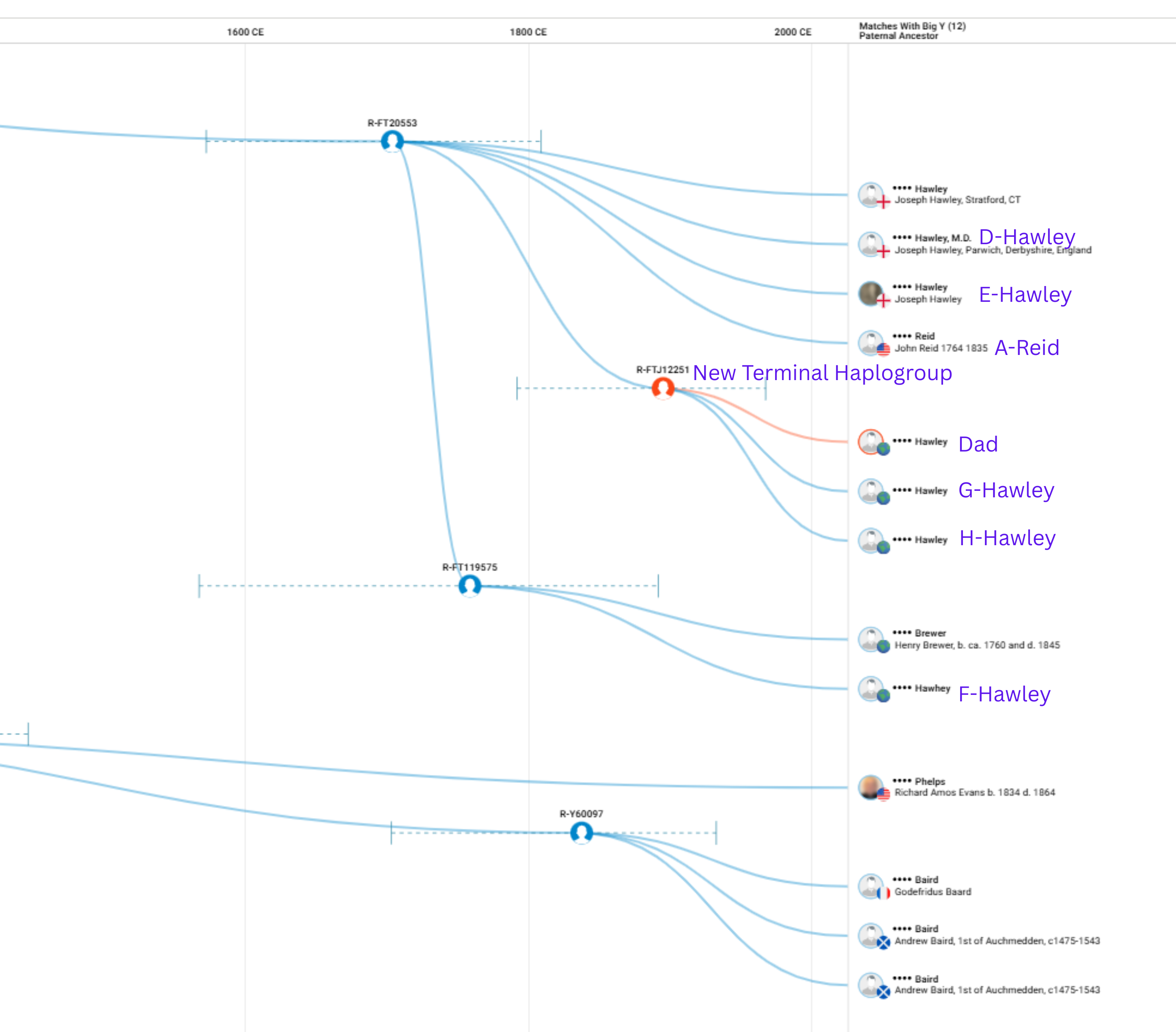 Figure 1 - FamilyTreeDNA Match Time Tree . The updated Big Y-700 Match Time Tree shows Dad, his brother
G-Hawley, and their paternal uncle H-Hawley on the newly identified
R-FTJ12251 branch beneath R-FT20553. The timeline across the top places
their shared paternal ancestry in context with other matches. Dashed
horizontal lines indicate estimated ranges for when the common ancestors
lived. These estimates and branch placements may be refined as additional
men test. LARGER VIEW
Figure 1 - FamilyTreeDNA Match Time Tree . The updated Big Y-700 Match Time Tree shows Dad, his brother
G-Hawley, and their paternal uncle H-Hawley on the newly identified
R-FTJ12251 branch beneath R-FT20553. The timeline across the top places
their shared paternal ancestry in context with other matches. Dashed
horizontal lines indicate estimated ranges for when the common ancestors
lived. These estimates and branch placements may be refined as additional
men test. LARGER VIEW
 Figure 2 - FamilyTreeDNA Big Y-700 Ancestral Path report.These haplogroups can be
compared to the Globetrekker maps below.
Figure 2 - FamilyTreeDNA Big Y-700 Ancestral Path report.These haplogroups can be
compared to the Globetrekker maps below.
 Figure 3 - FamilyTreeDNA Big Y-700 Globetrekker Map.
LARGER VIEW
Figure 3 - FamilyTreeDNA Big Y-700 Globetrekker Map.
LARGER VIEW
 Figure 3a. A close up of the above Big Y-700 Globetrekker map.
LARGER VIEW.
Figure 3a. A close up of the above Big Y-700 Globetrekker map.
LARGER VIEW.
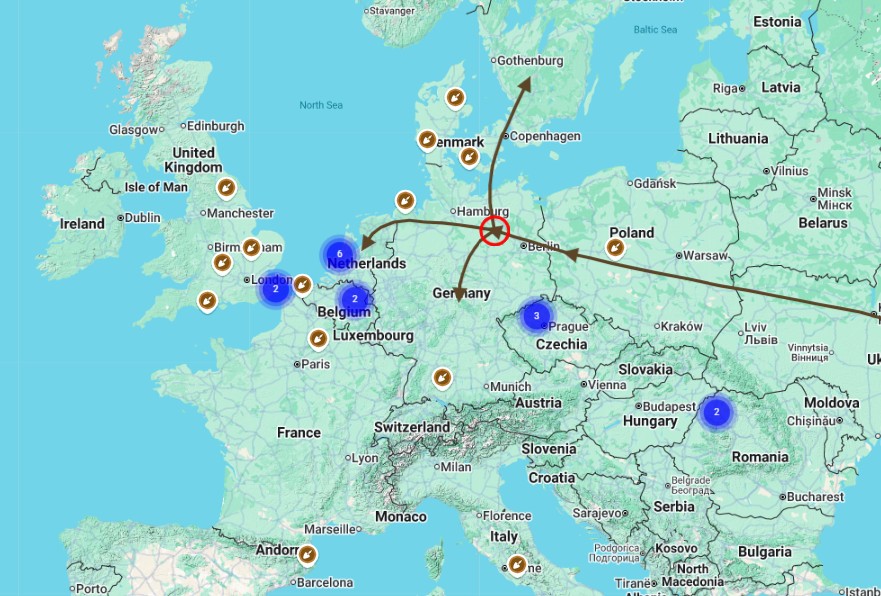 Figure 4 - FamilyTreeDNA Big Y-700 Migration Map.
LARGER VIEW
Figure 4 - FamilyTreeDNA Big Y-700 Migration Map.
LARGER VIEW
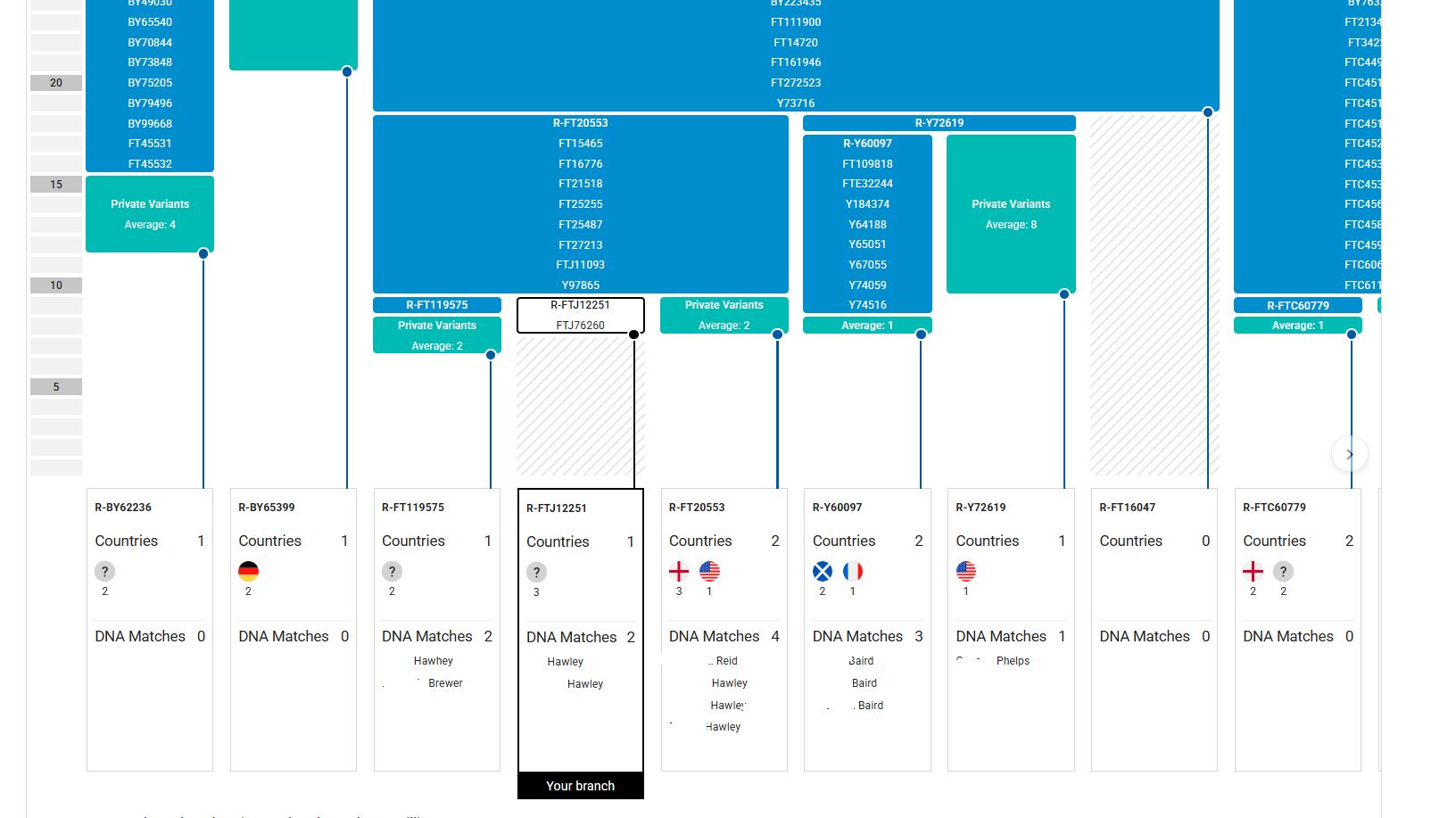 Figure 5 - FamilyTreeDNA Big Y-700 Block Tree.The updated Big Y-700 Block Tree shows Dad, his brother G-Hawley,
and their paternal uncle H-Hawley on the R-FTJ12251 branch, defined by
the shared SNPs FTJ12251 and FTJ76260. Their branch sits beneath
R-FT20553, which remains the terminal haplogroup for several other
Hawley testers and A-Reid. The neighboring R-FT119575 branch includes
F-Hawley and Brewer. All of these men share the older R-FT20553
ancestral branch, while the additional testing has distinguished
Dad’s family line more precisely within it. LARGER VIEW
Figure 5 - FamilyTreeDNA Big Y-700 Block Tree.The updated Big Y-700 Block Tree shows Dad, his brother G-Hawley,
and their paternal uncle H-Hawley on the R-FTJ12251 branch, defined by
the shared SNPs FTJ12251 and FTJ76260. Their branch sits beneath
R-FT20553, which remains the terminal haplogroup for several other
Hawley testers and A-Reid. The neighboring R-FT119575 branch includes
F-Hawley and Brewer. All of these men share the older R-FT20553
ancestral branch, while the additional testing has distinguished
Dad’s family line more precisely within it. LARGER VIEW
Big Y-700 testing has given our family a more precise place on the Hawley paternal tree. Comparing Dad’s results with those of his brother and their paternal uncle helped identify their shared R-FTJ12251 branch beneath R-FT20553. That is a meaningful step forward, even though it does not yet resolve whether our earlier line descends from Thomas Hawley or Joseph Hawley.
This level of testing is not equally productive for everyone. Some men receive few close matches, and the value often depends on how many others in the surname group have tested. In the case of the Hawleys, however, there is already a solid base of participants. For that reason, additional testers, particularly from different documented paternal lines, can help clarify the tree.
Finally, Big Y-700 testing is not just about the past; it is an investment in the future. Each result contributes to the ever-growing Y-DNA Haplotree, helping define new branches and place families more precisely within the broader paternal story. With every new Hawley tester, our position on that tree becomes clearer, one more brick removed, and one more branch defined.